
Nigeria's headline inflation fell to 14.63% in September. Core inflation, which strips out food and energy, rose at its fastest monthly pace of the quarter.
By Wole Ogundare, Founder and Managing Partner, Carthena Advisory
The National Bureau of Statistics published September's consumer price index on 15 October, and the number that travelled was 14.63 per cent, down from 15.39 per cent in August and the fourth consecutive monthly decline of 2026. It was received as relief, and on the year-on-year measure that is fair enough. Read a layer down, though, the September figures carry a second and considerably less comfortable finding, because the components that reflect Nigeria's underlying price pressure accelerated in the very month the headline improved. The improvement came from the harvest period, and the pressure it masked has not gone anywhere.
What the September figures actually say
Year-on-year inflation is a slow measure, shaped mostly by what was happening twelve months earlier. The month-on-month figures are where a current month shows its issue, and in September those figures split sharply by component.
Headline prices rose 0.06 per cent over the month, against 0.71 per cent in August, which is close to flat and is the basis for the relief. They were close to flat because farm produce fell 2.86 per cent and food overall fell 1.55 per cent, having risen 1.02 per cent the month before. Nigeria harvests its major produce between September and November, food carries the single largest weight in the basket at 5.85 percentage points of the headline rate, and when the crop comes in, the headline falls. This happens every year and it tells you very little about monetary conditions.
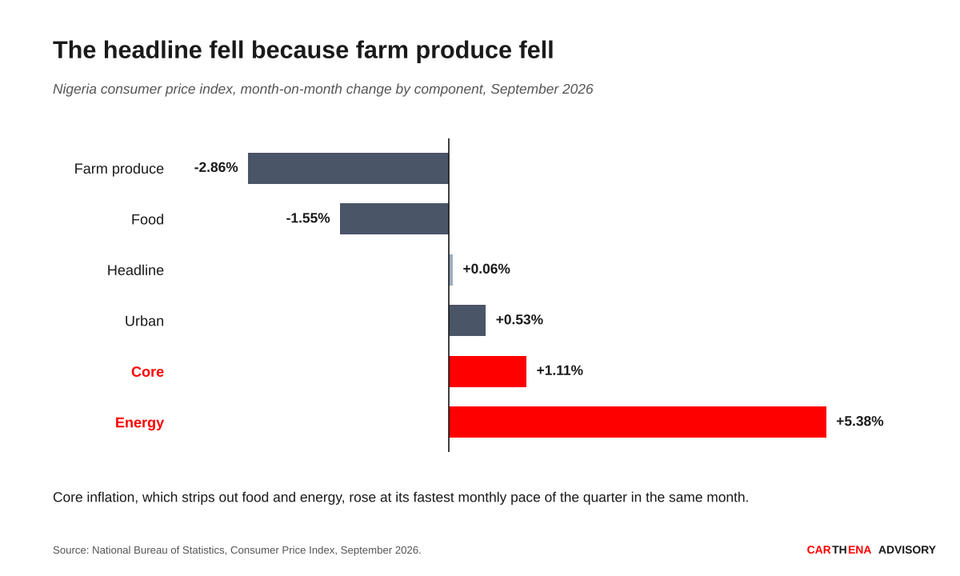
Set food aside and the picture inverts. Energy rose 5.38 per cent over the month and stands 10.85 per cent above a year earlier. Urban prices rose 0.53 per cent while rural prices fell 0.89 per cent, which is what a harvest looks like in a country where food is grown in one place and eaten in another. Food inflation on the year-on-year measure did not fall at all: it edged up from 19.57 per cent in August to 19.59 per cent in September, a detail that several outlets reported as food prices dropping.
The core turned in the same month
Core inflation strips out farm produce and energy precisely because those two are volatile and seasonal. It is the closest thing the Nigerian data offers to a reading of underlying price pressure, and it is what a central bank watches when it wants to know whether its own policy is working.
Core inflation rose 1.11 per cent over the month of September. In August it was minus 0.06 per cent, and in July 0.15 per cent. The series went from flat to its fastest monthly reading of the quarter in a single month, and it did so in the release that was reported as disinflation.
The two series crossed. Headline monthly inflation has fallen steadily through the quarter, from 1.57 per cent in July to 0.71 per cent in August to 0.06 per cent in September, while core has moved the other way. By September, core monthly inflation was running higher than headline monthly inflation had been running in August, which is to say that the part of the index the Bureau treats as structural was rising faster than the whole index had been rising a month earlier.
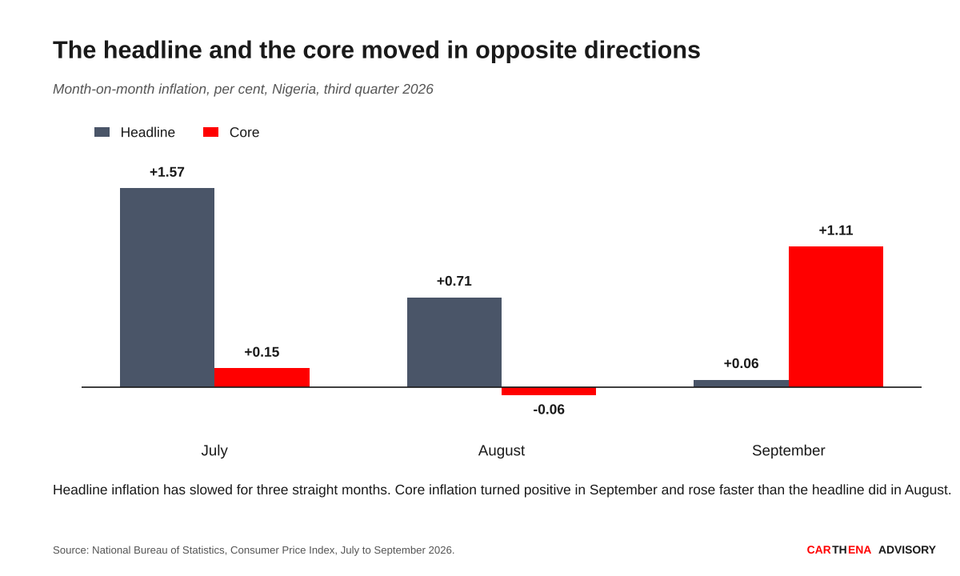
Carthena's reading is that September was not a disinflation at all, but a harvest arriving in the month that underlying pressure accelerated beneath it. Harvest season closes in November and the effect is out of the figures by December, whereas nothing in the data suggests the core pressure is going anywhere.
The cut came three weeks before the figures
This would be an academic distinction if no decision had rested on it, and one did.
On 22 September, at its 307th meeting, the Monetary Policy Committee cut the policy rate by 350 basis points, from 26.5 per cent to 23 per cent, the largest single reduction in the rate's history. The Committee also moved the standing facilities corridor to plus 50 and minus 300 basis points around the new benchmark, taking the deposit rate to 20 per cent, while holding the cash reserve ratio at 45 per cent. The stated justification was easing inflation, which at that point meant three consecutive months of moderation to 15.39 per cent in August.
The Committee was reading a series that had not yet shown what it was about to show. August's core reading, the one available on the day of the decision, was minus 0.06 per cent over the month, which anyone would reasonably take as underlying pressure having stopped. The September figure, published three weeks after the decision, was plus 1.11 per cent.
There is a defensible case for the cut on its own terms and it deserves stating fairly. The policy rate at 26.5 per cent had drifted well above an interbank rate of roughly 22 per cent, which made the benchmark a poor signal of actual funding conditions, and the Bank described the move as an operational reset rather than a change of stance. Even after the cut the rate sits around eight percentage points above headline inflation, reserves are above $55bn and second-quarter output grew 4.43 per cent.
Whether the September cut was right on the information available is a reasonable argument either way. The exposure sits in the decision after it. October and November will both be measured while the harvest is still running, so both sets of figures are likely to show continued easing whether or not the underlying pressure has gone anywhere. A Committee that reads those two the way it read August will be easing into a series that is telling it something other than what it appears to say.
The same shape appears in the capital account
The reason this matters beyond a single rate decision is that it is the second instance of the same pattern in Nigeria's headline numbers this year, and the first has already been examined at length.
In the first half of 2026, Nigeria took in $13.12bn of portfolio investment and $2.18bn of direct investment on the Central Bank's balance of payments. Six dollars arrived looking for a yield for every dollar that arrived to build something, and the reserve position above $55bn that featured in the case for the rate cut rests substantially on the first kind of money.
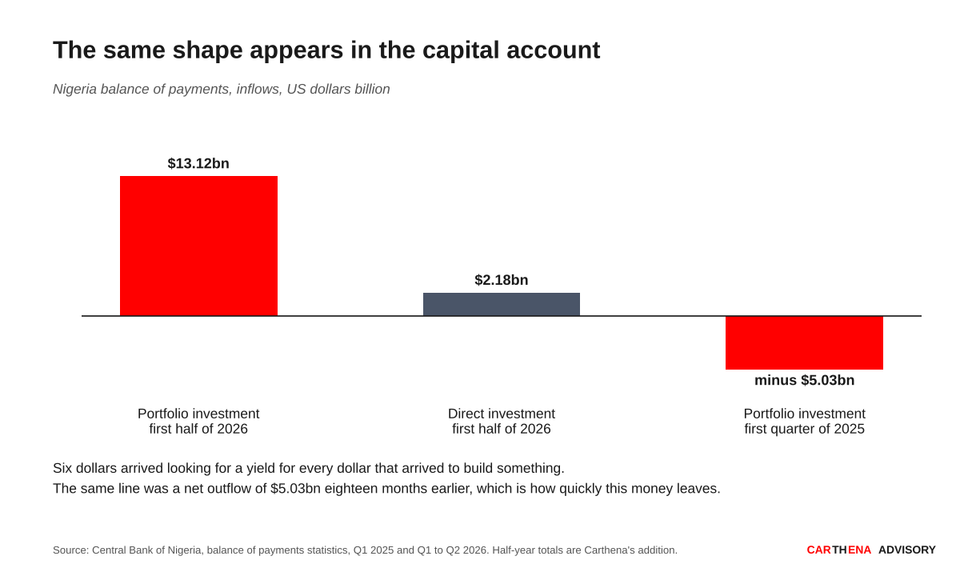
That money has left before, and recently. In the first quarter of 2025, portfolio investment liabilities were minus $5.03bn, a net divestment the Central Bank's own release described as a record outflow. Eighteen months separate a record outflow from a six-to-one inflow ratio, which is a fair measure of how quickly the position can turn.
The shape is the same in both cases: a headline number improves, the improvement is driven by something Nigeria neither caused nor controls, whether a harvest or a global rate environment, and a decision is then taken on the strength of that headline which outlasts the thing that produced it.
What would count as improvement
Carthena published The Carthena Position on 11 October, setting out six tests a Nigerian government's programme should be measured against before the January 2027 election. Two of them speak directly to what the September figures expose.
The first test is dollar generation. Nigeria earns $242 per person per year from selling goods to the world, against Vietnam's $4,676 and Egypt's $358. A reserve position built on portfolio inflows is a rented one, rented at a price set in Washington and Frankfurt rather than in Abuja, and earned foreign exchange does not reverse when a rate decision is taken somewhere else.
The second is fiscal room. Interest payments already take 53.7 per cent of federal government revenue. A state in that position has very little capacity to absorb a shock without borrowing into it, which is the practical reason the composition of an inflation reading matters to a finance ministry and not only to a central bank.
Neither test is satisfied by a month in which the crop came in. Both would be advanced by a programme that treated the September core reading as the signal and the headline as the noise.
The implication
For businesses setting prices and planning working capital into the first quarter of 2027, the operative number in the September release is 1.11 per cent rather than 14.63 per cent. Cost pressure outside food and energy is rising, energy itself is running above five per cent a month, and the headline relief currently visible has a seasonal expiry date somewhere around December. Pricing and borrowing decisions taken on the assumption that disinflation is established carry more risk than the headline suggests.
What settles this is the core figure in the October and November releases, and the first of them publishes in mid-November. If it falls back below roughly half a per cent a month once the harvest has passed, September was a seasonal blip and the Monetary Policy Committee read it correctly. If it is still running above one per cent, the Bank will have eased into pressure that was building underneath the number it was watching, and the decision after that one will have to account for it.
One caution on the data. The consumer price index was rebased in December 2025, with 2024 as the base year and a twelve-month average reference period replacing the single-month basis, and November 2025 inflation was revised up from 14.45 per cent to 17.33 per cent in the process. Every comparison in this piece is drawn month on month within the new series and is unaffected, but year-on-year comparisons that straddle the change deserve more care than they usually receive.
Sources
- National Bureau of Statistics, Consumer Price Index, September 2026, published 15 October 2026. Headline 14.63 per cent year on year and 0.06 per cent month on month; core 12.95 per cent year on year and 1.11 per cent month on month; food 19.59 per cent year on year and minus 1.55 per cent month on month; farm produce minus 2.86 per cent month on month.
- National Bureau of Statistics, Consumer Price Index, July and August 2026. Headline month on month of 1.57 per cent and 0.71 per cent; core month on month of 0.15 per cent and minus 0.06 per cent.
- Energy inflation of 5.38 per cent month on month and 10.85 per cent year on year, the urban and rural monthly rates, and the 5.85 percentage point food contribution, as reported from the NBS release by BusinessDay, 15 October 2026.
- Central Bank of Nigeria, 307th Monetary Policy Committee meeting, 22 September 2026. Policy rate cut of 350 basis points to 23 per cent, corridor at plus 50 and minus 300 basis points, cash reserve ratio retained at 45 per cent.
- Central Bank of Nigeria, balance of payments statistics. Direct investment of $1.03bn in the first quarter and $1.15bn in the second quarter of 2026; portfolio investment of $6.03bn and $7.09bn. Half-year totals are Carthena's addition.
- Central Bank of Nigeria, Balance of Payment Highlights, first quarter 2025. Portfolio investment liabilities of minus $5.03bn, described in the release as a record outflow.
- Consumer price index rebasing and the revision of November 2025 from 14.45 per cent to 17.33 per cent, as reported by BusinessDay, January 2026.
If you would like to discuss what the September decomposition means for your pricing, borrowing or planning assumptions into 2027, please get in touch at info@carthenaadvisory.com.