
On 1 May 2026, fifty-three African countries gained zero-tariff access to the Chinese market. South Africa, Egypt, Kenya and Morocco moved on day one. Nigeria did not. The execution gap is now measurable in real time.
On 1 May 2026, China activated zero-tariff access for fifty-three African countries. Within hours of the policy going live, South African apples cleared customs at Shenzhen Bay Port. Egyptian oranges followed in Shanghai. Kenyan avocados, South African wine, all moved on day one. Nigerian shipments did not. The country's exporters, by their own admission to BusinessDay, were unaware the policy had taken effect. The activation was the operationalisation of a structural shift this firm forecast in March 2026. The execution gap is now measurable in real time.
01 — The Activation, Not the Announcement
Six weeks ago, this firm published The Architecture of Disruption, arguing that the structural reordering of global trade was being rewired in real time, that Africa's most consequential negotiating failures were intelligence failures first, and that the window for execution-ready African economies was narrower than the rhetoric suggested. China's June 2025 announcement of tariff-free access for fifty-three African nations was named in that piece as a direct counter-move to Washington's reconfiguration of AGOA. The article placed the activation date — 1 May 2026 — on the analytical calendar.
That date has now passed.
What May 1 represents is not a new policy. It is the operational test of a policy framework that has been visible for eleven months. The substance of the test is straightforward: which African economies were ready to convert announced market access into actual export flows on day one, and which were not.
The early returns are unambiguous, and they should concentrate the minds of Nigerian policymakers more sharply than they currently appear to be doing.
02 — The Substance Beneath the Headline
The "China zero-tariff" headline has been reported across African media as a transformative gesture. The phrasing matters because it is misleading. The transformation, where it exists, is concentrated in a narrow band of product categories. For Nigeria's existing export composition to China, the change is closer to symbolic than structural.
A clean reading of the policy requires four distinct points to be held simultaneously.
First, the policy extends zero-tariff treatment to twenty additional African countries that have diplomatic relations with China and are not classified as least developed — Nigeria, South Africa, Egypt, Morocco, Algeria, Kenya, Ghana, Côte d'Ivoire, and twelve others — bringing the total covered to fifty-three. Eswatini is excluded because it maintains diplomatic ties with Taiwan. The exclusion is the political tell of the entire framework, and it should not be ignored.
Second, for the products that dominate African exports to China today, the tariff change is largely irrelevant. Iron ore, copper ore, refined copper, non-monetary gold, and iron and steel scrap already enter China at a zero most-favoured-nation rate. Crude oil, which is Nigeria's single largest export to China, is similarly already at zero. The China Global South Project, citing the official Chinese customs portal, confirms that for the bulk of exports from the DRC, South Africa, Zambia, Angola, Nigeria, and Republic of Congo, the policy changes nothing.
Third, where the policy does change the economic arithmetic is in three categories: processed agricultural goods, where tariffs of 8 to 15 percent on items such as roasted coffee and processed cocoa products are now eliminated; light manufactured goods, where textiles, leather products, and consumer manufactures previously faced material duties; and specialty agricultural products such as cashews, sesame, ginger, sorghum, and dried fruits. The first effects of the December 2024 LDC tariff measure are already visible. Chinese imports of African coffee rose by approximately 70 percent in the first quarter of 2025, according to Chinese state media.
Fourth, the policy is bilateral by design. China retains tariff-rate quota controls on sensitive categories. The "in-quota" rate is reduced to zero; the "out-of-quota" rate is unchanged. This gives Beijing a regulatory lever to manage import volumes in line with the actual absorption capacity of Chinese industrial processors. The framework is open in headline terms and managed in operational terms — a distinction that matters when the projection of unbounded market access begins to drift through African policy commentary.
The implication is straightforward. The economic gains from this policy are concentrated in value-added agricultural processing and light manufacturing. The countries that have built the export infrastructure to operate in those categories will benefit. The countries that have not, will not. The policy itself does not transfer industrial capacity. It removes one barrier in front of capacity that must already exist.
03 — The Geopolitical Frame: A Counter-Narrative That Cost Nothing
The activation of the zero-tariff framework on 1 May 2026 was timed with deliberate precision. It came eight months after the second Trump administration's reconfiguration of AGOA and the imposition of Section 122 reciprocal tariffs on most US trading partners, including a 15 percent tariff wall on Nigeria, a 30 percent tariff on South Africa and Algeria, a 32 percent tariff on Angola, a 47 percent tariff on Madagascar, and a 50 percent tariff on Lesotho. It came three months after the African Union's 39th Summit in Addis Ababa, where President Xi Jinping made the announcement that the framework would activate on 1 May.
The diplomatic positioning is exact. China presents itself as the first major global economy to grant comprehensive market access to African nations on a unilateral basis. The UN Secretary-General publicly welcomed the move, calling on developed economies to follow. The African Union Commission Chairperson framed it as vital at a moment when Africa bears the brunt of global uncertainties.
The cost to Beijing is modest. The political return is structural.
For products where the tariff genuinely changes the economics, China is opening access to a market in which Chinese consumer demand is concentrated in higher-value processed goods that few African economies are currently equipped to supply at scale. For products that already entered duty-free, no economic value has been transferred. The ledger entry is small. The geopolitical entry is significant.
In the architecture of the post-2025 global trade order, narrative control is itself a form of economic power. The countries that successfully position themselves as the providers of openness in a fragmenting trade system accumulate a form of soft leverage that compounds over time. China-Africa bilateral trade reached 348 billion US dollars in 2025, growing 17.7 percent year-on-year. China has been Africa's largest trading partner for sixteen consecutive years. The zero-tariff framework reinforces a trade relationship that was already structurally entrenched, on terms that are visibly more favourable than what Washington is currently offering.
For African policymakers, the strategic question is not whether to welcome the framework. The framework is welcome. The strategic question is whether African economies can use it to shift the underlying composition of trade with China — or whether they will continue to export raw materials, import finished goods, and watch the bilateral deficit widen under more agreeable rhetorical conditions.
The answer to that question began to emerge on 1 May.
04 — Day One: The Scoreboard
In the first forty-eight hours of policy activation, the operational readiness of African export economies became visible in a way that no announcement, framework agreement, or ministerial statement had previously made it.
A truck carrying twenty-four metric tons of fresh apples from South Africa cleared customs at Shenzhen Bay Port within hours of the policy going live. State-run China Global Television Network reported the shipment as the first to enter China under the expanded framework. In Shanghai, 516 tonnes of oranges from Egypt were received under the new measures, generating a tariff exemption of approximately $47,000 on a single shipment. Twenty-four tonnes of avocados from Kenya arrived in Shanghai. Six thousand bottles of wine from South Africa cleared customs at Changsha Huanghua International Airport.
Nigeria recorded no day-one shipments.
The absence is not a logistical accident. It is the visible surface of a systemic readiness gap that exporters and trade promotion bodies have been unwilling to publicly acknowledge until BusinessDay's reporting in early May made the situation impossible to obscure.
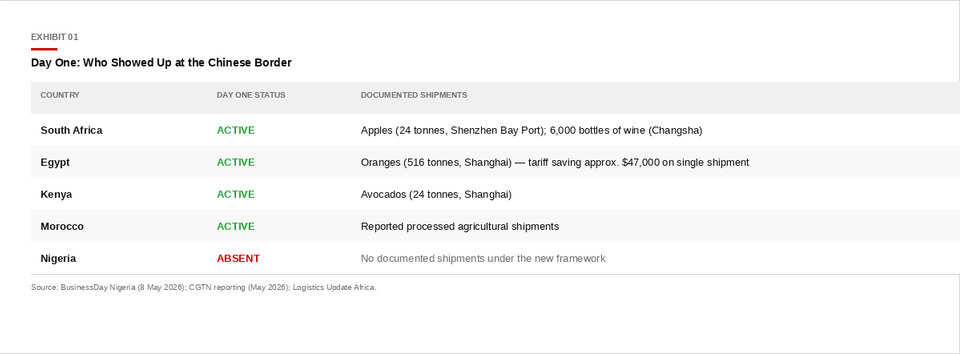
The Manufacturers Association of Nigeria Export Group (MANEG) admitted to BusinessDay that it had not officially engaged ministries, departments, or agencies on the initiative despite its formal role in non-oil export advocacy. Exporters belonging to organised trade associations told BusinessDay that they were unaware the policy existed or had taken effect. The Ministry of Trade did not immediately respond to inquiries.
This is a documented failure of state coordination, communication, and execution at the precise moment when coordination, communication, and execution would have produced measurable economic returns. The failure was not caused by the policy. The failure was caused by the absence of an institutional mechanism to translate policy into shipments.
The South African Department of Trade, Industry and Competition published a guidance note in the days following Xi Jinping's February announcement and worked with the Citrus Growers Association to align certifications and documentation in advance of 1 May. The Egyptian Ministry of Trade engaged its citrus exporters' federation through Q1 2026. The Kenya Plant Health Inspectorate Service pre-cleared avocado consignments for the Shanghai market in March. These are not heroic operational achievements. They are the standard institutional behaviours of countries that take trade promotion seriously.
The Nigerian equivalent did not happen. The institutional architecture exists — the Nigerian Export Promotion Council, MANEG, the Ministry of Industry, Trade and Investment, the Manufacturers Association of Nigeria — but the coordinated motion did not occur in the eight months between the announcement and the activation.
05 — The Nigerian Diagnostic in Hard Numbers
The composition and trajectory of Nigeria-China trade is the single most important context for understanding what May 1 revealed about Nigeria's positioning.
Bilateral trade between China and Nigeria reached approximately $28 billion in 2025, a 28 percent year-on-year increase. The headline reads as a deepening commercial relationship. The composition reads as something else.
Total bilateral trade in the first quarter of 2026 reached $7.7 billion. Of that, Nigerian exports to China accounted for $929 million — roughly 12 percent. Chinese exports to Nigeria accounted for the remaining 88 percent. The bilateral deficit on a Q1 2026 annualised basis is approximately $25 billion. The composition of Nigeria's exports remains dominated by mineral fuels, oil seeds, and unprocessed raw materials. Nigeria imports finished electronics, vehicles, textiles, building materials, pharmaceuticals, and industrial machinery.
This is not a partnership of economic equals. It is the colonial trade architecture — extraction outbound, finished goods inbound — operating under a different flag.
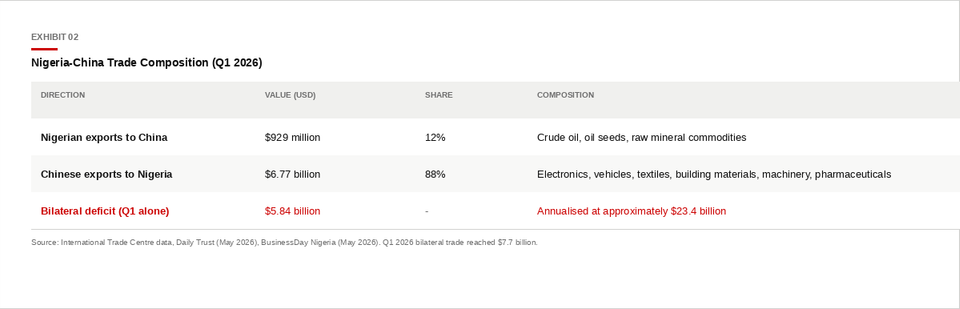
The zero-tariff framework, in the form it currently takes, does not address the structural condition that produces these figures. The categories where the tariff change matters most — processed agricultural goods, light manufactured products, value-added consumer goods — are precisely the categories where Nigeria has the weakest export base.
The reasons are familiar. They are also tractable.
Cold chain infrastructure is the binding constraint on perishable agricultural exports. Nigeria's cold chain network is fragmented, expensive, and unreliable. Cashews and ginger can be exported as raw commodities, but the value-added forms — dried, processed, packaged — require cold chain integrity that does not consistently exist between origin farms and the Apapa or Lekki ports.
Port and logistics inefficiency adds a structural cost premium that cannot be absorbed in commodity-margin businesses. Average dwell times at Apapa exceed twenty days for export consignments, against three to five days at Mombasa or Durban. The Lekki Deep Sea Port has improved capacity at the margin but has not yet displaced the operational pattern.
Certification and quality compliance is slow, costly, and inconsistent. Chinese phytosanitary requirements, food safety inspections, and product standard verifications require pre-clearance that the Nigerian Agricultural Quarantine Service has not built systematic capacity to deliver at the speed Chinese buyers expect.
Trade promotion and market intelligence is institutionally underfunded. The Nigerian Export Promotion Council operates with a budget that is a fraction of its peer agencies in South Africa, Kenya, and Egypt. The information flow between Chinese buyers, Nigerian exporters, and the regulatory agencies that must process documentation does not run at commercial speed.
Coordinated state engagement is absent. There was no Nigerian equivalent to the South African DTIC guidance note, no Nigerian equivalent to the KEPHIS pre-clearance process for avocados, no Nigerian equivalent to the Egyptian citrus federation's pre-positioning of consignments. The institutional coordination that produced day-one shipments from peer economies did not occur in Nigeria.
These five constraints, in combination, produced the day-one absence. They will continue to produce sub-scale Nigerian participation in the framework unless they are addressed deliberately and at speed.
06 — West Africa: The Coastal Calculation
Beyond Nigeria, the West African response to the framework activation reveals further structural divergence within the region.
Côte d'Ivoire and Ghana, as the world's first and second largest cocoa producers, are positioned to capture immediate gains from the elimination of tariffs on processed cocoa products entering China. Roasted coffee from Ethiopia, Kenya, and increasingly from Rwanda has already begun to flow under the LDC framework that activated in December 2024. The data point cited in Chinese state media — a 70 percent increase in African coffee imports in Q1 2025 — is the early signal of what processed agricultural exports can achieve when the export infrastructure exists.
Senegal, Côte d'Ivoire, and other CFA-zone economies face a complicating factor. The CFA franc's peg to the euro means that as the euro weakened against the dollar through 2025 and into 2026, CFA-zone exporters selling commodities priced in dollars have experienced deteriorating terms of trade. The zero-tariff framework with China, which prices trade in renminbi or dollar terms, partially insulates these economies from euro-zone monetary drift. The structural opportunity is real, but the operational readiness varies country by country.
The Sahel economies — Burkina Faso, Mali, Niger — present a different problem. Their political departure from ECOWAS and their establishment of the Alliance des États du Sahel has created a transit corridor disruption that affects not only their own export potential but also the economics of using coastal West African ports for intra-regional trade. None of the three is currently positioned to act on the framework at scale, and the coordination gap with Lagos, Tema, Lomé, Abidjan, and Dakar is widening.
The pattern across West Africa is consistent with what May 1 revealed at the continental level. The countries that built the institutional infrastructure to operate in higher-value export categories are positioned to benefit. The countries that did not are positioned to watch.
07 — The Window: Seventy-Two Hours of Day One Are Already Gone
There is a temptation in commentary on situations like this to argue that the window remains open, that Nigeria can still act, that the framework runs to April 2028 and there is time to recover the position. The temptation is partially correct and significantly misleading.
The framework runs for two years. That is true. But the strategic positioning that determines who captures Chinese market share over those two years is being established now, in the first weeks and months. South African apples that arrive in Shenzhen on day one establish supplier relationships, distribution channels, retailer trust, and brand recognition that compound over time. The Egyptian citrus shipments that cleared Shanghai customs on 1 May created precedent within Chinese customs procedures, established documentation templates that subsequent shipments will follow, and signalled to Chinese importers that Egypt is a reliable counterparty. Kenyan avocados in Shanghai are now in the supply graph. They will be ordered again.
The Nigerian agricultural commodities that did not arrive on 1 May are not in the supply graph. They are not yet established. They are not yet trusted. Every additional week without coordinated Nigerian shipments is a week in which the South African, Egyptian, and Kenyan positions are reinforced, and the cost of subsequent Nigerian entry rises.
This is the same execution-window dynamic that this firm flagged in March in the context of manufacturing trade diversion. The asset window does not stay open indefinitely. The longer the delay, the higher the threshold for displacement.
For agricultural categories specifically — cashews, sesame, ginger, sorghum, dried fruits — the practical window for Nigeria to establish meaningful first-year supplier positions to Chinese importers is approximately ninety days. After ninety days, the importers who placed initial orders with South African, Egyptian, Kenyan, and Moroccan counterparties will have begun to lock in second-quarter and second-half supply commitments. Nigerian entry after that point will require displacing established suppliers, which is a fundamentally harder commercial proposition than entering with peers on day one.
08 — The Five Things Nigeria Must Do in the Next Ninety Days
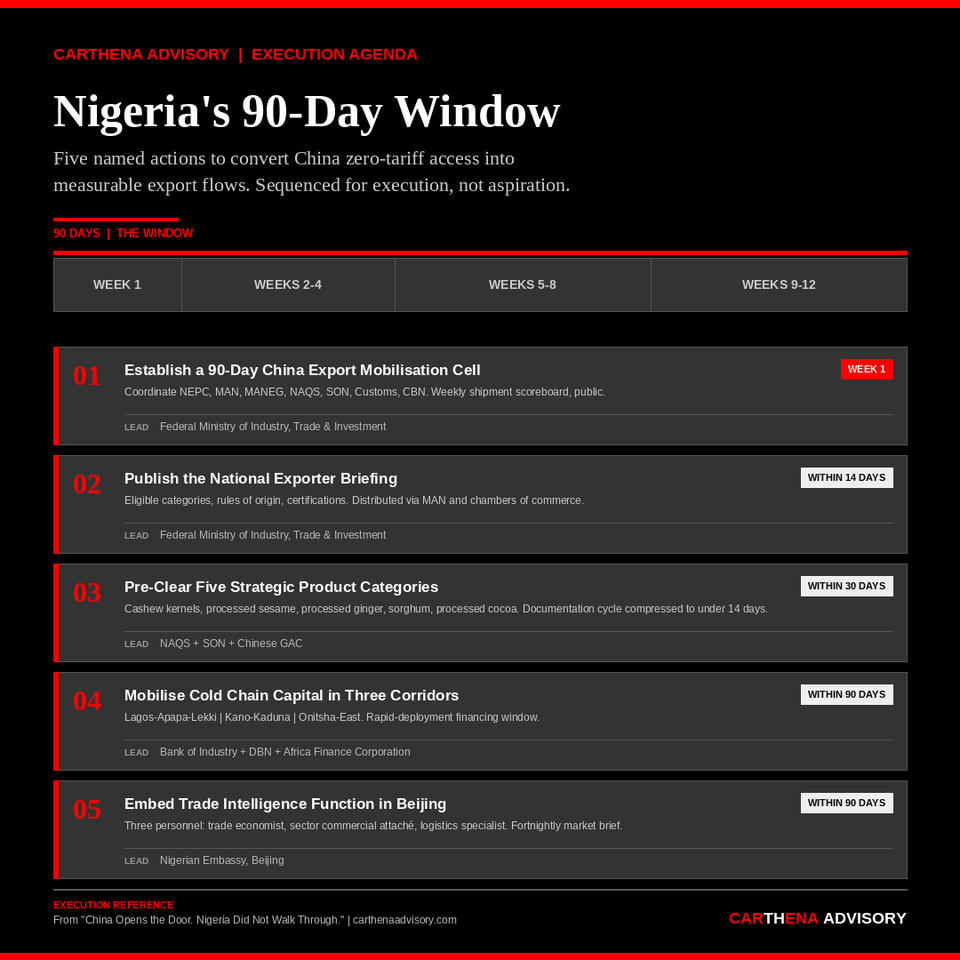
One — Establish a 90-Day China Export Mobilisation Cell
The Federal Ministry of Industry, Trade and Investment should immediately convene a coordination cell with named participation from the Nigerian Export Promotion Council, the Manufacturers Association of Nigeria, MANEG, the Nigerian Agricultural Quarantine Service, the Standards Organisation of Nigeria, the Nigeria Customs Service, and the Central Bank of Nigeria. The cell should report weekly to the Minister, with a specific brief: produce documented Nigerian shipments under the zero-tariff framework within the first ninety days.
A weekly published shipment scoreboard — product, exporter, port of destination, value, customs status — would create the public accountability that has been absent from Nigeria's trade promotion architecture for at least a decade.
Two — Publish a National Exporter Briefing Within Fourteen Days
The South African DTIC published its guidance note within days of the February announcement. The Nigerian equivalent does not yet exist. A clear, sector-specific exporter briefing covering the eligible product categories, the rules of origin requirements, the inspection and quarantine standards, and the documentation requirements should be published by the Federal Ministry of Industry, Trade and Investment within fourteen days. It should be distributed through MANEG, the chambers of commerce, and the agricultural commodity associations. It should be written in language that an exporter without legal counsel can act on.
Three — Pre-Clear Five Strategic Product Categories
Five product categories should be selected for accelerated pre-clearance by the Nigerian Agricultural Quarantine Service and the Standards Organisation of Nigeria, in coordination with the Chinese General Administration of Customs. The recommended categories: cashew kernels, processed sesame, processed ginger, sorghum, and processed cocoa products. Pre-clearance protocols, inspection schedules, and certification templates should be agreed and published within thirty days. The objective is to compress the Nigerian export documentation cycle from its current six-to-eight week average to under fourteen days.
Four — Mobilise Capital for Cold Chain and Logistics in Three Export Corridors
The cold chain and logistics constraints cannot be resolved nationally within ninety days. They can be addressed in three priority corridors: Lagos-Apapa-Lekki for processed cashews and cocoa; Kano-Kaduna for sesame and sorghum; Onitsha-Eastern ports for ginger and dried fruits. The Bank of Industry, the Development Bank of Nigeria, and the Africa Finance Corporation should establish a rapid-deployment financing window for cold chain and logistics infrastructure investment in these three corridors, with disbursement targets aligned to the ninety-day mobilisation cycle.
Five — Embed a Trade Intelligence Function in the Embassy in Beijing
The information asymmetry between Nigerian exporters and Chinese buyers is structural. The Nigerian Embassy in Beijing should be reinforced with a dedicated trade intelligence and commercial liaison function, staffed with a minimum of three personnel — one trade economist, one commercial attaché with sector expertise, and one logistics specialist. The function should produce a fortnightly market intelligence brief covering Chinese demand patterns, regulatory developments, importer preferences, and competitive positioning by African peer economies. This brief should be distributed to MANEG, the Nigerian Export Promotion Council, and the chambers of commerce.
The cost of these five actions is modest. The cost of not taking them, against the strategic context the May 1 activation has revealed, is the entrenchment of a bilateral trade structure that disadvantages Nigeria for the duration of the framework and beyond.
Carthena Advisory analysis. May 2026.
09 — The Question That Sits Beneath All of This
The May 1 activation is a single data point. The pattern it reveals is not.
In March, this firm wrote that Africa's most consequential negotiating failures were intelligence failures first. The May 1 activation has now produced an execution failure that is, at root, also an intelligence failure. The information that the framework was activating on a specific date was public for eleven months. The institutional readiness to act on that information was not built.
The structural condition this exposes is not unique to the China zero-tariff framework. It will recur whenever Nigeria is required to convert announced policy access into measurable economic flows under time pressure. It will recur if and when the United States introduces revised AGOA replacement terms. It will recur as the African Continental Free Trade Area moves from declaration to operational implementation. It will recur in every bilateral framework Nigeria signs in the next decade.
The question for Nigerian policymakers is not whether to act on the China framework specifically. The question is whether the institutional architecture for converting trade policy into trade flows is going to be built. The May 1 absence is the diagnostic. The ninety-day mobilisation is the test of whether the diagnosis has been received.
The architecture of the global trade order is being redrawn. The countries that will emerge stronger are those whose institutional capacity matches the speed of the redrawing. South Africa, Egypt, Kenya, and Morocco demonstrated on 1 May 2026 that they have built that capacity. Nigeria has not yet demonstrated it.
The window remains open. It will not remain open indefinitely.
The gap between what Nigeria's market access is worth in this new geopolitical moment and what Nigeria's exporters have so far been able to convert that access into is not a market problem. It is an execution problem. Execution problems are solvable — but only by institutions that recognise the problem they have. — Carthena Advisory, May 2026