
Asia's route to prosperity is harder to copy now, but Nigeria still needs factories. The first ones should process what the country already grows and mines.
By Wole Ogundare, Founder and Managing Partner, Carthena Advisory
Asia will produce nearly 60 per cent of the world's economic growth in 2026, according to UNCTAD's Trade and Development Report 2026, presented in London on 13 November. The report asks whether other developing countries can still follow the same path, and its answer is cautious. What lifted Asia, UNCTAD's director Anastasia Nesvetailova said at the launch, was "a rare alignment of scale, timing and accumulated capacity". Those conditions are not widely shared, and the industries that now attract investment demand more technology, finance and skill than textiles or consumer goods ever did. For Nigeria, the report is right about the obstacles and wrong if it is read as advice to look for another road. Industrialisation remains the only route that can employ Nigeria's young people at the scale they are arriving. What has to change is the kind of industrialisation Nigeria attempts, the order in which it builds it, and the discipline with which it is run.
The jobs arithmetic settles the first question
Productivity can rise in many ways. Better farming raises output per hectare, software raises output per worker, and good logistics cuts waste across every sector. None of these is a reason to argue against factories in Nigeria, because none of them can absorb the number of people who need work.
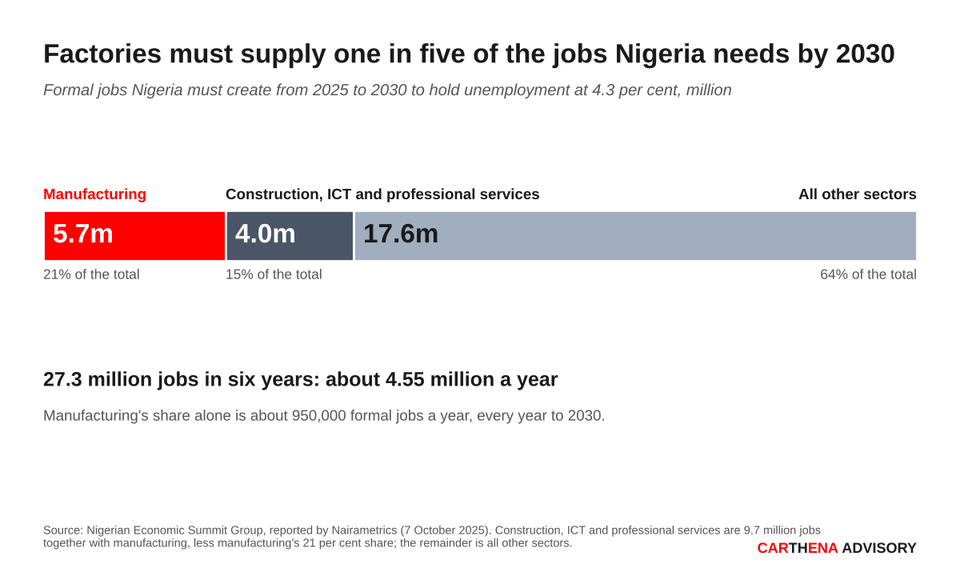
The Nigerian Economic Summit Group estimates that Nigeria must create 27.3 million jobs between 2025 and 2030 to hold unemployment at 4.3 per cent, an average of about 4.55 million new formal jobs a year. It expects manufacturing alone to supply 21 per cent of them, about 5.7 million jobs.
The other routes each stop short of that scale. A services-led path, the one India took through software and business services, depends on a large pool of educated workers. Nigeria has 10.2 million primary-age children out of school, according to UNICEF, among the highest numbers in the world. Agriculture already employs a large share of Nigerians, but at low productivity, and raising farm yields alone tends to release workers rather than absorb them. Manufacturing, and light manufacturing in particular, is the one sector that has repeatedly taken people with limited schooling and made them several times more productive within a generation. That was the Asian story, and Nigeria's population, its literacy levels and the age of its workforce point to the same need.
The gap is wider than the target admits
The federal government agrees on the direction. The Nigerian Industrial Policy, launched by President Tinubu in February 2026, aims to raise manufacturing's share of the economy to about 20 per cent by 2030 and 25 per cent by 2035, according to the Minister of State for Industry, John Enoh.
Measured on the same World Bank basis as its peers, Nigeria's manufacturing sector was worth 8.3 per cent of GDP in 2025. Vietnam, China and Thailand sit between 23 and 25 per cent. Bangladesh, which was poorer than Nigeria in the early 2000s, is at 22 per cent. Egypt and Morocco, closer to home, are at about 15 per cent.
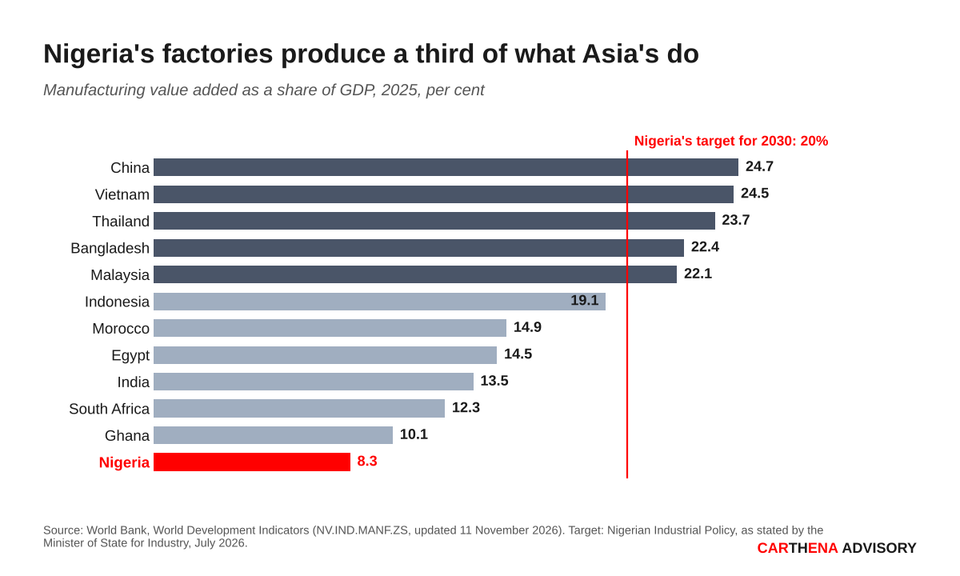
The target matters because of what it implies. If the wider economy grows by 4 per cent a year, manufacturing must grow by about 24 per cent a year, every year until 2030, to reach 20 per cent of GDP. In 2025 it grew by 1.4 per cent in real terms, according to the National Bureau of Statistics, while the economy grew by around 4 per cent. Even the 2035 goal of 25 per cent requires growth of about 16 per cent a year for a decade. South Korea managed rates of that kind in the 1960s and 1970s, but it did not do so on diesel generators.
A target with no route to it becomes a slogan. The useful question is not whether Nigeria should industrialise but where the first ten years of growth can realistically come from, and what has to be true for it to happen.
Asia's real lesson was discipline, not ambition
The part of the Asian story most often told is ambition: steel mills, shipyards and electronics plants built by governments that thought continuously for decades. The part most often missed is discipline. South Korea and Taiwan gave their manufacturers cheap credit, protection from imports and access to foreign exchange, but they attached conditions. Firms had to export, and meet published targets. Those that failed lost their support, and some lost their businesses. The economist Alice Amsden called this reciprocity: support in exchange for performance.
Nigeria has tried protection without the reciprocity. Import bans, foreign exchange restrictions on 41 items from 2015, tariff waivers and concessionary loans have all been used to encourage local production. Each created profits for the firms that received them, and very few came with a measurable obligation in return. Ajaokuta Steel, begun in 1979, has absorbed public money for more than four decades without producing steel at scale. The pattern is not that Nigeria lacks industrial ambition. It is that its support for industry has rarely been tied to results, and has rarely been withdrawn when results did not come.
This is where the question of governance comes in. Nigeria's institutions are still immature, and some argue that industrial policy should wait until governance improves. The stronger argument runs the other way. A weak state cannot run a broad industrial policy covering every sector, because it cannot monitor what it has funded. It can run a narrow one, with a small number of clusters, support tied to figures anyone can check, such as tonnes processed, exports to neighbouring countries and local inputs used, and an automatic end date for every incentive. Institutions learn by doing something specific and measurable. Immature governance is a reason to choose a narrow industrial policy, not a reason to have none.
Start with what Nigeria already produces
UNCTAD's report shows where global investment is going. Semiconductors, artificial intelligence infrastructure and clean energy technology made up 44 per cent of announced greenfield foreign investment in 2025, up from 16 per cent in 2020. Developed economies captured most of it. Developing economies won the larger share in only one strategic category: critical minerals and strategic materials, where they attracted 59 per cent of announced investment between 2020 and 2025.
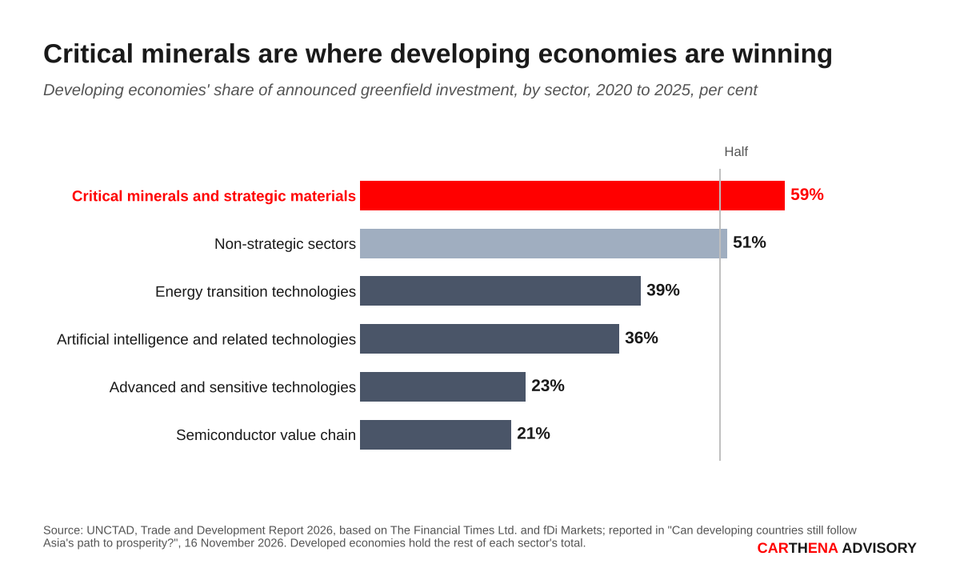
Nigeria will not build a semiconductor industry in this decade, and it should not try. It does have two advantages that need no new technology to exploit: what it grows and what it digs.
Food that never reaches a market. The Organisation for Technology Advancement of Cold Chain in West Africa estimates that Nigeria lost between ₦3.5 trillion and ₦5 trillion of food after harvest in 2025, some 30 to 40 million tonnes of tomatoes, vegetables, fruit, dairy, meat, fish and root crops. That loss is an industrial failure, not an agricultural one. It comes from the absence of cold storage, processing plants, packaging and reliable transport between the farm and the buyer. Every tomato paste plant, cassava starch mill, feed mill and cold store that closes part of that gap is a factory that pays for itself from produce Nigeria is already growing, and each one raises the price farmers can get for what they grow. As we argued in September was a harvest, not a disinflation, Nigeria's food prices still swing with the harvest because so little of it can be stored or processed.
Minerals that leave as rock. The rise of critical minerals is the one part of the new global investment map where developing countries are winning. Nigeria has lithium, tin, columbite and other deposits that buyers want. Exporting the ore earns little and employs few. Processing it at home, even to the first intermediate stage, keeps more of the value and builds the skills for the next stage.
A home market of more than 200 million people. UNCTAD is right that garments and consumer goods no longer offer an easy route into global supply chains. Nigeria's case is different, because its own market is large enough to support light manufacturing before it exports anything. The African Continental Free Trade Area adds a regional market that UNCTAD's emphasis on regional cooperation points directly towards. Selling to neighbours is also a fair test: a factory that can compete in Accra or Abidjan is one that no longer needs protection at home.
Power has to come first, cluster by cluster
None of this works without electricity. Nigeria has more than 13,000 megawatts of installed generation capacity, and less than half of it reliably reaches homes and businesses, according to the Minister of Power. Most manufacturers therefore generate their own power from diesel or gas, at costs that no competitor in Asia pays. When the Industrial Policy was launched, Aliko Dangote put it in three words: "No power, no growth."
Waiting for the national grid to be fixed would take longer than Nigeria's young workers can afford. The Electricity Act of 2023 offers another route. It allows states to run their own electricity markets and allows generators to sell directly to large customers. An industrial cluster can therefore have its own power: a gas-fired or solar plant built into an industrial park and sold directly to the factories in it, with a contract both sides can enforce. As we set out in Nigeria's power sector earns in naira and pays in dollars, the grid's finances will take years to repair. A factory cluster with its own supply does not have to wait for that repair.
Roads and ports follow the same logic. A processing plant needs one good road to the farms that supply it and one to the market it serves, not a national network finished first. Sequencing the clusters by where infrastructure can be made reliable fastest is a better plan than spreading investment thinly across every state.
Where the critics are right
Three arguments against this approach deserve a fair hearing.
Factories employ fewer people than they used to. The economist Dani Rodrik has shown that countries now reach their peak share of manufacturing employment at lower incomes than Asia did, a pattern he calls premature deindustrialisation. Automation means a modern factory employs fewer workers per unit of output. This is real, and it strengthens the case for processing food and raw materials, which remains labour-heavy, over automated assembly, which does not.
Farm productivity should come first. Some economists argue that rising farm yields, not factories, drove the early growth of most successful economies. Agro-processing answers both camps. A processing plant gives farmers a buyer, a price and a reason to invest in better seed and storage, so the factory and the farm grow together.
Governance should come first. If public institutions cannot run an industrial policy honestly, the money will be wasted again. That risk is the reason for a narrow policy with conditions attached, not a reason to do nothing while the population grows. Nigeria's history shows what happens when support comes without conditions. It does not show what happens when support is tied to results, because that has rarely been tried.
What this means
Nigeria should industrialise, and it should say plainly how. The first decade of industrial growth is most likely to come from processing what the country already grows and mines, sold first to its own market and then to its neighbours, in a small number of clusters with their own power, and supported only in return for results anyone can check. That is a narrower ambition than the 20 per cent target suggests, and a more achievable one.
Three decisions would show whether the Industrial Policy is serious. First, naming no more than five priority clusters, with the farms, mines and markets each one depends on. Second, publishing the conditions attached to every incentive, and the date each one ends. Third, licensing dedicated power for each cluster under the Electricity Act within a year.
The test of this argument is simple. If, by 2028, the first clusters have reliable power and attached conditions, but manufacturing employment in them has not risen, the case for this kind of industrialisation is weaker than we believe, and Nigeria should look harder at services and agriculture. Until that test has been run, the evidence from Asia, and from Nigeria's own history, points to factories, built with discipline, as the first step.
Sources
- UNCTAD, "Can developing countries still follow Asia's path to prosperity?", 16 November 2026: Asia's share of 2026 global growth; strategic sectors at 44 per cent of announced greenfield investment in 2025, from 16 per cent in 2020; developing economies' 59 per cent share of critical minerals investment, 2020 to 2025.
- World Bank, World Development Indicators, manufacturing value added as a share of GDP, 2025 (updated 11 November 2026): Nigeria 8.3 per cent and peer economies.
- Nairametrics, "Manufacturing's GDP contribution dips to 8.05% in real terms as output lags", 28 February 2026, citing the National Bureau of Statistics: manufacturing real growth of 1.41 per cent in 2025.
- Nairametrics, "Tinubu unveils Nigeria Industrial Policy", 17 February 2026: launch of the Nigerian Industrial Policy and Aliko Dangote's remarks on power.
- ThisDay, "Enoh sets 20% manufacturing GDP target by 2030", 31 July 2026: targets of 20 per cent by 2030 and 25 per cent by 2035.
- Nairametrics, "NESG warns Nigeria must create 27.3 million jobs by 2030", 7 October 2025: jobs needed, annual average and manufacturing's 21 per cent share.
- Premium Times, citing UNICEF, November 2025: 10.2 million primary-age children out of school.
- Nairametrics, citing OTACCWA, 23 February 2026: post-harvest losses of ₦3.5 trillion to ₦5 trillion and 30 to 40 million tonnes in 2025.
- BusinessDay, "Half of Nigeria's 13,000MW never reaches consumers", 24 June 2026: installed capacity and delivery.
- Alice Amsden, "Asia's Next Giant: South Korea and Late Industrialization" (1989): reciprocity between state support and firm performance. Dani Rodrik, "Premature deindustrialization", Journal of Economic Growth (2016).
- Target arithmetic is Carthena's calculation, assuming the wider economy grows by 4 per cent a year.
If you would like to discuss what Nigeria's industrial policy means for your business, please get in touch at info@carthenaadvisory.com.


