
Nigeria needs $120bn a year in infrastructure investment. It mobilises roughly $5bn. Power alone has an $11bn annual gap. The money problem is really a machinery problem.
By Wole Ogundare, Founder and Managing Partner, Carthena Advisory
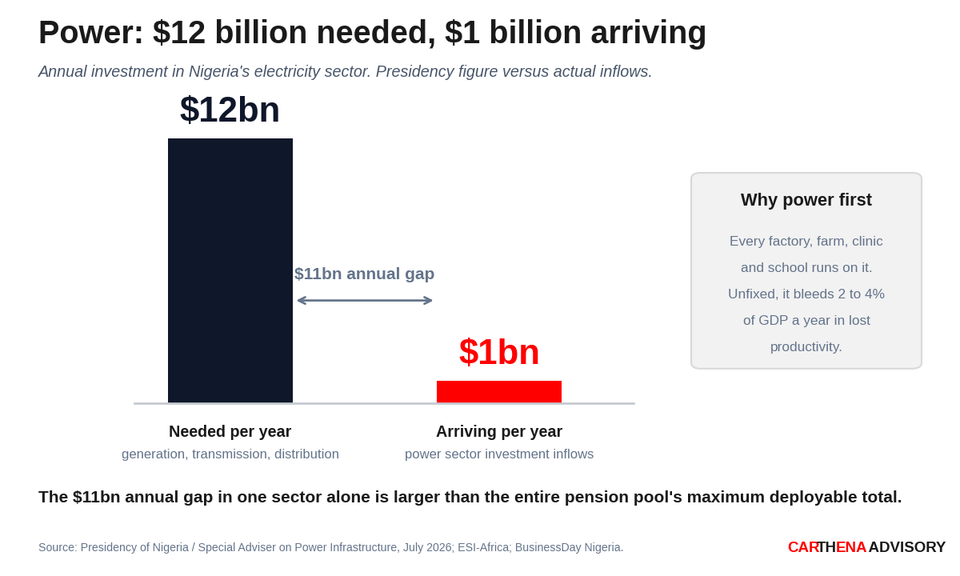
Nigeria knows what it needs to build. The government has said so publicly, in numbers, repeatedly. The Special Adviser to the President on Power Infrastructure stood before an energy forum in Lagos in July 2026 and said the electricity sector needs between ten and twelve billion dollars a year to function. The country currently attracts about one billion. That eleven billion dollar annual gap, in a single sector, is the most important number in Nigeria's economic story right now, because power is not one infrastructure need among many. Every factory, every processing line, every farm storage facility, every hospital, every classroom runs on it. Fix power and you multiply the return on everything else, but leave it broken and every other investment, domestic or foreign, operates at a fraction of its potential.
This is Issue 6 of the Carthena Read, and it is the conclusion the first five issues were building toward. Issues 1 and 2 established that capital is not flowing to Nigeria at the scale its size warrants. Issues 3, 4 and 5 argued that the reason is not ignorance of the opportunity but a failure to fix the fundamentals that attract committed and patient capital. This issue names what fixing those fundamentals actually costs, where the money is supposed to come from, and why the honest answer to both questions is far more confronting than the announcements suggest.
What the financing stack actually looks like
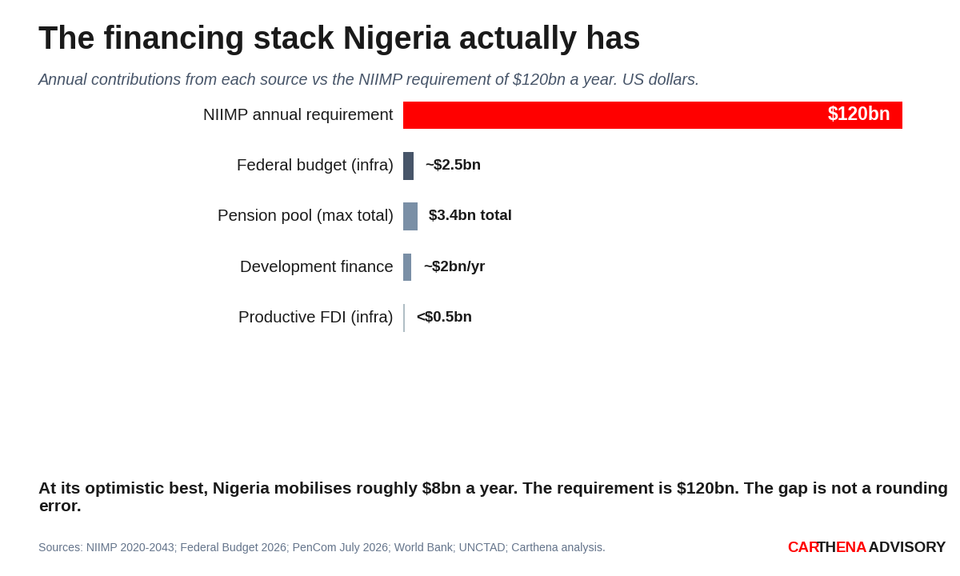
Nigeria's National Integrated Infrastructure Master Plan sets the requirement at about 2.3 trillion dollars by 2043. Spread across the plan's full horizon that is roughly 100 billion dollars a year; across the seventeen years now remaining, and with little delivered against it so far, closer to 135 billion. Call it 120 billion a year. Set that against what the country can realistically mobilise from each source, and the picture becomes uncomfortable quickly.
The federal budget's capital allocation for infrastructure in 2025 was approximately 2.7 billion dollars. The 2026 budget earmarked 3.23 trillion naira, roughly 2.2 billion dollars at current rates, for roads, rail and coastal projects. Call it 2 to 3 billion dollars a year, and that assumes full execution, which historically runs at 15 to 20% of planned spending in many fiscal years.
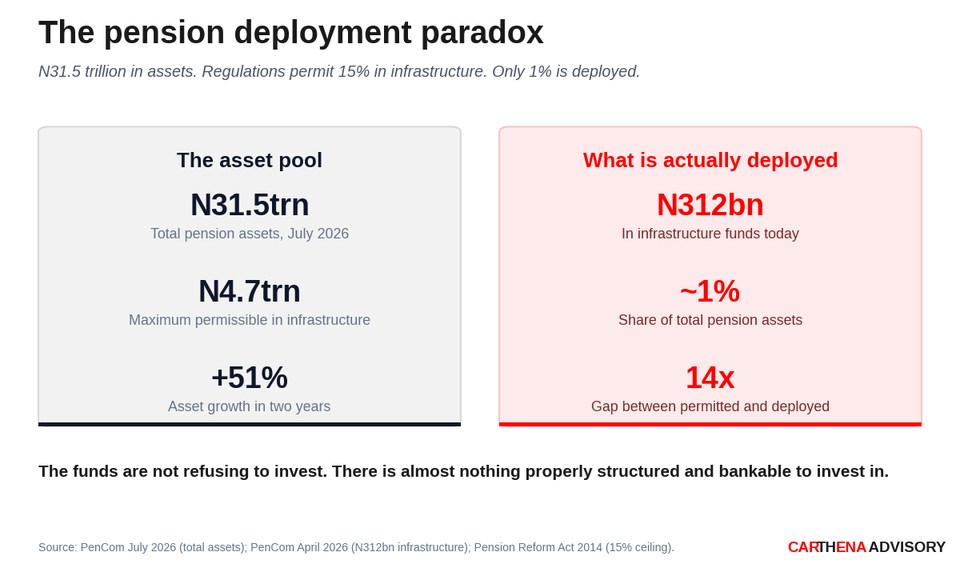
The pension system is where the conversation always arrives next, because the asset base has grown fast. Nigeria's pension assets reached 31.48 trillion naira, about 22.85 billion dollars, in July 2026, a 51% increase in two years. PenCom's regulations permit pension funds to deploy up to 15% into infrastructure. If every pension fund used every bit of that permission, the maximum deployable total would be approximately 4.7 trillion naira, roughly 3.4 billion dollars - not per year, but in total. Actual current infrastructure allocation sits at about 312 billion naira, 226 million dollars, or around 1% of pension assets, because the regulation permits 15% but there are almost no properly structured, bankable infrastructure projects into which that capital can be deployed. PenCom has now raised its own alarm about this. The funds are not refusing to invest in infrastructure. There is simply nothing credible enough to invest in.
Development finance institutions, including the World Bank and African Development Bank, have contributed programmes totalling over 2 billion dollars in the power sector alone over recent years. That is real and welcome, but it is episodic, project-specific, and contingent on the Nigerian government maintaining the reform conditions those institutions attach to their facilities.
Productive foreign direct investment into infrastructure is near zero. The FDI that arrives, one to four billion dollars a year on the UNCTAD series, is overwhelmingly oil-related, it does not build power plants, toll roads or scale port capacity.
Add it up honestly: the federal budget contributes perhaps 2 billion a year. The pension pool at its absolute maximum contributes 3.4 billion in total, not per year. Development finance adds another 1 to 2 billion annually in good years. Against 120 billion dollars required every year, those contributions are not a financing strategy, they're a decimal point.
Power as the proof
The Presidency chose power as the sector in which to make its case. The logic is sound, because Nigeria needs between 100 and 228 billion dollars in electricity investment between now and 2045, depending on the ambition level. The Ministry of Power's near-term breakdown is about 30 billion dollars to add 20,000 megawatts of generation capacity, 20 billion for transmission, and 47 billion split between distribution upgrades and gas infrastructure. At current capital costs of 1.5 to 2 million dollars per megawatt for gas generation, reaching South Africa's current per-capita generation levels would require roughly 166,000 megawatts of installed capacity. Nigeria currently has 13,625 megawatts installed, delivering around 4,000 megawatts at any given time.
Against all of that, Nigeria currently attracts about 1 billion dollars a year in power sector investment. The gap is 11 billion dollars, annually, in this one sector.
The consequences are not abstract. Seventy percent of Nigeria's households and small businesses have fewer than four hours of electricity supply per day. Sixty million petrol and diesel generators fill the gap, at enormous cost, in money, in carbon, and in productive hours lost. The Infrastructure Master Plan estimates the power shortfall alone bleeds 2 to 4% of GDP per year in lost productivity. At Nigeria's current GDP of around 377 billion dollars, that is 7.5 to 15 billion dollars a year, destroyed quietly, every year, by the inability to keep the lights on.
The power case study makes the financing argument visible because the numbers are government-sourced and recent, and the same structure applies to ports, roads, rail and water. The current gap is systemic, not sectoral.
The political season and what it does to the window
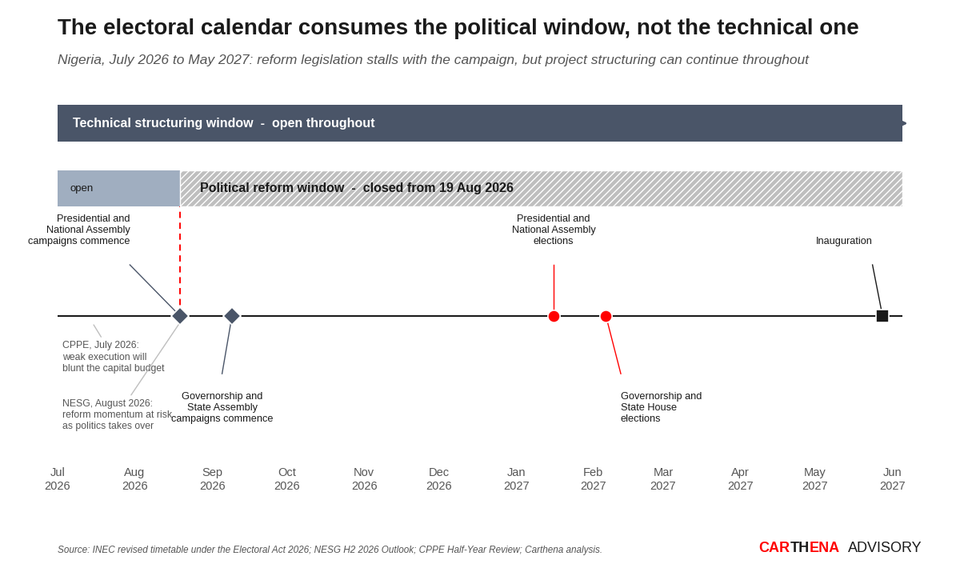
Here the analysis has to be honest about the calendar, not partisan, but honest. Nigeria is 3 to 4 months from a presidential election. The Nigerian Economic Summit Group warned in August 2026 that as political activities intensify ahead of the 2027 elections, reform momentum could weaken while fiscal discipline comes under pressure from increased pre-election spending. The Centre for the Promotion of Private Enterprise made the same point in July, warning that election-related spending may increase liquidity in the economy, potentially fuelling inflationary pressures and raising demand for foreign exchange.
The concern is not electoral democracy. Elections are the correct mechanism for political accountability. The concern is specifically about what Nigerian election cycles do to the structural reform work that infrastructure financing depends on. That work requires sustained attention to building project pipelines, reforming the regulatory frameworks that govern private investment in power and transport, and creating the deal-making architecture that turns a power plant proposal into a financeable instrument with predictable revenues. None of that is glamorous and none of it produces a ribbon-cutting before polling day. Most of it produces results in three to five years, not three to five months.
There is already evidence the cycle is turning. Sources in the Presidency and the APC in August linked the federal government's reluctance to enforce local government financial autonomy to the political importance of state governors to President Tinubu's re-election effort. The 2026 capital line is subject to the same execution record set out above, in which only 15 to 20% of planned capital spending historically reaches real investment. Campaign spending caps set at 10 billion naira for presidential candidates and 3 billion for governorship candidates represent official limits that bear no relationship to actual expenditure, with credible accounts of single state elections consuming more than 110 billion naira by a single party.
The electoral cycle is not the cause of Nigeria's infrastructure financing gap. The gap is structural and predates this administration. What the electoral cycle does is consume the time that represents the remaining window for structural reforms, before campaign season crowds out serious economic work entirely. The political window for new reform legislation closed when presidential campaigning commenced in August. The technical window did not. Structuring offtake agreements, building revenue models and assembling the documentation that makes a project financeable require institutional attention rather than political capital, and that work can proceed through a campaign season. Whether it does is the test.
What closing the gap would actually require
Naming the gap without naming what could close it is diagnosis without direction, and the Carthena Read does not do that.
The gap cannot be closed by domestic capital alone. The arithmetic does not permit it. Even a fully optimised version of Nigeria's domestic financing stack, with the pension funds at 15% infrastructure allocation, the budget executing fully on its capital line, and development finance at historical highs, would mobilise perhaps 4 to 5 billion dollars a year on a recurring basis, rising to 8 billion in any year in which the pension pool deploys close to its ceiling. Against 120 billion dollars required annually, that is between 4 and 7% of the need. The remainder, more than nine tenths of the requirement, has to come from productive private foreign capital, primarily project finance, infrastructure funds and direct investment in assets with contractual revenue streams.
That capital does not come because a summit was held or a memorandum was signed. It comes when three things are in place: a pipeline of bankable projects structured with clear revenue mechanisms, tariffs, tolls, power purchase agreements, long-term offtake; an operating environment stable enough to support 20 to 25 year investment horizons, which means currency, contract enforcement and repatriation; and a deal-making apparatus in government and the private sector capable of originating, structuring and closing transactions at speed. Nigeria has none of the three in adequate measure.
Building the project pipeline is the first and most actionable step, because it is what unlocks everything else. A properly structured power project with a credible offtake agreement from a creditworthy buyer attracts foreign project finance. A properly structured toll road with a transparent revenue collection mechanism attracts infrastructure equity. The pension funds move when there is somewhere to put the money. The development finance institutions move when the pipeline is real. The foreign capital moves when the pipeline has been de-risked by early domestic and development capital.
This is the work of the next twelve months. It needs an institutional window, not a legislative one. If it is not done while the campaign runs, the country defers the conversation again, to 2031.
The test
The claim this analysis makes is testable. If Nigeria exits the 2027 election cycle with a functioning infrastructure project pipeline, with pension funds deployed above 8% of assets in real infrastructure instruments, with power sector investment running above 3 billion dollars a year, and with productive foreign investment in infrastructure above 2 billion dollars annually, then the structural work was done despite the political pressure. If the numbers in 2028 look the same as they do today, the election cycle consumed the window and the conversation defers again.
Nigeria knows what it needs to build. The question is whether the 12 months ahead produce the machinery to finance it, or produce the spending that makes that machinery impossible to build for another cycle. The answer will show in the numbers, and the Carthena Read will be watching them.
Sources
- Special Adviser to the President on Power Infrastructure, Sadiq Wanka, energy forum Lagos, July 2026, cited by National Daily, The Sun Nigeria and ESI-Africa
- Revised National Integrated Infrastructure Master Plan, 2020 to 2043
- PenCom pension asset data, July 2026 (31.48 trillion naira) and April 2026 infrastructure allocation (312 billion naira)
- NESG H1 2026 State of the Economy report and H2 2026 outlook, August 2026
- CPPE half-year review and second-half outlook, July 2026
- BusinessDay Nigeria on budget infrastructure execution rates and 2026 capital allocations
- ESI-Africa on power sector FDI, July/August 2026
- BusinessDay on the impact of the 2027 election cycle, May to August 2026
Carthena Advisory works with boards, chief executives and investors across Sub-Saharan Africa on strategy, transactions and the institutional capability to execute. To discuss what this analysis means for your business, write to info@carthenaadvisory.com.