
Nigeria's numbers have turned, and the markets like what they see, but that recovery has stayed at the top. For most Nigerians nothing has changed, and the real work of progress carries a massive bill the country still can't foot.
By Wole Ogundare, Founder and Managing Partner, Carthena Advisory
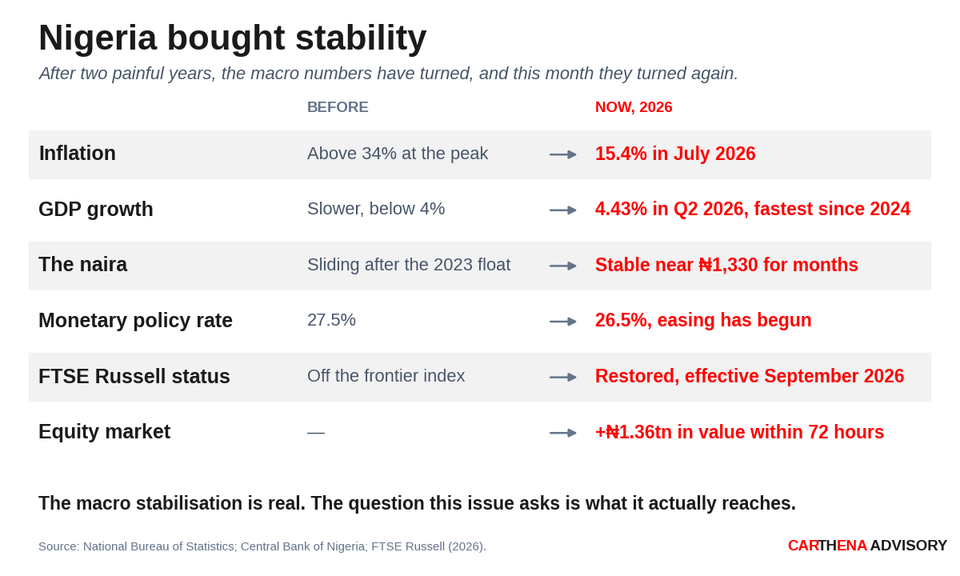
For three issues this newsletter argued that Nigeria mistakes motion for progress. Intellectual honesty now requires the opposite observation, because something has genuinely changed. In the space of a year the headline numbers have turned, and this week they turned again. Real GDP grew 4.43% in the second quarter of 2026, the fastest in almost two years. Inflation has fallen from a peak above 34% to 15.4%. The naira, after the 2023 float, has held near 1,330 to the USD for months rather than sliding, and the central bank has begun to cut. This month FTSE Russell restored Nigeria to its Frontier Market index, a decision that added about 1.36 trillion naira to market value within seventy-two hours. After two painful years, the stabilisation economists predicted, has arrived.
So let the credit stand where it is due - Nigeria has bought stability. The question this issue asks is the harder one that follows: has it bought progress? The answer, on the evidence, is not yet, and the distance between those two words is the whole of the argument.
Stability reached the markets, not the majority
The growth acceleration, the disinflation, the currency calm and the index readmission are real, but they are macro and market events, and Nigeria's macro and markets are not its people. Pull the aggregates apart and the household picture barely moves. Real GDP per person grew about 1.9% last year, which against a population expanding at well over 2% is close to standing still. Food inflation, the price line that actually governs most Nigerian lives, was still running above 20% in July even as the headline rate fell. And the human floor has not lifted: around 133 million Nigerians remain in multidimensional poverty, and roughly 63% of the population lives on less than 3.65 USD a day. The 1.36 trillion naira that appeared in three days went to holders of equities and to the foreign funds that track the index, not to the majority for whom stability is a statistic they cannot eat.
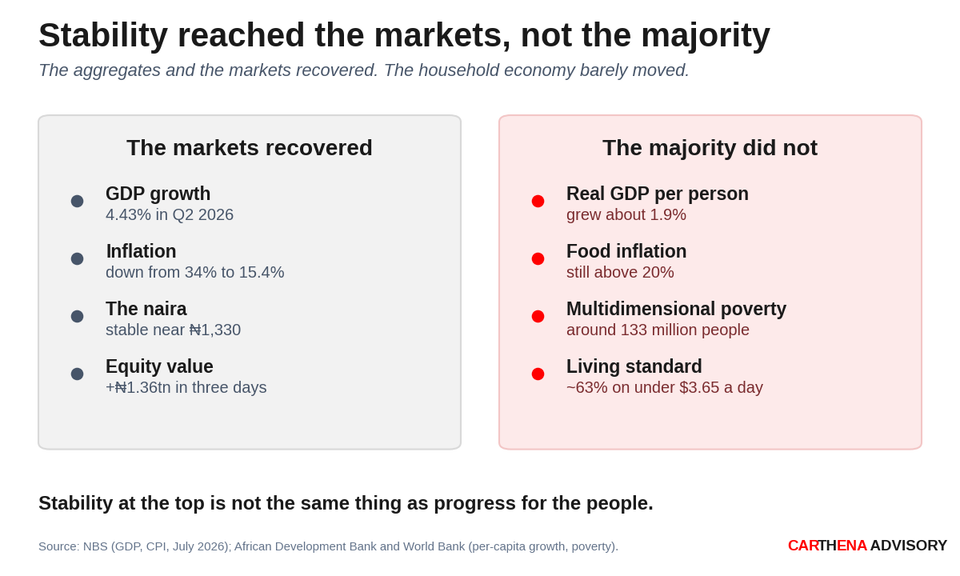
This is the distinction the celebration blurs. Stability at the level of the aggregates is a necessary condition for progress. It is not progress itself, and treating the two as the same thing is how a country persuades itself it has arrived when it has only stopped falling.
What the market actually bought
It matters, too, what kind of money the 'progress' attracted. An index readmission draws portfolio capital, the funds that must now hold Nigerian equities because the benchmark includes them. That money is welcome, and it is a genuine vote of confidence in the reforms, but it is also 'mobile'. It is a judgment on foreign-exchange access, liquidity and the credibility of the naira, not on the productive base of the economy, and it can leave as fast as it arrived at the first external shock. Portfolio capital rents a country, it does not build one. The capital that builds a country is direct investment in factories, power, ports and logistics, and on that measure Nigeria has not progressed.
The productive path has a price, and it is enormous
The argument here leaves opinion and becomes arithmetic. To move from a stabilised economy to a productive one, Nigeria has to close its infrastructure deficit, and the country's own NIIMP has already costed the task. The National Integrated Infrastructure Master Plan (NIIMP) puts the requirement at about 2.3 trillion USD between 2020 and 2043, and in its medium-term phase at roughly 150 billion USD a year, to lift the infrastructure stock towards 70% of GDP and set the economy on a productive footing.
Set that figure against what the country actually mobilises. The entire federal budget for 2026 is of the order of 45 billion USD, and the capital allocation for infrastructure within it is a small fraction; the 2025 budget set aside about 2.7 billion USD for it. Foreign direct investment, the money that is supposed to close most of the gap, peaked at 8.8 billion USD in 2011 and has since fallen to between one and four billion USD a year, so the productive requirement is not marginally larger than the resource, it is a different order of magnitude. One hundred and fifty billion dollars a year is more than three times the entire national budget. It is also about seventeen times the most foreign direct investment Nigeria has ever attracted in a single year, and it is needed not once, but every year for five years.
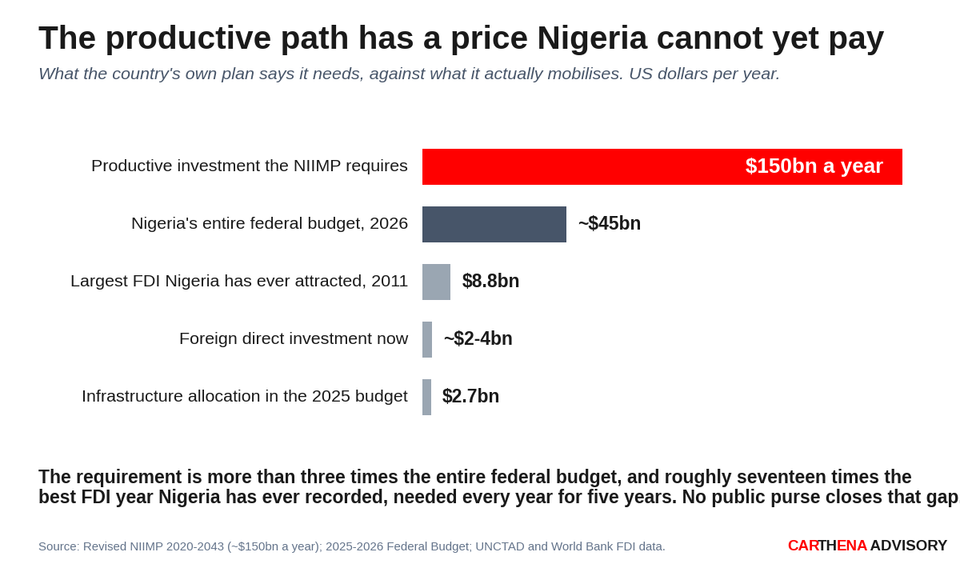
No public purse closes a gap of that size, and no serious person believes Nigeria's will. The money can only come as private and foreign capital at a scale the country has never approached. Which raises the question the macro celebration is carefully avoiding.
Can this leadership attract capital at that scale?
The honest answer has to begin with the magnitude. Attracting 150 billion USD a year is not an incremental improvement on today's one to four billion; it is thirty to forty times it, sustained. Macro stability is the entry ticket to that conversation, and Nigeria has, at last, bought the ticket; stability opens the door, it does not walk anyone through it. Capital at this scale goes to countries that have also fixed the operating environment that direct investors actually price, reliable power, working ports, physical security, contract enforcement, and policy that does not reverse with the political weather, and it goes to countries with the institutional machinery to originate, structure and close bankable projects at speed. As I have argued before, the difference between nations that build and nations that plan is not the quality of their documents, but the quality of their deal-makers. On that test, nothing in the current trajectory, a budget a third of the annual requirement and an infrastructure allocation near 2.7 billion USD, suggests a country geared to mobilise capital at the level its own plan demands. The reforms are real and necessary. The apparatus to convert them into 150 billion USD a year does not yet exist.
The trillion-dollar economy, and the only way to reach it
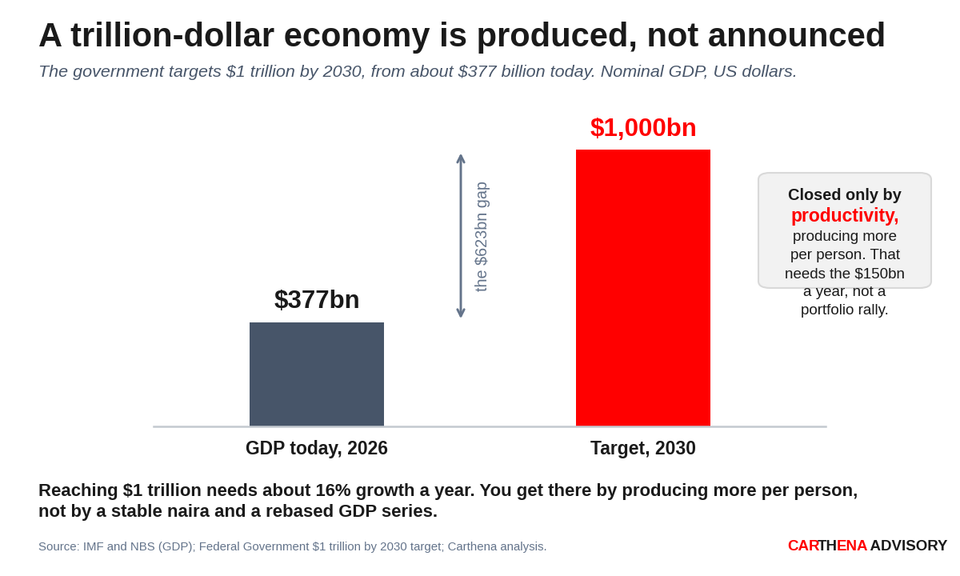
All of this bears directly on the ambition the government returns to most often: a one-trillion-dollar economy by 2030. From about 377 billion USD today, that target implies sustained nominal growth of roughly 16% a year, and it will not be reached the way the last year's numbers were produced. You do not build a trillion-dollar economy on a stable currency and a portfolio rally. You build it by producing more for each person who works, which is the definition of productivity, and productivity is exactly what the financing gap denies. A trillion-dollar headline resting on mobile capital and a rebased GDP series is not a trillion-dollar economy; it is the macro shadow of one. The substance is built in power stations, ports, farms and factories, and those are built with the productive investment Nigeria has shown it cannot yet attract.
The test
So the verdict is precise, and it is not ungenerous. Nigeria has done the hard, unpopular macro work, and it is being rewarded for it. That is real, and after years of deferral it deserves acknowledgement, but stability is the floor, not the building. The test from here is simple to state and hard to pass: does the calm convert into direct investment that builds productive capacity and lifts output per person, reaching the majority who have felt none of the recovery, or does the portfolio money take its profit and leave the fundamentals exactly where they were? Nigeria has bought stability. Nigeria has bought stability, but real progress, the kind that is produced rather than announced and that ordinary people can feel, costs far more than the country can currently afford.
Sources
- National Bureau of Statistics, second-quarter 2026 GDP report, real growth 4.43%
- National Bureau of Statistics, Consumer Price Index, July 2026, headline 15.4% and food 20.3%
- Central Bank of Nigeria, exchange rate and Monetary Policy Rate, September 2026
- FTSE Russell, reclassification of Nigeria to Frontier Market status, effective September 2026
- Revised National Integrated Infrastructure Master Plan (NIIMP), 2020 to 2043, about 2.3 trillion USD in total and roughly 150 billion USD a year in the medium term
- UNCTAD and World Bank foreign direct investment data, 2011 peak of 8.8 billion USD
- African Development Bank and World Bank on GDP per capita and poverty, real per-capita growth about 1.9% and 133 million in multidimensional poverty
Carthena Advisory works with boards, chief executives and investors across Sub-Saharan Africa on strategy, transactions and the institutional capability to execute. To discuss what this analysis means for your business, write to info@carthenaadvisory.com.