
Nigeria announced $11.5 billion of investment pipeline in 2025 and received $4 billion, half of it one oil deal. The gap between announcement and arrival is a knowledge problem, decomposed.
By Wole Ogundare, Founder and Managing Partner, Carthena Advisory
Nigeria's Investment Promotion Commission reported that its 2025 promotion effort generated between 120 and 135 investment leads with an estimated potential value of about $11.5 billion. At the Bauchi State Investment Summit alone, 47 memoranda of understanding were signed with aggregate commitments exceeding $5.2 billion, including a $2.7 billion petrochemical city. Across the year, state summits, roadshows, deal rooms and inbound missions produced a steady procession of announcements, each with a headline figure and a signing photograph. UNCTAD, measuring what actually arrived, recorded Nigerian foreign direct investment for 2025 at $4.01 billion, and roughly half of that was a single oil and gas project finance deal.
The gap between what Nigeria announces and what Nigeria receives is not an execution problem, and it is not bad luck. It is the visible symptom of a knowledge problem, because the country's entire investment-attraction apparatus is oriented toward producing activity rather than securing outcomes, and it measures the wrong things because it misunderstands what productive foreign capital actually responds to. A memorandum of understanding is not an investment, a lead is not an investment, and an expression of interest is not an investment, yet these are the units in which Nigeria's success is counted. Until the country understands the difference between motion and progress, the announcements will keep coming and the capital will keep staying away.
1. The gap between announcement and arrival
The most useful way to see the problem is to place the two numbers side by side, because they describe the same country in the same year through two different measuring instruments.
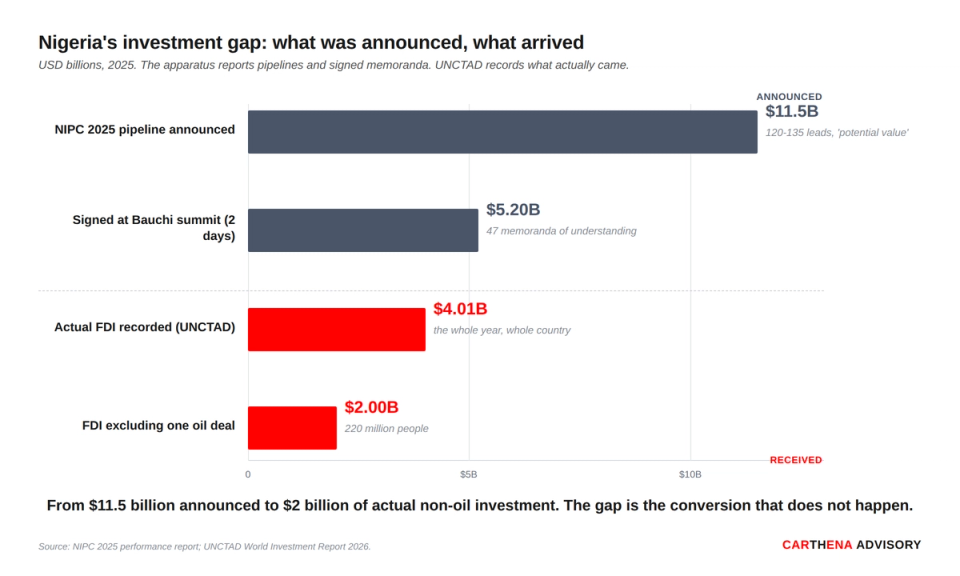
On the announcement side, the numbers are large and the momentum looks real. The commission's pipeline for the year carried an estimated $11.5 billion in potential value, the Bauchi summit produced $5.2 billion in signed memoranda in two days, a Brazilian meat processor indicated $2.5 billion of interest in the livestock value chain, and the West African Economic Summit deal room screened 66 businesses and showcased more than 40 investment-ready projects. Read on its own, this is the record of a busy and well-organised promotion agency doing what promotion agencies are asked to do.
On the arrival side, the number is small and its composition is worse than its size. Actual FDI for the year was $4.01 billion, and once the single large oil and gas transaction is stripped out, the underlying figure sits at roughly $2 billion for a country of 220 million people. The production and manufacturing sector, the part of the economy that a petrochemical city or an agricultural park would supposedly represent, attracted a fraction of that. The Bauchi petrochemical city that headlined a summit does not appear in the arrival data, because a signed memorandum and a built facility are separated by exactly the constraints that Nigeria has not resolved.
The two numbers are not in contradiction, because they measure different stages of a process that mostly does not complete. The announcement figure measures intention. The arrival figure measures commitment that survived contact with Nigerian operating conditions. The distance between them is the conversion that does not happen, and the size of that distance is the clearest measure of how far the country's self-assessment sits from reality.
2. The unit-of-measurement problem
An organisation becomes what it measures, and Nigeria's investment apparatus measures activity because activity is what it knows how to produce.
A memorandum of understanding is a document in which two parties record an intention to explore a transaction. It carries no obligation to invest, no committed capital, and no penalty for non-performance, which is precisely why so many are signed. A lead is the identification of a party that might invest. An expression of interest is a statement that a party has noticed an opportunity. A potential value is an estimate of what a pipeline might be worth if every item in it converted, which none ever does. Each of these is a real and legitimate stage in a business development process, and each is also, on its own, worth nothing until it converts into capital that clears into the economy and stays.
The difficulty is that these intermediate artefacts are easy to produce, easy to count, and easy to announce, whereas the thing they are supposed to lead to is hard to produce, slow to arrive, and dependent on factors the promotion agency does not control. A summit can be convened in ninety days. A memorandum can be drafted and signed in an afternoon. A press release writes itself. A functioning power supply, a predictable foreign exchange regime and a working port take fifteen years and lie outside the promotion agency's authority entirely. Faced with that asymmetry, an apparatus that is judged on visible output will produce the artefacts it can control and will report them as achievement, because the alternative is to report that the fundamentals remain unfixed and that little has therefore changed.
This is not dishonesty, and it is not incompetence on the part of the people doing the work, many of whom are capable and diligent. It is a structural miscalibration, in which the entire system optimises for the metric it can move rather than the outcome that matters, because it has not been equipped with a correct understanding of the relationship between the two.
3. What productive capital actually evaluates
The knowledge that is missing is not obscure, and it is not proprietary. It is the standard analysis that any institutional investor runs before committing long-term capital to a jurisdiction, and it is knowable by anyone prepared to think from the investor's side of the table rather than the promoter's.
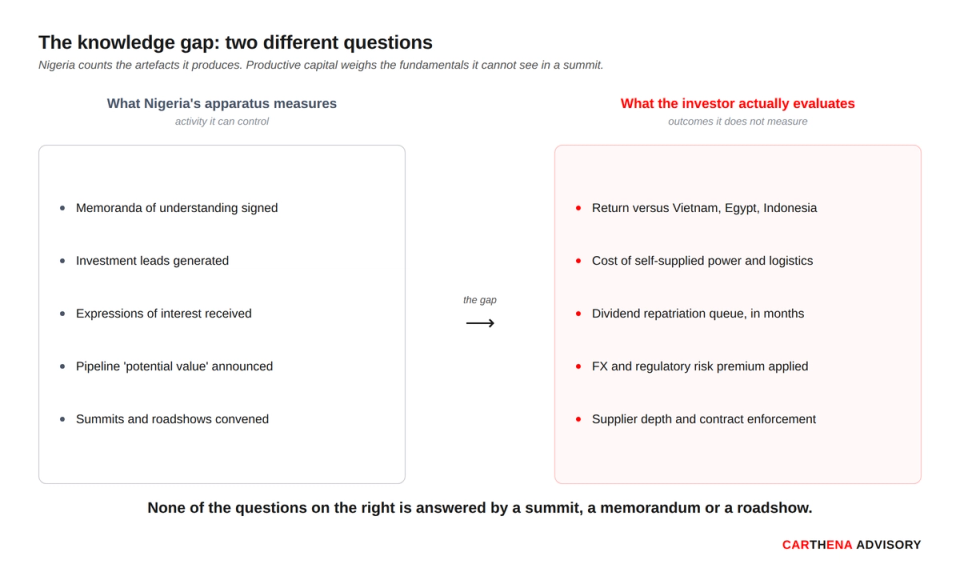
Foreign direct investment is a discounted cash flow decision made by an investor with global alternatives. Before committing, that investor asks a specific and consistent set of questions. What return can this project generate, and how does it compare with the same capital deployed in Vietnam, Egypt, Indonesia or Bangladesh, all competing for the same global pool. What is the cost of the parallel infrastructure the project must build for itself, the private power, the water, the security and the logistics that the state does not reliably provide. What is the probability that dividends declared in year three can be repatriated in year four, and what is the queue. What is the volatility of the exchange rate, the tariff regime and the regulatory environment, and what risk premium must therefore be applied to every future cash flow. What is the depth of the local supplier base, the availability of skilled labour, and the reliability of contract enforcement.
None of these questions is answered by a summit, a memorandum or a roadshow. They are answered by the fundamentals of the operating environment, which is to say by the three constraints this newsletter has named in previous issues, power, the foreign exchange regime, and ports and logistics, together with the institutional depth that sits beneath them. An investment-attraction strategy that understood this would spend the overwhelming majority of its effort on the fundamentals, because the fundamentals are the answer to the only questions the investor is actually asking, and the promotional activity would follow as the final and smallest step once the answers were favourable. Nigeria has the sequence inverted, spending most of its effort on the promotion and almost none on the answers.
4. Why the summit model fails on its own terms
The summit model would be defensible if it were the last mile of a strategy that had already fixed the fundamentals, because in that case the promotion would be converting genuine advantage into committed capital. The reason it fails in Nigeria is that it is asked to do the opposite, to substitute for the fundamentals rather than to showcase them.
When an investor attends a Nigerian investment summit, hears the pitch, and signs a memorandum, the memorandum is signed in good faith on both sides. The investor then begins the diligence that any serious commitment requires, and that diligence surfaces the same operating conditions that drove Shell, GlaxoSmithKline, Procter and Gamble, Unilever and Sanofi out of productive operations in Nigeria between 2023 and 2024. The investor learns that the project must generate its own power at roughly four times the grid cost paid by competitors in Egypt or South Africa. The investor learns that dividend repatriation cannot be timed with confidence. The investor learns that cargo takes fifteen days to clear Apapa against three to five days at competing ports. The memorandum, signed with genuine enthusiasm at the summit, quietly does not convert, because the diligence returns the verdict that the fundamentals return.
The apparatus records the memorandum as a success and moves to the next summit, and the failure to convert is not recorded anywhere, because the system has no metric for the gap between what it announces and what arrives. This is the mechanism by which a country can report $11.5 billion of pipeline and receive $2 billion of non-oil FDI in the same year without any individual within the system behaving dishonestly. The metric that would reveal the problem, the conversion rate from announcement to committed capital, is the one metric the apparatus does not keep, because keeping it would indict the model.
5. The countries that did the unglamorous work
The comparators that Nigeria measures itself against did not win their foreign investment through superior summits, and it is worth being precise about what they actually did, because the contrast is the whole lesson.
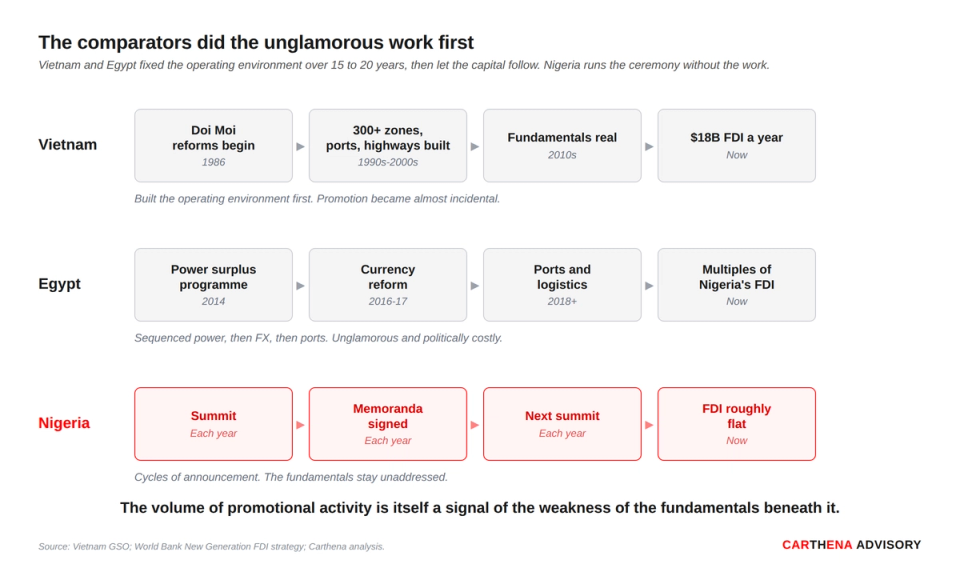
Vietnam began its transformation with the Doi Moi reforms in 1986 and spent the following two decades building the fundamentals that investors evaluate. It established more than 300 special economic zones and industrial parks, each engineered to solve the investor's operating problems inside a bounded geography, with reliable power, streamlined customs, predictable land tenure and proximity to functioning seaports. It built the highways and the port capacity that let cargo move. It integrated itself into global value chains through sustained trade opening rather than through episodic promotion. By the time Vietnam was attracting $15 billion and then $18 billion a year in foreign investment, the promotion was almost incidental, because the country had already answered every question a manufacturer asks before it had to be asked. The zones sold themselves because the fundamentals inside them were real.
Egypt sequenced its reforms across roughly fifteen years, beginning with power, where it moved from chronic shortage to a substantial installed surplus, and proceeding to the currency reforms and port investments that followed. The work was unglamorous, domestically painful and politically demanding, and it was the work that actually moved the investment numbers. Neither country ran its strategy through the announcement of memoranda, because neither country needed to, and both understood that the memorandum is the artefact of a weak hand, deployed by a jurisdiction that has to promise what it cannot yet demonstrate.
The uncomfortable implication for Nigeria is that the volume of its promotional activity is itself a signal of the weakness of its fundamentals. A country that had fixed power, foreign exchange and ports would not need 47 memoranda from a single summit, because the capital would arrive in response to the operating conditions without requiring the ceremony. The busyness is not evidence of a strategy working. It is evidence of a strategy substituting motion for the progress it has not made.
6. The knowledge deficit sits above the three constraints
This newsletter has argued across previous issues that power, the foreign exchange regime, and ports and logistics are the three horizontal constraints that determine whether foreign capital builds productive capacity in Nigeria. The argument of this issue sits one level above those three, because there is a prior constraint that determines whether the three ever get fixed, and that prior constraint is the quality of the analysis brought to the problem.
A country cannot solve a problem it has misdiagnosed, and it cannot prioritise correctly if it does not understand which of its many possible actions actually move the outcome. The reason Nigeria pours effort into summits and memoranda while the fundamentals stay unaddressed is not that its officials are unwilling to fix power or ports. It is that the system has not correctly understood that fixing power and ports is the investment strategy, and that the summits are, at best, the final ornament on work that has not been done. The misallocation of effort follows directly from the misdiagnosis of the problem, and the misdiagnosis follows from a deficit of the specific analytical knowledge that would let the country see its situation as an investor sees it.
This is why the knowledge deficit is the binding constraint above the binding constraints. Fixing it does not require capital, and it does not require a fifteen-year sequencing programme. It requires only that the country apply to its own investment problem the same rigorous, investor-side analysis that any competent advisor would apply, and then allocate effort in proportion to what that analysis reveals rather than in proportion to what generates a photograph. The analysis is not expensive. The failure to commission it, or to act on it, is what is expensive, and the price is paid every year in the gap between $11.5 billion announced and $2 billion received.
7. Two Nigerias
It is possible to describe two versions of the country, distinguished by nothing other than the quality of thought applied to the same set of facts, and the distance between them is the distance this newsletter has been measuring.
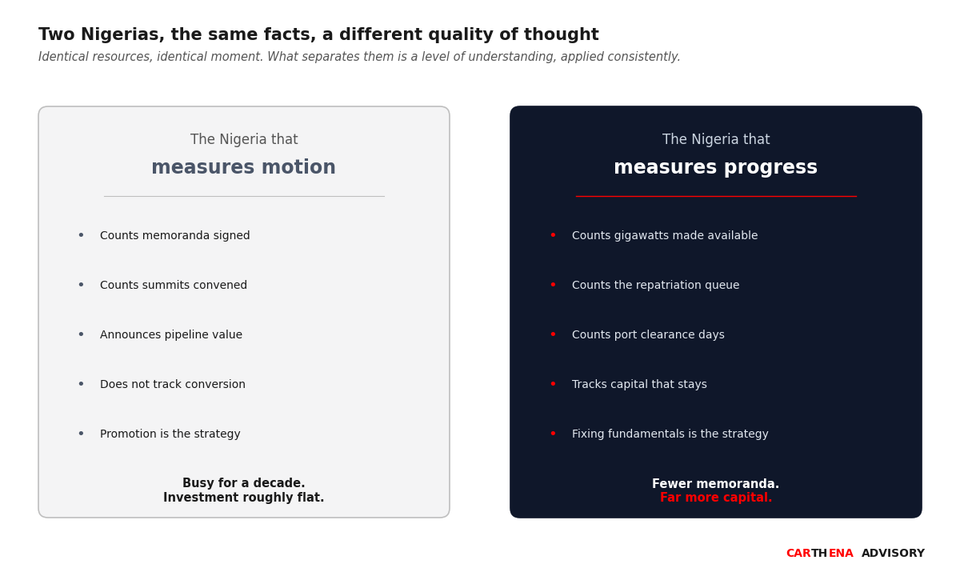
The first Nigeria measures its progress in memoranda signed, summits convened, leads generated and potential value announced. It treats the promotion of investment as the substance of investment strategy. It reports pipelines as achievement and does not track conversion. It responds to the departure of multinational manufacturers by convening another summit to attract their replacements, without asking why the replacements will not come. It mistakes the volume of its activity for the effectiveness of its strategy, and it sustains this mistake because the metrics it keeps are the metrics that flatter it. This Nigeria has been busy for a decade and has moved its productive foreign investment almost not at all.
The second Nigeria understands what productive capital evaluates and works backward from the investor's decision. It measures its progress in the fundamentals that determine that decision, in gigawatts made reliably available, in the length of the dividend repatriation queue, in the number of days cargo takes to clear a port. It treats the fixing of power, foreign exchange and logistics as the investment strategy itself, and it treats promotion as the final and smallest step, undertaken only once there is something real to promote. This Nigeria would sign far fewer memoranda and would receive far more capital, because it would have understood that the memorandum is the symptom of a weak position and the functioning fundamental is the source of a strong one.
The two Nigerias face identical facts, possess identical resources, and inhabit the same moment. What separates them is a level of understanding, applied consistently to the problem, and a willingness to allocate effort according to what that understanding reveals rather than according to what produces the more satisfying announcement. The country that Nigeria becomes over the next decade will be decided by which of these two versions its institutions choose to be.
8. The single test
The claim of this issue is testable, and it is worth stating the test so that it can be proven wrong. If, over the next two years, Nigeria's investment apparatus continues to report large pipelines of memoranda and potential value, and if the actual productive-capacity FDI recorded by UNCTAD does not rise materially above the level of the past three years, then the apparatus is producing activity without producing outcomes, and the diagnosis offered here holds. If instead the promotional activity is accompanied by a measurable improvement in the fundamentals, and productive investment rises in step, then promotion and fundamentals are being pursued together and the criticism is misplaced.
The reverse test is the one that matters more, and it is available to any observer. When the next investment summit is announced, with its headline figure and its signing ceremony, the question to ask is not how many memoranda were signed or how many billions were pledged. The question is what changed in the fundamentals, in the power supply, in the repatriation queue, in the port clearance time, in the weeks before the summit convened. If the answer is nothing, then the summit is motion, and the capital will not come, whatever the memoranda say. If the answer is something specific and measurable, then the promotion is finally pointing at progress that has actually been made.
Nigeria does not lack ambition, and it does not lack activity, and the past decade has produced no shortage of either. What it has lacked is the knowledge, consistently applied, to tell the difference between the two, and to direct its formidable energy at the fundamentals that determine the outcome rather than at the ceremonies that merely announce the intention. The countries that overtook Nigeria did the unglamorous work first and let the capital follow. The country will make meaningful progress on the day it decides to do the same, and not before.
Sources
- Nigerian Investment Promotion Commission, 2025 investment promotion performance report; BusinessDay Nigeria coverage of NIPC 2025 outcomes, January 2026.
- Bauchi State Investment Summit and Katsina State Economic and Investment Summit outcome reports, 2025.
- UN Conference on Trade and Development, World Investment Report 2026 (7 July 2026), Nigeria country data.
- National Bureau of Statistics, Nigeria Capital Importation Reports 2025.
- Tafese, Lay and Tran, From fields to factories: Special economic zones, foreign direct investment, and labour markets in Vietnam, Journal of Development Economics, 2025.
- General Statistics Office of Vietnam, FDI inflows 2021 to 2025; World Bank, New Generation FDI strategy for Vietnam.
- Company exit communications and SEC filings for Shell, GlaxoSmithKline, Procter and Gamble, Unilever and Sanofi, 2023 to 2024.
If you would like to discuss what this analysis means for your organisation, board or investment strategy, please get in touch at info@carthenaadvisory.com.