
Power distribution revenue is up more than sevenfold in naira since 2016 but only 29 per cent in dollars, and it still does not cover the cost of generating the power.
By Wole Ogundare, Founder and Managing Partner, Carthena Advisory
On 5 October, Nigeria's grid carried 2,034 megawatts, with 16 of its 29 generating plants producing nothing. Installed capacity is about 13,000 megawatts. The usual explanations are gas shortages, vandalised lines and an ageing grid, and each is real, but each is a symptom of one problem. Nigeria's electricity industry buys its gas, its equipment and its capital in dollars and sells its output in naira at tariffs that do not follow the exchange rate, so every devaluation since 2016 has widened a gap that no one is paying to close. Until that changes, new plants will sit idle for the same reason old ones do now.
The naira figures flatter the sector
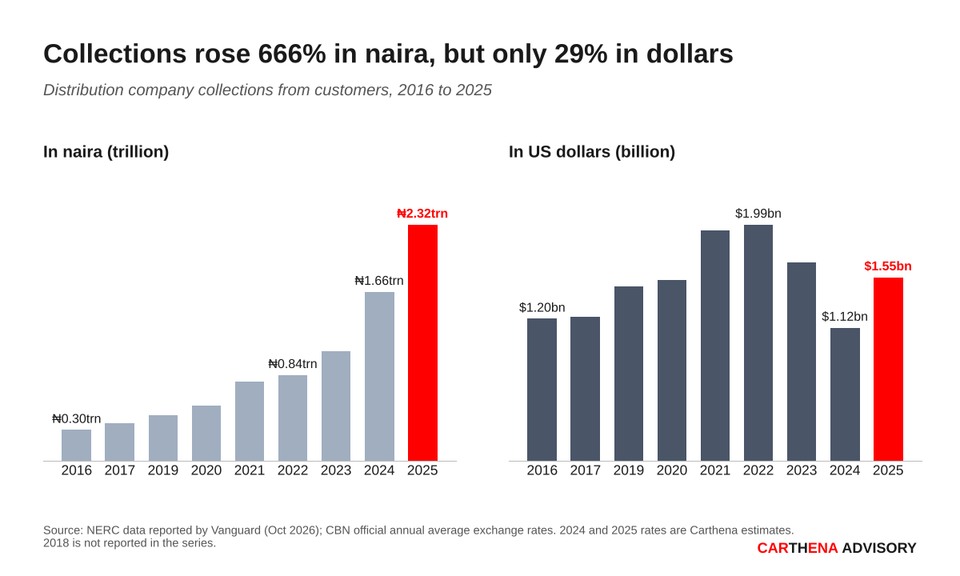
The headline numbers suggest an industry that has finally started to earn. Distribution companies collected ₦2.32 trillion from customers in 2025, against ₦302.9 billion in 2016, an increase of 666 per cent. In the first half of 2026 alone they collected ₦1.2 trillion, more than in the whole of 2023.
Converted at the Central Bank's average official rate for each year, the same revenue tells a different story. The sector collected about $1.2 billion in 2016 and about $1.55 billion in 2025, an increase of roughly 29 per cent over nine years. Measured from 2022, when revenue reached about $2 billion before the naira was floated, dollar revenue has fallen by more than a fifth, while naira revenue has nearly tripled. In 2024, the year of the sharpest devaluation, collections were worth about $1.1 billion, the lowest in the series since 2016, even though distribution companies received more electricity that year than in any other year on record.
The volume of power sold has hardly moved. Distribution companies received 16,861 gigawatt-hours in the first half of 2018 and 17,668 in the first half of 2026, an increase of less than 5 per cent in eight years. Per kilowatt-hour, the sector collected between 3.6 and 4.2 US cents in the first half of 2018, depending on the exchange rate used, and about 4.9 cents in the first half of 2026. For an import-dependent industry, that is the number that matters, and it has moved little through two currency collapses.
Five cents does not pay for a kilowatt-hour
The industry's costs are set in dollars, whatever currency they are invoiced in. The regulator sets the price of gas for power at $2.18 per million British thermal units, raised from $2.13 in April 2026. A new gas-fired plant costs more than $1.5 million per megawatt, most of it in imported turbines and equipment, and the transformers, cables, spares and meters that keep the grid running are imported too. When the naira falls, each of these costs rises in naira almost one for one.
Tariffs do not follow. Only Band A customers, who are promised at least 20 hours of supply a day, pay a tariff that reflects cost, a point a commissioner of the Nigerian Electricity Regulatory Commission made publicly in September. Customers in Bands B to E pay tariffs that have been held flat in naira, so each devaluation turns more of the cost of their power into a subsidy.
The result is visible in the regulator's own figures. In the first half of 2026, generation companies invoiced ₦1.34 trillion for the power they produced, about ₦76 for each kilowatt-hour that reached a distribution company. Distribution companies collected about ₦68 per kilowatt-hour from their customers. Collections therefore fall short of the cost of generation alone, before a single naira has been spent on transmitting the power, distributing it, maintaining the network or paying for the capital that built it.
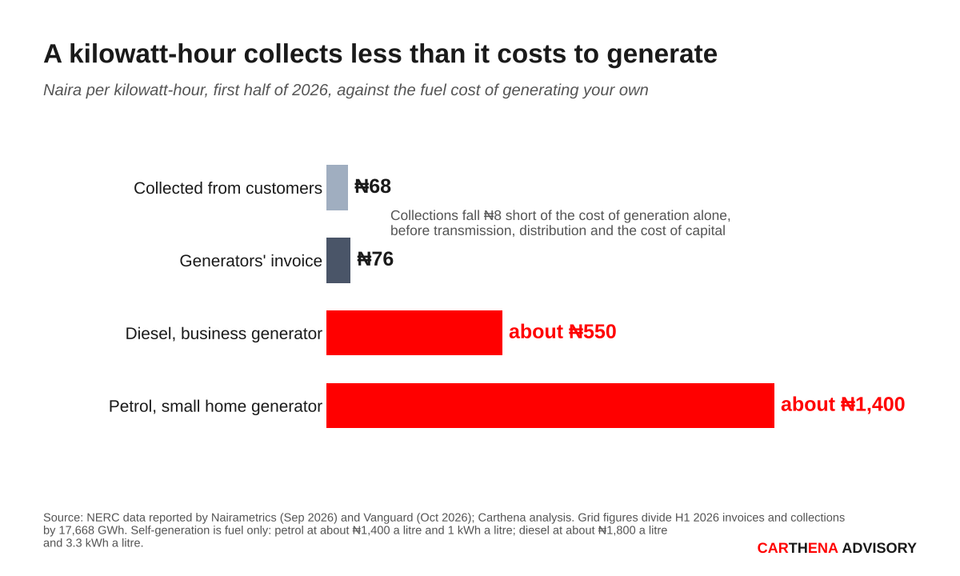
The customers who cannot get grid power pay far more for the shortfall. A small petrol generator, the kind most households run, produces roughly one kilowatt-hour per litre, so with petrol at about ₦1,400 a litre its electricity costs about ₦1,400 per kilowatt-hour in fuel alone, some twenty times what distribution companies collect for grid power. Businesses running larger diesel sets do better, at roughly 3.3 kilowatt-hours per litre, but with diesel at about ₦1,800 a litre they still pay about ₦550 per kilowatt-hour, eight times the grid. Nigerian households and businesses are not refusing to pay for electricity. They are already paying for it at generator prices, to fuel marketers and generator dealers rather than to the power sector.
Where the money stops
The gap between what power costs and what is collected does not disappear. It travels back up the chain, and at each link someone is left unpaid.
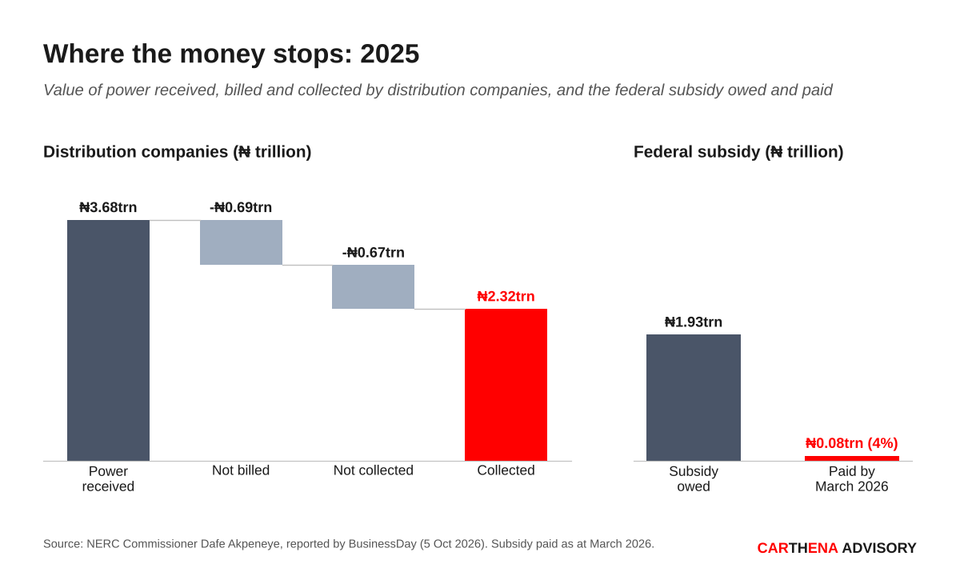
Distribution leaks a third of the value it receives. In 2025, distribution companies received electricity worth ₦3.68 trillion at regulated tariffs, billed customers ₦2.99 trillion and collected ₦2.32 trillion. About 37 per cent of the value of the power they received never became cash. More than a third of the 12.75 million active customers on the regulator's books in August 2026, about 4.7 million, still have no meter and pay estimated bills that are disputed, discounted or ignored.
The federal government owes half of every generation invoice and pays little of it. The subsidy covered 52 per cent of generation invoices in the first quarter of 2026 and 50 per cent in the second, ₦680 billion in the half year. For 2025 the subsidy requirement was ₦1.93 trillion, of which ₦77 billion, about 4 per cent, had been paid by March 2026. A subsidy that is promised but not paid becomes, in practice, a debt to the generation companies.
The debt lands on the generators, and the generators pass it to their gas suppliers. The government has approved a ₦3.3 trillion settlement for legacy debts accumulated between February 2015 and March 2025. The Minister of Power said in late October that ₦1.23 trillion of it had been paid. The generation companies put what they are owed at ₦6 trillion or more, and Professor Barth Nnaji, a former Minister of Power, put it at more than ₦7 trillion this month. Gas suppliers, who sell a dollar-priced commodity, have repeatedly threatened to stop supplying thermal plants over about ₦3.3 trillion in unpaid gas bills.
Idle plants are the rational response
Seen from the gas well rather than the grid, the outages of the past year are not a mystery. A gas supplier owed for past deliveries, in a currency that has lost most of its value since the invoices were raised, has every reason to supply only what it expects to be paid for. A generator that cannot be sure of payment has every reason to run below capacity. That is why available capacity averaged 4,456 megawatts in the first half of 2026, 41 per cent below the 7,566 megawatts of the first half of 2018, at a time when naira revenue was rising fastest.
The same arithmetic stops new investment. A plant financed in dollars has to earn dollars, or be protected against failing to, and Nigeria offers neither. The partial risk guarantee that once covered power purchase payments was suspended in 2015, and about 1,000 megawatts of planned capacity, including projects by ExxonMobil and Century Power, has stalled without it. Even concessional capital has gone unused: this year the federal government and the World Bank cancelled $717.7 million of undisbursed funds from the power sector recovery programme. Carthena's view is that this, rather than a shortage of money in the world, is why Nigeria cannot find the money to build what it knows it needs. Investors will fund power plants in Nigeria when they can see how they will be paid in a currency that holds its value.
What a working power sector requires
The government has begun to act. The legacy debt settlement, the ₦729 billion bond-backed settlement that the Nigerian Bulk Electricity Trading company began in October, a target of 19,000 megawatts of transmission capacity within two years, and the state electricity markets created by the Electricity Act 2023 are all real steps. None of them will hold unless the chain that pays for electricity is repaired at every link, and the order matters.
Revenue: index the tariff and fund the subsidy. Tariffs for every band should move with the exchange rate and the gas price, as Band A tariffs already do, so that a devaluation no longer turns into a hidden subsidy. Where government chooses to protect poorer customers, it should do so explicitly, through a subsidy that is budgeted, appropriated and paid monthly, and targeted through meters at the households that need it, rather than accumulating as arrears on generators' balance sheets.
Generation: settle once, then pay for gas first. The legacy debt should be settled in full and closed, with a ring-fenced payment mechanism that guarantees gas suppliers are paid before any other party in the chain. Reinstating a partial risk guarantee, with the World Bank or the African Development Bank, would give new plants the payment security that dollar financing requires.
Transmission: build ahead of generation, and price it. The grid carries about 5,000 megawatts today. The target of 19,000 megawatts will need dollar financing on a scale the sector has never raised, and that financing depends on transmission charges that cover the cost of the network rather than a residual share of whatever is collected.
Distribution: meter every customer and let states compete. Closing the 4.7 million meter gap is the single fastest way to turn energy received into cash collected, because metered customers pay for what they use and estimated customers do not. The state markets now forming, led by Lagos, which has taken over regulation of its own market and is contracting new independent plants, should be encouraged to price power at cost and to attract embedded generation that earns its own return.
The test for 2027
The 2027 budget, which the federal government expects to submit in December, will show whether any of this is taken seriously. If it appropriates the electricity subsidy as a funded line, rather than leaving it as an obligation to be settled later, and if the regulator moves Bands B to E onto tariffs that follow the exchange rate, the sector will begin to earn in a currency that holds its value, and the plants already built will start to run. If neither happens, Nigeria will spend another year adding generation capacity on paper while the grid carries less power than it did in 2018, and its households and businesses will keep paying diesel prices for the difference.
Sources
- Nigerian Electricity Regulatory Commission data, reported by Vanguard, October 2026: distribution company revenue of ₦302.93 billion (2016) to ₦2.32 trillion (2025) and ₦1.2 trillion in H1 2026; energy received of 16,861 GWh (H1 2018), 17,668 GWh (H1 2026), 23,742 GWh (2016), 37,093.7 GWh (2024) and 31,251 GWh (2025); average available capacity of 7,565.5 MW (H1 2018) and 4,456 MW (H1 2026).
- Nigerian Electricity Regulatory Commission quarterly data, reported by Nairametrics, 30 September 2026: subsidy of ₦358.32 billion (Q1 2026) and ₦321.26 billion (Q2 2026), 51.95% and 49.60% of generation invoices; generation invoices of ₦689.72 billion (Q1) and ₦647.72 billion (Q2).
- BusinessDay, 5 October 2026, on remarks by NERC Commissioner Dafe Akpeneye: only Band A customers pay a cost-reflective tariff; 2025 subsidy requirement of ₦1.928 trillion, of which ₦76.95 billion was paid by March 2026; distribution companies received ₦3.68 trillion, billed ₦2.99 trillion and collected ₦2.32 trillion in 2025.
- ThisDay, 15 October 2026, NERC factsheet: 12.75 million active customers, 8.05 million metered and 4.70 million unmetered, August 2026.
- Nigerian Midstream and Downstream Petroleum Regulatory Authority, domestic base price of gas for power of $2.18/MMBtu from 1 April 2026 (previously $2.13), reported by Nairametrics, 1 April 2026.
- Rio Times, October 2026: grid generation of 2,033.66 MW on 5 October 2026, with 16 of 29 plants producing nothing.
- Self-generation costs are Carthena estimates, fuel only: petrol at about ₦1,400 a litre and about 1 kWh per litre for a small home generator; diesel at about ₦1,800 a litre (median depot price of ₦1,780 on 6 November 2026, reported by Awajis from petroleumprice.ng) and about 3.3 kWh per litre for a larger set.
- Nairametrics, 3 November 2026, on remarks by Professor Barth Nnaji as reported by ThisDay: installed capacity of about 13,000 MW; plant costs above $1.5 million per MW; partial risk guarantee suspended in 2015; about 1,000 MW stalled; generation company debt above ₦7 trillion.
- Economy Post, 29 October 2026, on remarks by the Minister of Power, Dr Joseph Tegbe: ₦1.23 trillion of the ₦3.3 trillion legacy debt paid; transmission target of 19,000 MW within two years.
- Aluko & Oyebode, Nigeria Energy Quarterly Report Q2 2026: ₦3.3 trillion settlement for debts accumulated between February 2015 and March 2025; cancellation of $717.7 million of undisbursed World Bank power sector recovery funds; Lagos State regulation under the Electricity Act 2023.
- Nairametrics, 9 October 2026: NBET settlement of ₦729 billion for generation companies and gas suppliers.
- Exchange rates: Central Bank of Nigeria official annual averages of ₦253 (2016), ₦305 (2017), ₦306 (2019), ₦356 (2020), ₦399 (2021), ₦423 (2022) and ₦645 (2023), as compiled by FocusEconomics and StatiSense. For 2024 (about ₦1,480), 2025 (about ₦1,500) and H1 2026 (about ₦1,400), the averages are Carthena estimates from month-end official rates reported by Nairametrics. H1 2018 per-kWh values use ₦306 (official) and ₦361 (investors' and exporters' window). Before 2023 the official rate was stronger than the market rate, so dollar values for those years are, if anything, overstated.
If you would like to discuss what this means for your energy costs, power investments or exposure to the sector, please get in touch at info@carthenaadvisory.com.