
Reserves stand at an eighteen-year high while interest consumes 53.7% of federal revenue. Nigeria is not being paid for its stability; it is paying for it.
By Wole Ogundare, Founder and Managing Partner, Carthena Advisory
On 22 September the Central Bank of Nigeria cut its policy rate by 350 basis points to 23 per cent, the largest single reduction since 2006 and considerably more than the market expected, since five of the eight economists polled by Bloomberg had expected no change at all. At the same briefing the Governor told the room that gross external reserves stood at $55.25 billion as of 18 September, the highest in eighteen years and about 11.3 months of import cover. The equity market has returned more than 60 per cent this year. By almost every measure the country was invited to conclude that it has arrived somewhere better.
It has, and the stabilisation was hard won. What has gone largely unexamined is what the stability is made of, what it costs and who is paying for it.
Issue 6 of this series set out that Nigeria needs roughly $120 billion a year to close its infrastructure gap and mobilises something closer to $5 billion. This issue looks at the money that is actually arriving. The conclusion is uncomfortable. Nigeria is not being paid for its stability. It is renting it, and the rent is more than half of federal revenue.
What the money actually is
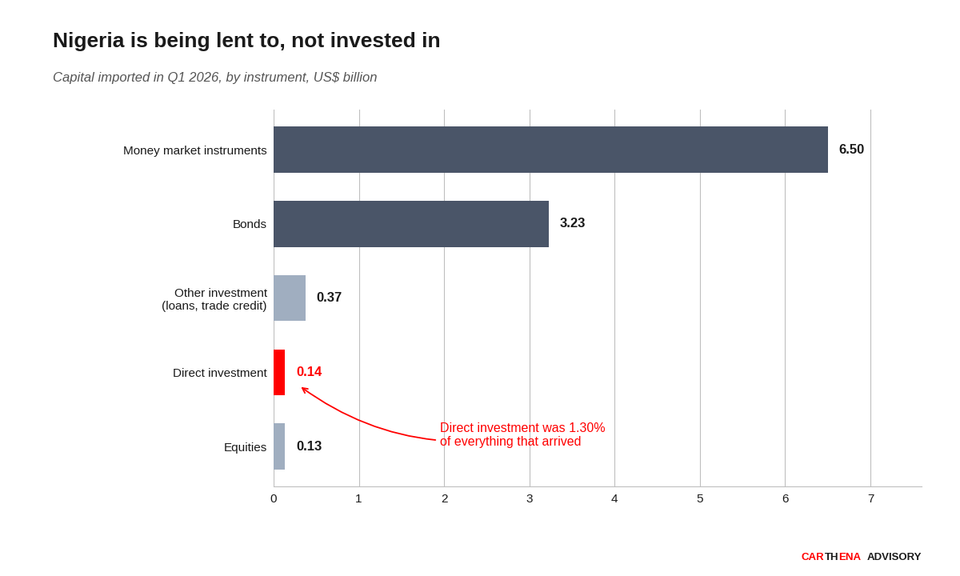
Nigeria imported $10.37 billion of foreign capital in the first quarter of 2026, an increase of 83.83 per cent on the same quarter of 2025. That headline was widely reported as evidence of returning investor confidence, and on its own it looks like exactly that.
The composition says something else. Portfolio investment accounted for $9.86 billion, or 95.09 per cent of the total. Other investment, meaning loans and trade credit, came to $374.48 million. Foreign direct investment was $135.08 million, which is 1.30 per cent.
Open the portfolio figure and it narrows further - money market instruments took $6.50 billion and bonds took $3.23 billion, while equities took $131.81 million. The banking sector received $7.55 billion, 72.79 per cent of everything that entered the country. Of every hundred dollars that arrived in the quarter, roughly sixty-three went into money market instruments, thirty-one into bonds and one into direct investment.
Nigeria is not being invested in. It is being lent to, at short tenor, through the banking system.
Two qualifications belong here and the second one matters. The second quarter continued the same pattern, with portfolio inflows of $7.09 billion against direct investment of $1.15 billion on the Central Bank's balance of payments measure. That Central Bank figure differs from the Bureau of Statistics figure because, as the Bureau explains in its own release, the capital importation series captures fresh capital reported by commercial banks and excludes other components of direct investment such as reinvested earnings. The gap between the two measures in the first quarter, roughly $895 million, is therefore largely money already inside Nigeria choosing to stay rather than new money choosing to come. Both numbers are correct. The narrower one tells you how many new foreign investors actually turned up.
What the money costs
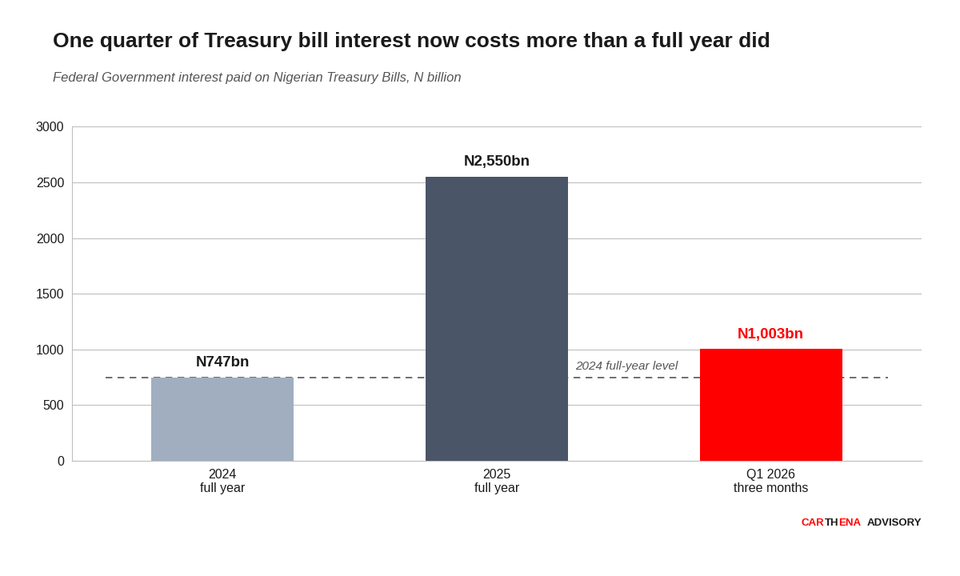
The yields that attracted that capital are paid by the Nigerian taxpayer, and the bill has moved faster than almost anything else in the public accounts.
The Debt Management Office's latest portfolio report puts the stock behind that cost at N166.79 trillion as at 30 June 2026, up N7.44 trillion in three months and N14.39 trillion over the year, against N87.38 trillion three years earlier. Domestic debt accounts for N91.59 trillion of the total and grew 13.7 per cent over twelve months against 4.7 per cent for external debt, so the borrowing driving the increase is overwhelmingly domestic and overwhelmingly naira. Within the federal domestic portfolio, Nigerian Treasury Bills stood at N19.48 trillion and securitised Ways and Means advances at N22.11 trillion.
The Federal Government spent N3.14 trillion servicing domestic debt in the first quarter of 2026. Interest accounted for N2.97 trillion of that, or 94.6 per cent, against N169.68 billion of principal. The quarterly figure was 20.3 per cent above the first quarter of 2025 and 217 per cent above the first quarter of 2024, when the entire domestic debt service bill came to N989.24 billion. Interest alone this year was about three times the whole bill two years ago. Within the quarter the monthly path ran N741.82 billion in January, N967.67 billion in February and N1.43 trillion in March.
Treasury bills are where it shows most sharply, because they are the instrument the carry trade actually buys. Interest on Nigerian Treasury Bills rose from N747 billion in 2024 to N2.55 trillion in 2025, an increase of 241 per cent. In the first quarter of 2026 alone, Treasury bill interest reached N1.003 trillion, more than the whole of 2024.
The International Monetary Fund puts the consequence in a single ratio. Interest payments will consume 53.7 per cent of federal government revenue in 2026, up from 53.2 per cent in 2025 and 40.8 per cent in 2024, easing only to 52.4 per cent in 2027. Christian Ebeke, the Fund's resident representative in Nigeria, put it in plain terms, observing that when more than half of tax collection goes on interest there is very little room left to pay for health, education, cash transfers and security.
The Fund is careful in its language and this analysis should be too. The same assessment holds that Nigerian debt remains sustainable, that the risk of sovereign stress is moderate, that a debt to GDP ratio in the mid-thirties compares favourably with peers, and that reserves should reach $58.1 billion this year and $62 billion in 2027. This is not an argument about solvency. It is an argument about what the money buys.
Set the two halves of the picture together and the shape becomes clear. Nigeria pays more than half its federal revenue in interest. That interest is what draws in $9.86 billion of portfolio money in a single quarter. That portfolio money is most of what carries reserves to $55.25 billion. The reserve figure is then read out at a press conference as the achievement.
Why the banks made the same calculation
Foreign investors were not the only ones who preferred government paper to productive lending.
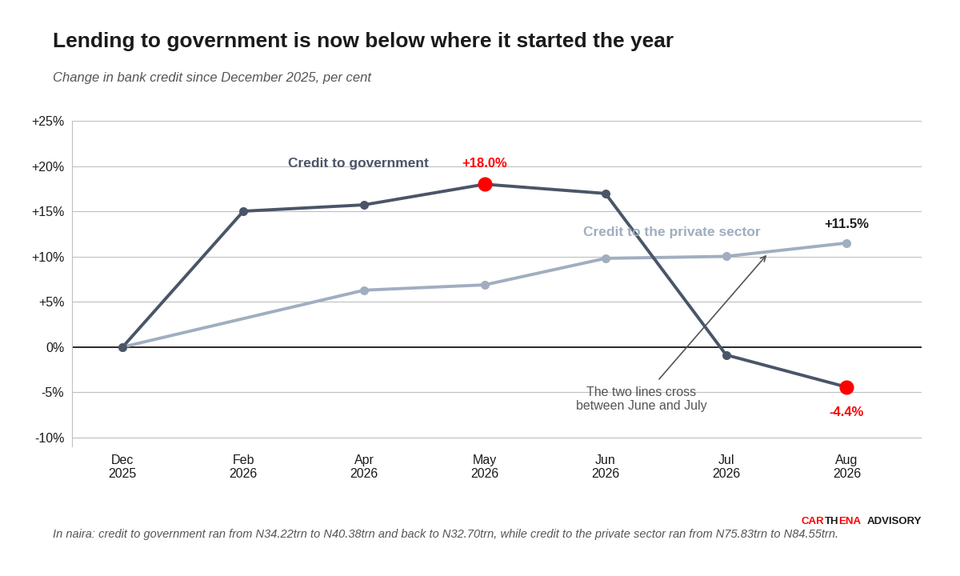
Credit to government rose from N22.95 trillion in August 2025 to a peak of N40.38 trillion in May 2026. The government's share of net domestic credit climbed from 23.46 per cent in April 2025 to 32.95 per cent in April 2026. The Fund's 2026 Article IV assessment puts Nigerian banks' holdings of government securities at about 22 per cent of total bank assets, and notes a relationship between higher bank holdings of sovereign debt and weaker growth in private credit.
A member of the Monetary Policy Committee said it without qualification in his own statement. Bandele Amoo wrote that the skewed investment of banks in favour of government securities is crowding out intermediation to the real sector.
The arithmetic left the banks very little to debate. An institution could hold a government instrument yielding around twenty per cent with no credit assessment, no monitoring and no recovery process, or it could lend to a manufacturer at a rate that has averaged 36.6 per cent and carry the risk on its own balance sheet - almost nobody chose the manufacturer.
Something has changed in the last quarter, and it has gone largely unremarked. Credit to government peaked in May and has fallen in each of the three months since, to N40.03 trillion in June, N33.92 trillion in July and N32.70 trillion in August. Credit to the private sector has risen in each of the last four months, from N80.59 trillion in April to N84.55 trillion in August. The unwinding began three months before the rate cut, which means it cannot be attributed to the rate cut and cannot yet be relied upon to continue.
What the rate cut does, and what it does not
Four things are true about the September decision at the same time, and most of the commentary has taken note of one and let go of the others.
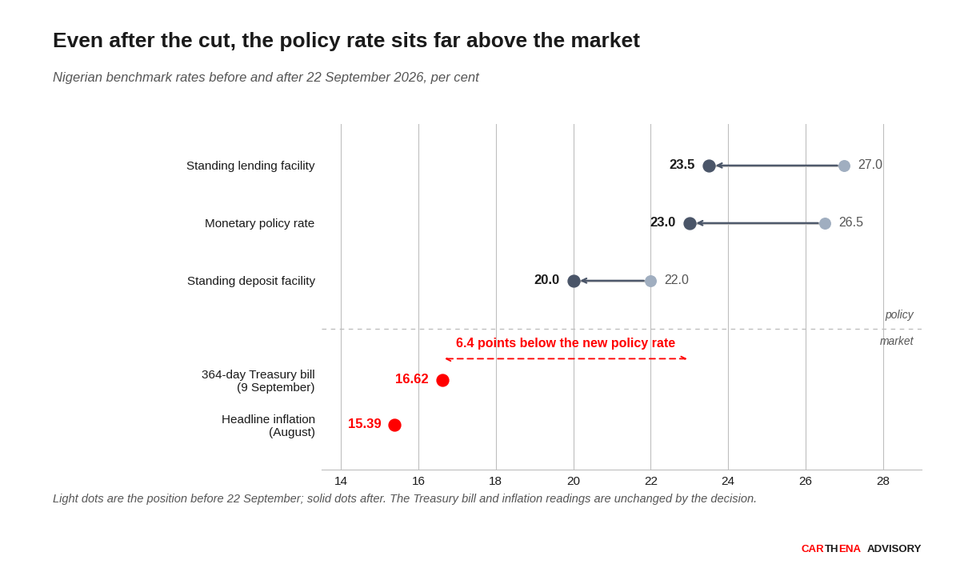
It was partly an admission rather than an easing. The stop rate on the 364-day Treasury bill had already fallen from 17.59 per cent in August to 16.62 per cent by 9 September, a third consecutive decline. A policy rate of 26.5 per cent was sitting roughly ten points above where the market was clearing. The Governor described the move as an operational realignment intended to strengthen transmission rather than a change of stance, which is a fair description of what happened. Note also that the corridor narrowed from minus 450 to minus 300 basis points, so the deposit facility fell only from 22 per cent to 20 per cent. The headline was 350 basis points. The floor moved 200.
The largest borrower is the largest beneficiary, slowly. Lower yields reduce the cost of rolling maturing paper and of issuing new paper, though the relief arrives only as debt turns over and much of the existing stock was issued in the tighter environment. Against a 2026 budget carrying expenditure of N68.32 trillion, revenue of N36.87 trillion, a deficit of N31.46 trillion and a borrowing plan raised to N29.20 trillion, even a gradual fall in the marginal cost of borrowing is worth a great deal to the Federal Government.
It narrows the carry, and that is the live risk. Headline inflation was 15.39 per cent in August against a 364-day bill at 16.62 per cent, which leaves a real return of roughly one point before currency risk and transaction costs are taken into account. The comparison a foreign investor actually makes is not Nigeria's policy rate against America's, but the attainable Nigerian yield, after currency expectations and costs, against a United States Treasury, paying close to five per cent with no naira risk attached. Nigeria's carry advantage over Ghana is already reported to be eroding. If the portfolio money rotates out, the reserves built on it will follow it out.
It does not restore credit, because the constraint was left in place. The Committee retained the Cash Reserve Requirement at 45 per cent for deposit money banks, 16 per cent for merchant banks and 75 per cent on non-Treasury Single Account public sector deposits. Nearly half of every naira deposited in a Nigerian bank cannot be lent out. Reducing the price of money while sterilising almost half of it is a signal without a mechanism.
The three things that did not change
Issue 6 argued that productive foreign capital arrives when three conditions are in place: a pipeline of projects structured with contractual revenue, an operating environment that will support a twenty to twenty-five year horizon, and the apparatus in government and the private sector to originate, structure and close transactions at speed.
A rate cut touches none of the three. It does not create an offtake agreement, enforce a contract, guarantee repatriation at scale or turn a power station into a financeable instrument. Those are institutional tasks and they move at institutional speed, which is precisely why $135 million of new direct investment arrived in a quarter that brought in $9.86 billion of portfolio money.
The test
Issue 6 set a test for the project pipeline. This issue sets one for the money, and the September decision has conveniently started the experiment running.
Over the next two quarters, watch whether portfolio inflows hold as yields fall. If they hold, the money was buying Nigeria and the reserve position is deserved. If they leave, the money was buying yield, the position was rented, and the country will discover what an eighteen-year high was actually made of.
Watch, second, whether credit to the private sector grows faster than credit to government in any quarter before the middle of 2027. The unwinding that began in June is the first real evidence in three years that bank balance sheets can turn back towards the productive economy. If the Cash Reserve Requirement stays at 45 per cent, that move will stall, and the rate cut will have changed the price of money without changing where it goes.
Nigeria has bought itself time and has paid a great deal for it. The question the next twelve months will answer is whether that time is used to build something that earns dollars, or simply to refinance the cost of having borrowed them.
Sources
- Central Bank of Nigeria, Monetary Policy Committee, 307th meeting, 21 and 22 September 2026, for the 350 basis point reduction to 23 per cent, the standing facilities corridor at plus 50 and minus 300 basis points, and the Cash Reserve Requirement retained at 45 per cent for deposit money banks
- Governor Olayemi Cardoso, post-MPC briefing, 22 September 2026, for gross external reserves of $55.25 billion as of 18 September and 11.3 months of import cover
- National Bureau of Statistics, Nigerian Capital Importation Report, Q1 2026, for total capital importation of $10.37 billion, portfolio investment of $9.86 billion, direct investment of $135.08 million, money market instruments of $6.50 billion, bonds of $3.23 billion, equities of $131.81 million and the banking sector share of 72.79 per cent, together with the Bureau's note that the series excludes reinvested earnings
- Central Bank of Nigeria, Balance of Payments statistics, Q2 2026, for direct investment of $1.15 billion and portfolio investment of $7.09 billion
- Debt Management Office, Public Debt Portfolio Report, Q2 2026, for total public debt of N166.79 trillion at 30 June 2026, domestic debt of N91.59 trillion, external debt of N75.20 trillion, Nigerian Treasury Bills of N19.48 trillion and securitised Ways and Means advances of N22.11 trillion
- Debt Management Office, Domestic Debt Service Report, Q1 2026, for domestic debt service of N3.14 trillion, interest of N2.97 trillion, Treasury bill interest of N1.003 trillion and the monthly path from January to March
- Debt Management Office, for Treasury bill interest of N747 billion in 2024 and N2.55 trillion in 2025
- International Monetary Fund, 2026 Article IV assessment of Nigeria, for interest payments at 53.7 per cent of federal revenue in 2026, bank holdings of government securities at about 22 per cent of total assets, projected reserves of $58.1 billion in 2026, and the remarks of Christian Ebeke
- Central Bank of Nigeria, Money and Credit Statistics, August 2025 to August 2026, for credit to government and credit to the private sector
- Bandele Amoo, personal statement, Monetary Policy Committee, 2026, for the observation on crowding out
- National Bureau of Statistics, Consumer Price Index, August 2026, for headline inflation of 15.39 per cent
- Federal Ministry of Finance, 2026 Appropriation, for expenditure of N68.32 trillion, revenue of N36.87 trillion, a deficit of N31.46 trillion and a borrowing plan of N29.20 trillion
If you would like to discuss what this means for your capital raising, treasury position or investment case in Nigeria, please get in touch at info@carthenaadvisory.com.