
Nigeria keeps writing national agendas and abandoning them. The fix is not another plan but an economic identity, three choices, and the discipline to hold them.
By Wole Ogundare, Founder and Managing Partner, Carthena Advisory
Every Nigerian administration arrives with a fresh multi-point agenda and leaves it for the next one to abandon. The country is not short of plans. It is short of the one thing that makes plans work: a durable national identity, a small set of hard choices that follow from it, and a system that selects for excellence in delivering them. Productivity, income and debt all trace back to that single gap.
The pattern: a new agenda every few years, none of it strategy
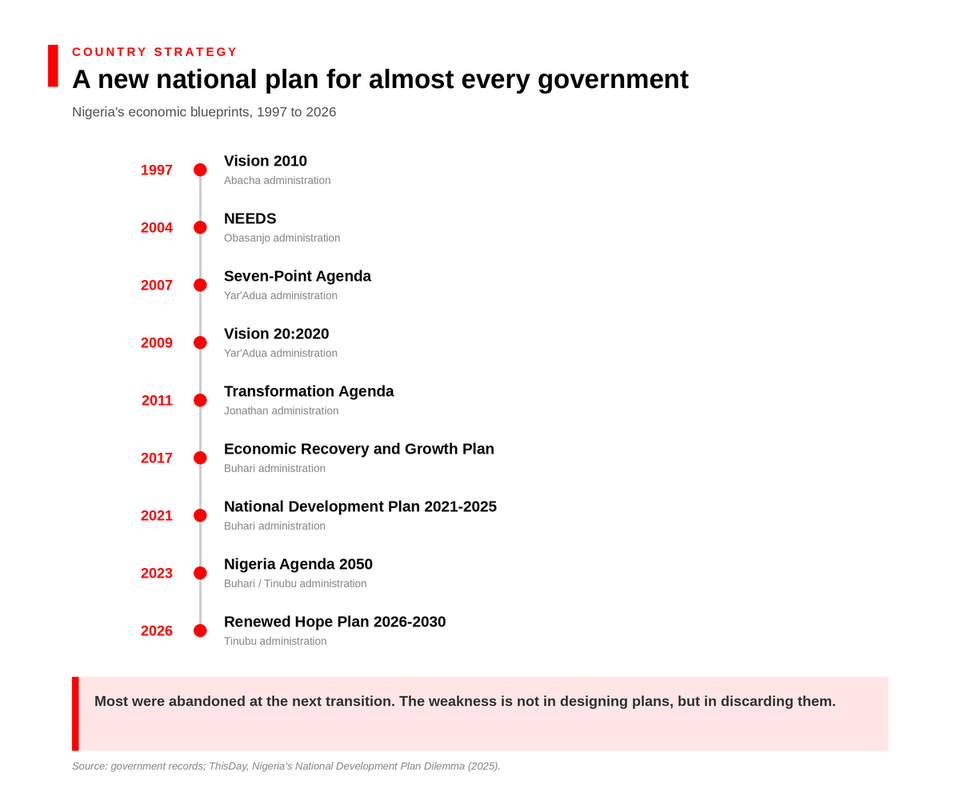
Nigeria has produced a national blueprint for almost every administration of the past three decades. Vision 2010 under Abacha. The National Economic Empowerment and Development Strategy under Obasanjo. The Seven-Point Agenda under Yar'Adua. The Transformation Agenda under Jonathan. Vision 20:2020, launched in 2009 to place Nigeria among the world's 20 largest economies by 2020, targeting a $900 billion economy and per capita income above $4,000. The Economic Recovery and Growth Plan, 2017 to 2020, under Buhari. The National Development Plan, 2021 to 2025, with its nine priority areas. Nigeria Agenda 2050, the thirty-year perspective plan launched in 2023, promising per capita GDP of $33,328 by 2050 and the lifting of all but 2.1 million citizens out of poverty. The Renewed Hope Agenda under Tinubu, which folded the previous plan's nine priorities into eight. And now the Renewed Hope Plan, 2026 to 2030, sold as a practical road to a one-trillion-dollar economy by 2030.
Read the list again and the problem announces itself. These are not strategies. They are inventories of everything a government would like to be true, ranked and renumbered each time power changes hands. A strategy is a small set of choices about where to compete and how to win, made in the knowledge that choosing one path forecloses others. A seven, eight or nine-point agenda makes no choice at all. It promises power and roads and jobs and security and diversification and human capital and digital growth, each as a separate workstream, none ranked above the rest, none traded off against another. When everything is a priority, nothing is.
The deeper failure is not in the drafting but in the discarding. A Nigerian commentator put it precisely in 2025: the country's weakness lies not in designing plans but in abandoning them. Vision 2010 collapsed with the change of government. Vision 20:2020 was sidelined before its targets matured. Nigeria Agenda 2050, barely two years after its launch, has in practice given way to a new administration's slogan, with the public resources spent designing it now largely sunk. The National Development Plan, 2021 to 2025, was written with the explicit aim of putting in place legislation for continuous implementation beyond the tenure of any one government. That aim did not survive the transition either.
The electoral cycle turns this from a weakness into a mechanism. A four-year term, with the final year consumed by re-election, leaves roughly three years to design a plan, staff it, and show results before attention drifts to the next contest. No serious economic transformation completes inside that window. So each administration starts again, rebranding the same ambitions, and the country runs in place. Identity, by contrast, is supposed to outlast the people who hold office at any moment. Nigeria has inverted this. Its slogans change every cycle while its underlying economic identity has never been settled at all.
The execution layer: selection without an excellence filter
A flawed strategy delivered by an excellent system can still produce results. A sound strategy delivered by a system that does not select for capability cannot. Nigeria has built the second case into its constitution.
The federal character principle, set out in Sections 14(3) and 14(4) of the 1999 Constitution and first formalised in the 1979 Constitution, requires that the composition of government and its agencies show no predominance of persons from a few states or ethnic groups. The intent is sound and necessary. In a federation of more than 250 ethnic groups, a state that visibly belonged to one bloc would not hold. Representation is a legitimate goal of nation-building, and on its own terms the principle has helped keep a fragile federation intact.
The failure is in the application, and it is not a partisan claim. In March 2025, Nigeria's own Senate opened an investigation into what it called the systemic abuse of the principle, concluding that the quota system had, in many cases, created confusion between merit-based recruitment and equitable representation, to the detriment of discipline, morale and institutional efficiency. The point is not that any region lacks talent. Every state in the federation can supply excellence. The point, as one Nigerian editorial framed it, is that those who select and recruit too often do so for motives that have little to do with the transparent and excellent discharge of duty.
This is where the two failures compound. A multi-point wishlist with no central choice gives the public service no clear standard of what success looks like. A selection system that elevates representation without an equal and explicit demand for capability then staffs the execution of that wishlist. The result is predictable: the apparatus of the state is rarely populated by the most capable available Nigerians, and it is rarely pointed at a small enough set of goals to succeed at any of them. Poor execution, weak institutions and the corruption that fills the vacuum where accountability should sit are not separate diseases. They are symptoms of the same structural choice.
Representation and excellence are not opposites. A system can require both: every appointment reflecting the federation, and every appointment meeting a published standard of merit. Nigeria has built the first requirement into law and left the second to chance.
The cost, counted
The consequences are measurable, and the most important measure is productivity, because productivity is what ultimately turns into income.
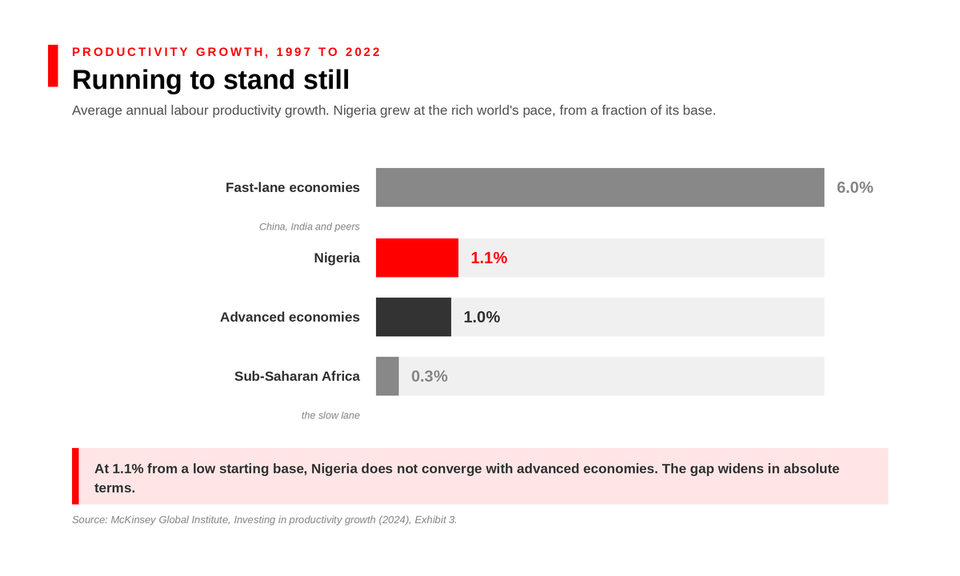
The McKinsey Global Institute's 2024 study of global productivity makes the Nigerian position unusually plain. Read from its convergence chart, Nigeria's labour productivity grew at roughly 1.1 per cent a year between 1997 and 2022, barely above the 1 per cent pace of economies that were already rich, and from a small fraction of their starting level. Growing at the rich world's rate from a poor starting point is the definition of failing to converge: the gap does not close, it widens in absolute terms. The wider region tells the same story, with Sub-Saharan Africa placed in what the institute calls the "slow lane" at an average of 0.3 per cent productivity growth, a pace at which it would never catch up. The institute also noted that foreign direct investment into Africa had fallen fastest in its two largest economies, Nigeria and South Africa. The human-capital starting point is just as stark: the World Bank's Human Capital Index finds that a child born in Nigeria today will grow up to be only 36 per cent as productive as she could be with full health and education, below the regional average.
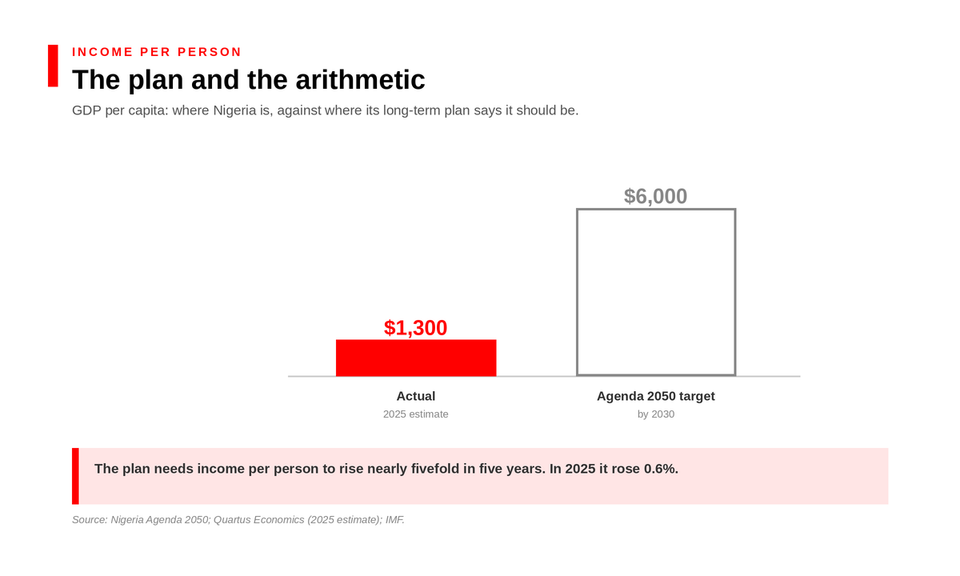
Low productivity becomes low income with almost arithmetic reliability. Despite a 2025 rebasing that lifted nominal GDP by 34 per cent and full-year real growth of 3.87 per cent reported by the National Bureau of Statistics, Nigeria's GDP per capita stood at an estimated $1,300 in 2025, on figures from Quartus Economics. Set that against Agenda 2050's own milestone of $6,000 per capita by 2030, and the distance between the plan and the arithmetic is total. The International Monetary Fund expects real output per person to rise by 0.6 per cent in 2025 and 0.3 per cent in 2026: growth on paper, stagnation in the household. Inflation has eased to 15.69 per cent as of April 2026 on the National Bureau of Statistics' rebased index, down from above 30 per cent in 2024, though part of that fall reflects the rebasing of the price index itself rather than relief at the market.
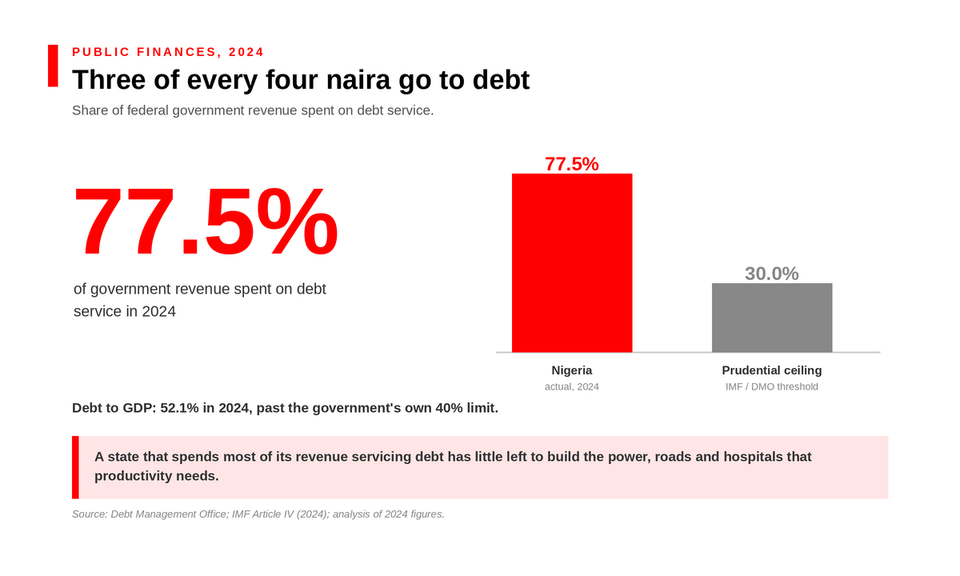
Low income for citizens means low revenue for the state, and that is where the debt trap closes. Nigeria's total public debt reached ₦153.3 trillion, about $104 billion, by the third quarter of 2025, per the Debt Management Office. The debt-to-GDP ratio climbed to 52.1 per cent in 2024 from 41.5 per cent a year earlier, breaching the government's own 40 per cent ceiling. More revealing still is the debt service to revenue ratio, which reached roughly 77.5 per cent in 2024 against a prudential threshold of about 30 per cent. A government spending more than three of every four revenue naira on interest and principal has little left to build a road, equip a hospital or stand up the power and transport infrastructure that productivity growth requires. The McKinsey evidence is that fast-lane economies sustain investment at 20 to 40 per cent of GDP. Nigeria, consuming its revenue on debt service, cannot come close.
The human result is a country growing poorer while its economy grows larger. The World Bank projects that 52.5 per cent of Nigerians lived in poverty in 2025, with extreme poverty rising from 34.7 per cent in 2018/19 to 41.8 per cent in 2022/23. Its most arresting finding is that across those years every household became poorer, with the wealthiest losing proportionally more. The National Bureau of Statistics counts 133 million Nigerians, 63 per cent of the population, as multidimensionally poor. By the World Bank's April 2025 reckoning, Nigeria alone is home to around 19 per cent of Sub-Saharan Africa's extreme poor. Insecurity, crime and the steady exit of skilled citizens are not a separate crisis layered on top of the economy. They are what deepening poverty produces.
This is the chain, and each link is sourced above: weak productivity, weak income, weak revenue, a debt service burden that crowds out investment, an infrastructure deficit that suppresses productivity further, and a population sliding backward while the official growth rate reads positive. A wishlist cannot break this chain, because a wishlist never decides which link to attack first.
How durable strategy is actually built
The contrast with how serious organisations set direction is instructive, because the discipline that Nigeria lacks is the one that ordinary companies are forced to learn or die.
A well-run business does not publish an eight-point plan. It starts from a core belief about why it exists and what it is for, and it makes that belief the test for every subsequent decision. Carthena Advisory has argued this case directly in its work on the power of "why": organisations that genuinely build from a clear purpose outward do not merely communicate more compellingly, they make better strategic decisions at every level, because the purpose tells them what to do and, just as importantly, what to refuse. From that belief flow a small number of choices, usually three to five, about where the business will compete and how it will win there. Those choices are then resourced, owned by named individuals, and governed by a regular rhythm of review that kills what is not working and backs what is. Capability is recruited and promoted against the standard those choices demand, not against any other criterion.
Strip the corporate language away and the architecture is simple. A belief that endures. A few choices that follow from it. A system staffed for excellence to execute them. A governing rhythm that holds the choices steady between decisions. It is precisely this architecture that Nigeria has never assembled at the national level. The country has tried to skip the belief and the choices and move straight to a list of desired outcomes, then hand that list to a system selected on a basis other than capability, with no rhythm to carry it past the next election.
A strategy doctrine for Nigeria
The prescription follows from the diagnosis, and it is available to federal and state governments alike. A state governor, in particular, need not wait for Abuja: the same discipline can be applied to a single state economy within one tenure, and the states that do it first will pull away from those that do not.
First, settle the identity before the plan. The opening question is not "what are our priorities", but "what is this economy for, and what does it intend to be known for winning at". An identity is a position a country chooses and defends over decades, not a slogan that changes with the government. It is the test against which every policy is later judged. Without it, each plan is a list with no organising logic, which is exactly what Nigeria keeps producing.
Second, make three choices, not eight promises. From the identity flow a small number of where-to-play and how-to-win decisions for the economy: the few sectors, regions and capabilities the country will concentrate behind, and, by direct implication, the many things it will decline to chase. The McKinsey evidence on which economies escaped the slow lane is unambiguous about what these choices tend to involve: sustained high investment, the right kind of urbanisation, rising productivity within services, more sophisticated and globally connected manufacturing, and the institutions to support all four. The discipline is not in naming these as aspirations. It is in choosing among them and accepting the trade-offs.
Third, fuse representation with excellence. Federal character should remain, because national unity is a real constraint and a legitimate goal. It should be paired with an equal and published standard of merit, so that every appointment both reflects the federation and meets a defined bar of capability. Representation and excellence are not in conflict; treating them as if only one can be satisfied is the choice that has hollowed out delivery.
Fourth, install a governing rhythm that outlasts the cycle. The reason plans die at every transition is that nothing holds them in place between administrations. A national strategy needs a delivery cadence, anchored in law and in an institution insulated from the electoral calendar, that reviews progress on the few choices, reallocates resources, and reports publicly. The National Development Plan, 2021 to 2025, named this need explicitly and then failed to meet it. The fix is structural, not rhetorical.
Only once these four are in place does the annual argument over fiscal, monetary and budget policy become productive. Today those debates float free, each year's budget a fresh negotiation with no fixed point to serve. Anchored to a settled identity and three durable choices, the same debates acquire a test: does this tax measure, this rate decision, this spending line advance the chosen position, or not. Policy stops being a ritual and starts being an instrument.
The implication for decision-makers
Out of everything a Nigerian government could do to change its trajectory, crafting a national economic identity is the cheapest and the highest in leverage. It requires no new borrowing, which matters for a state already spending most of its revenue on debt. It requires the one thing that has been missing: the willingness to choose, and to keep choosing the same thing after the people who made the choice have left office.
The single test that would prove this argument wrong is continuity. If a Nigerian administration were to adopt a small set of economic choices and a successor government of a different party were to sustain them unchanged, and productivity and income still failed to move over a decade, then the problem would lie somewhere other than strategy. That experiment has never been run. Until it is, the evidence points one way. Nigeria has never suffered from a shortage of plans. It has suffered from the absence of a strategy, and from a system built to deliver representation rather than results. The country does not need another agenda. It needs an identity, three choices, and the discipline to hold them.
Sources
- McKinsey Global Institute, Investing in productivity growth, 27 March 2024, Exhibit 3 (productivity growth per employee, CAGR 1997 to 2022) - Nigeria's productivity growth of approximately 1.1 per cent a year, read from the chart, against advanced-economy growth of 1 per cent; Sub-Saharan Africa in the slow lane at 0.3 per cent; fast-lane investment of 20 to 40 per cent of GDP; FDI decline in Nigeria and South Africa.
- World Bank, Human Capital Index, Nigeria country brief - a Nigerian child reaching 36 per cent of potential productivity.
- National Bureau of Statistics - full-year 2025 real GDP growth of 3.87 per cent; 2019 GDP rebasing; headline inflation of 15.69 per cent (April 2026) on the rebased index; 2022 Multidimensional Poverty Index of 133 million people (63 per cent).
- Quartus Economics (reported May 2026) - GDP per capita estimated at $1,300 in 2025.
- International Monetary Fund, World Economic Outlook (April 2025) - real per capita output growth of 0.6 per cent (2025) and 0.3 per cent (2026).
- Debt Management Office - total public debt of ₦153.3 trillion (about $104 billion) at Q3 2025; debt service of ₦10.81 trillion for the first nine months of 2025.
- Debt-to-GDP of 52.1 per cent (2024) and debt service to revenue of approximately 77.5 per cent (2024), against a 40 per cent debt ceiling and a roughly 30 per cent service threshold (DMO and IMF Article IV).
- World Bank, Poverty and Equity Brief and Africa's Pulse (April 2025) - poverty rate of 52.5 per cent projected for 2025; extreme poverty rising to 41.8 per cent (2022/23); the finding that every household became poorer between 2018/19 and 2022/23; Nigeria home to around 19 per cent of the region's extreme poor.
- Constitution of the Federal Republic of Nigeria, 1999, Sections 14(3) and 14(4); Senate Committee on Federal Character investigation, March 2025.
- ThisDay, Nigeria's National Development Plan Dilemma, 30 August 2025 - the lineage and abandonment of national plans.
- The State House and the National Economic Council - Renewed Hope Plan, 2026 to 2030, and the one-trillion-dollar economy target; Nigeria Agenda 2050 per capita targets.
- Carthena Advisory, Understand the Power of WHY: Unlock the Path to Business Success, 1 August 2023. https://carthenaadvisory.com/insights/understand-the-power-of-why-path-to-business-success/