
Tosin Eniolorunda was half right about Nigeria’s talent gap. The other half is a 60-year education decline and a hiring process that misses what matters.
On May 1, 2026, at The Platform Nigeria in Lagos, Tosin Eniolorunda told a room full of professionals what most CEOs say only privately. Moniepoint has roughly 500 open roles. The company made a deliberate decision to hire only Nigerians. It cannot find enough of them at the standard it needs.
His exact words, all three of which travelled far past the auditorium:
“I have world-class people working on the organization, and here I am, looking for Nigerians that can not meet requirements to build world-class products.”
“I used to think Nigerians are really bright, but I am beginning to feel we need to do something for the general IQ of this country, not to go lower.”
“This is a role model problem - the person they see around them is that local boy who has collected $30,000, and they want to be like him.”
The pushback was immediate and uncharitable. A young woman on TikTok argued Moniepoint should pay international salaries if it wants international talent. On X, @officicialsamkayz said two engineers Moniepoint had rejected were now working at Amazon and in Silicon Valley - “this isn’t a talent problem. It’s a hiring process problem.” Segun Olugbile of Data Analytics Privacy Technology, writing in BusinessDay, pointed out that Eniolorunda himself was a mechanical engineer until Interswitch invested in his development. A widely-shared Punch op-ed put it more sharply: “Many employers want finished products. They do not want raw material. That is not a strategy. That is extraction.”
Both sides are partially right. That is the problem.
The honest reading is that two things are simultaneously true. Nigeria has a real talent supply problem that has been building for sixty years. And the way most Nigerian companies screen for talent makes the supply problem look worse than it is. Conflating the two produces the worst possible outcome: founders who blame the country, candidates who feel insulted, and a hiring system that keeps missing the people it could actually develop.
This is my reading of what happened, what the data says, and what a serious response looks like.
What Eniolorunda got right
Educational standards in Nigeria have fallen. Not in the past three years - across decades. The most visible scoreboard is the West African Senior School Certificate Examination, the gateway exam every Nigerian secondary school graduate sits.
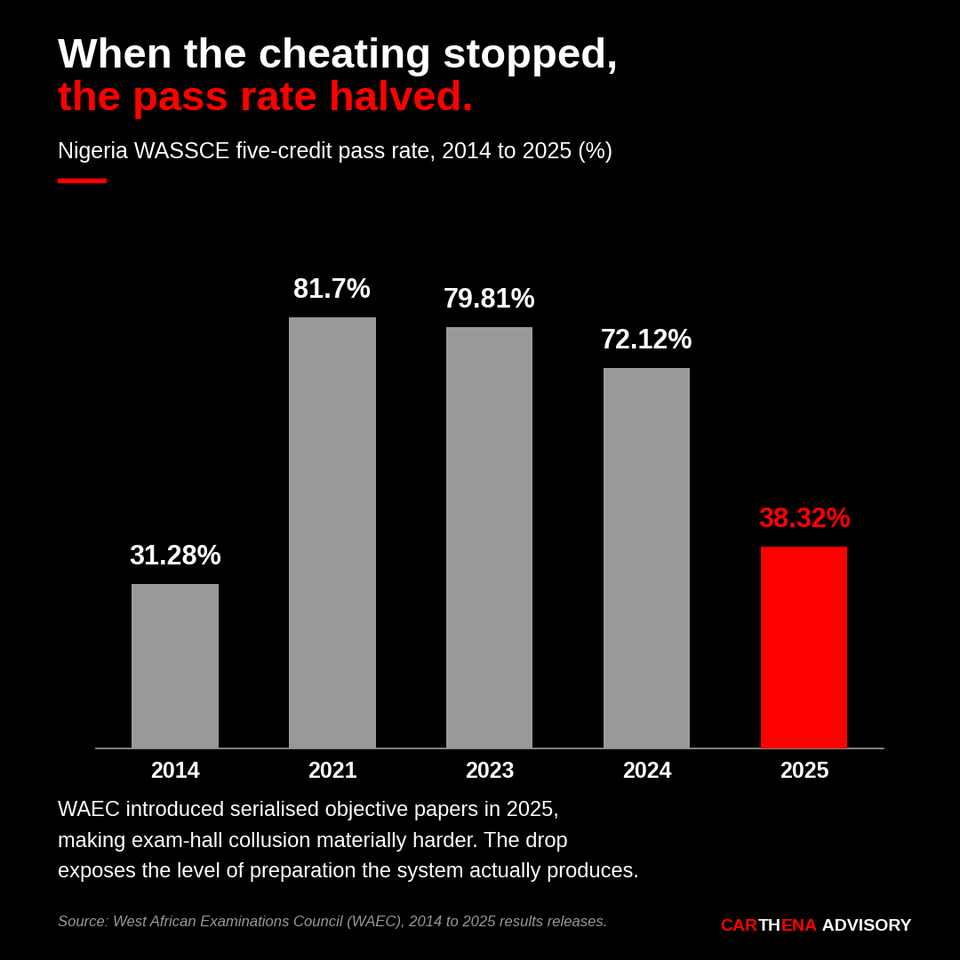
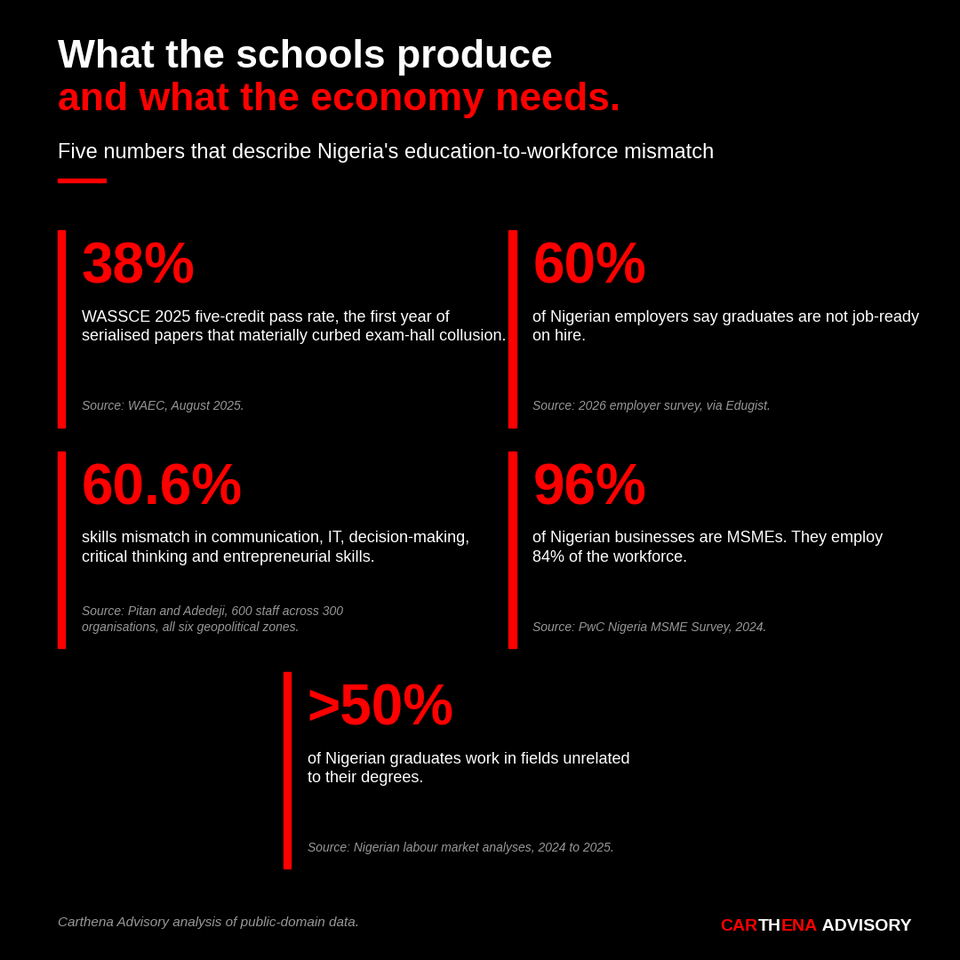
The 2025 results, released in August, recorded a pass rate of 38.32 percent - the share of candidates obtaining five credits including English and Mathematics. The 2024 rate was 72.12 percent. The 2023 rate was 79.81 percent. The 2021 peak was 81.7 percent. The crash in 2025 happened the moment WAEC introduced serialised objective papers to defeat copying. WAEC’s own Head of Nigeria Office, Amos Dangut, said the new format “drastically reduced the incidence of collusion and made examination malpractice more difficult.” Translation: the pass rates of the previous five years were inflated by systemic cheating. The 38 percent figure is closer to the real level of preparation Nigerian secondary schools are now producing.
Look further back and the pattern is older than the controversy. The 2014 pass rate was 31.28 percent. There is no clean upward trend hidden in the volatility. There is a long, uneven decline in foundational learning, masked for a decade by exam-hall coordination that finally got harder to pull off.
The underlying structural numbers are worse than the exam results suggest. The World Bank’s 2024 learning assessment found that 72.6 percent of Nigerian children aged 7 to 14 cannot read and understand a simple text. UNICEF’s 2024 Situation Analysis puts 10.2 million primary-school-age children and 8.1 million lower-secondary-age children out of school - the largest such population anywhere in the world. Between 1960 and 2023, Nigerian governments allocated an average of 5.94 percent of public spending to education. The UNESCO recommendation is 15 to 20 percent. The 2025 federal allocation was 7.08 percent.
So when Eniolorunda says the country needs to do something to prevent the general level from going lower, he is reading the data correctly. The schools are not preparing candidates the way they used to. A Nigerian degree in 2026 carries less guaranteed competence than a Nigerian degree in 1996, which itself carried less than one in 1976.
That is the part of his statement that should not be argued with.
What he missed
The schools are only the upstream half of the problem. The downstream half is the bridge between the classroom and the workplace, and that bridge in Nigeria has structural defects that no amount of teacher recruitment will solve on its own.
A 2026 employer survey cited by Nigerian recruiters found that nearly 60 percent of employers consider Nigerian graduates not job-ready. The earlier Pitan and Adedeji study of 600 management staff across 300 organisations spanning all six geopolitical zones identified a 60.6 percent skills mismatch in communication, IT, decision-making, critical thinking, and entrepreneurial skills. More than half of Nigerian graduates work in fields unrelated to their degrees.
The instinct is to read these numbers as a second indictment of the schools. They are not. They are an indictment of something the public discourse keeps missing: Nigeria’s education system is calibrated for a workforce that mostly does not exist.
Consider the shape of the actual economy. PwC’s 2024 MSME Survey found that Micro, Small and Medium Enterprises account for 96 percent of all businesses in Nigeria and employ 84 percent of the workforce. The National Bureau of Statistics reports that 92.7 percent of Nigerian labour is engaged in the informal sector. Self-employment accounts for 85 percent of employed persons. The Moniepoint of Eniolorunda’s statement, with its 3,500 employees and structured graduate programme, is a statistical outlier. The Nigerian economy a graduate walks into is overwhelmingly a sole proprietorship with four staff, no induction budget, and no capacity to bridge the gap between a theoretical degree and an operational role.
The curriculum was designed for a workforce of structured corporates that never materialised at scale. The graduate was trained to join a company that does not exist in the numbers required. So both fail on contact. The graduate is “half-baked” not only because the oven was cold, but because there was never going to be a kitchen ready to finish the job.
Germany solves this through its Dual Education Model, where vocational training runs in formal partnership between firms, schools, and the state. Switzerland does similar through its Vocational Education and Training system. In both, the employer is part of the educational design. In Nigeria, employers complain about the output of an education system they do not co-design, do not co-fund, and largely do not employ at the volumes that would create the absorbing capacity for graduates to be trained on the job.
Eniolorunda’s frustration is real. His diagnosis is incomplete. The blame is not entirely on the schools, and it is not entirely on the youth. It sits in the structural disconnect between what Nigerian universities produce and what an SME-dominated economy can actually absorb and develop.
The hiring decision that follows from this
If the supply pipeline is genuinely weaker than it was, and the bridge to the workforce is structurally broken, then the hiring decision facing Nigerian firms is not “do we have talent” but “are we screening for the things that actually predict performance once trained?”
The honest answer for most Nigerian recruiters is no.
The dominant pattern is still CV plus credential plus unstructured interview. Three filters, each with well-documented weaknesses. The CV filters for institutional pedigree that has weakened in the ways described above. The credential filters for an exam regime that just lost much of its credibility. The unstructured interview filters for whoever the recruiter happens to like in a thirty-minute conversation. None of these three filters captures what the research has been saying for thirty years about what actually predicts job performance.
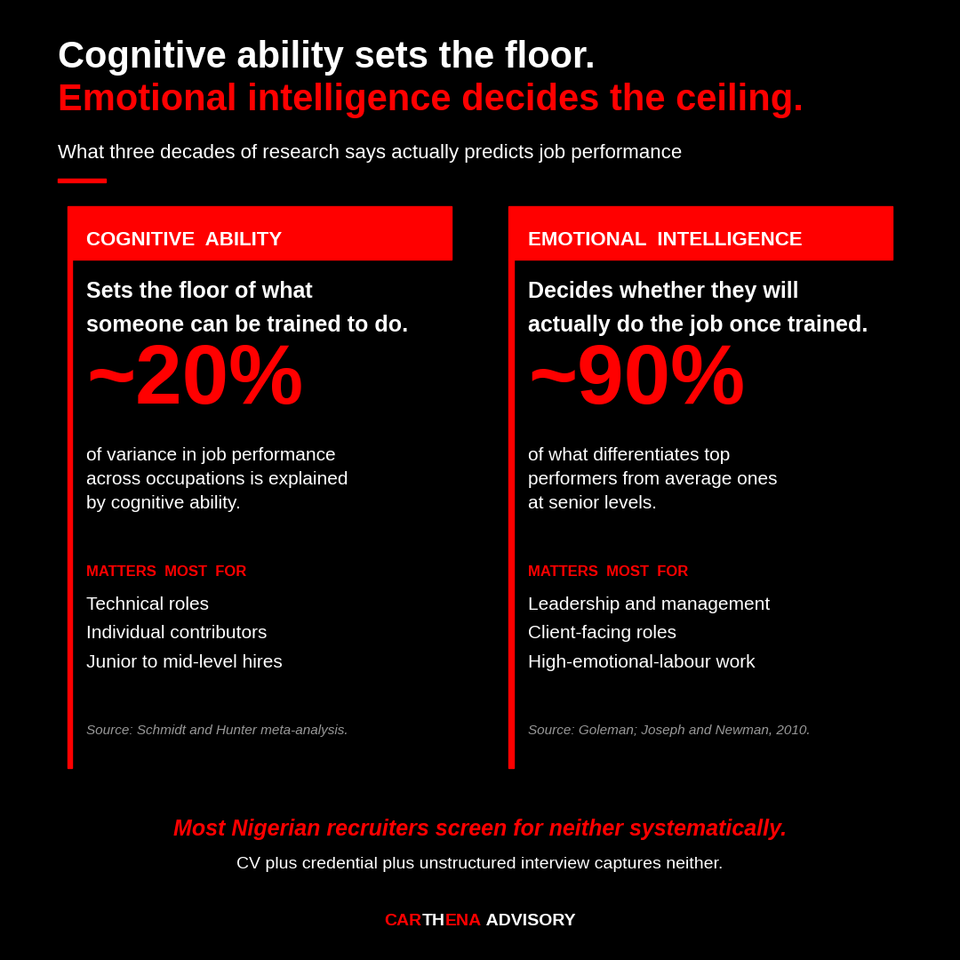
The research is clear and the relevant numbers are not controversial. Cognitive ability is a strong predictor of performance for technical and individual-contributor roles - Schmidt and Hunter’s foundational meta-analysis remains the reference point, with cognitive ability explaining roughly 20 percent of variance in job performance across occupations. Joseph and Newman’s 2010 meta-analysis showed that emotional intelligence becomes the stronger predictor in roles requiring emotional labour - leadership, service, healthcare, customer-facing work. Daniel Goleman’s leadership research puts EQ at roughly 90 percent of what differentiates top performers from average ones at senior levels. TalentSmart’s industry data shows high-EI individuals outperforming peers 90 percent of the time. A CareerBuilder survey found 71 percent of employers value EQ over IQ and 75 percent are more likely to promote a high-EQ candidate over a high-IQ one.
The implication is not “EQ over IQ.” It is that both matter, weighted by the role, and most Nigerian recruiters are screening for neither systematically.
Cognitive ability sets the floor of what someone can be trained to do. Behavioural and emotional intelligence determines whether they will actually do it - whether they will show up on time, handle a frustrated client, accept a piece of difficult feedback, work productively with a colleague they did not choose. These are the traits that decide whether a hire becomes a contributor or a problem, and they are precisely the traits Nigerian companies typically discover six months into the relationship rather than six minutes into the screening process.
What proper screening looks like
The two engineers Moniepoint allegedly rejected and Amazon hired are the diagnostic case. If true, it is hard to read that outcome as a talent problem. It is much easier to read it as a screening problem: a process that filtered out signal it could not detect, and would not have known how to use even if it had.
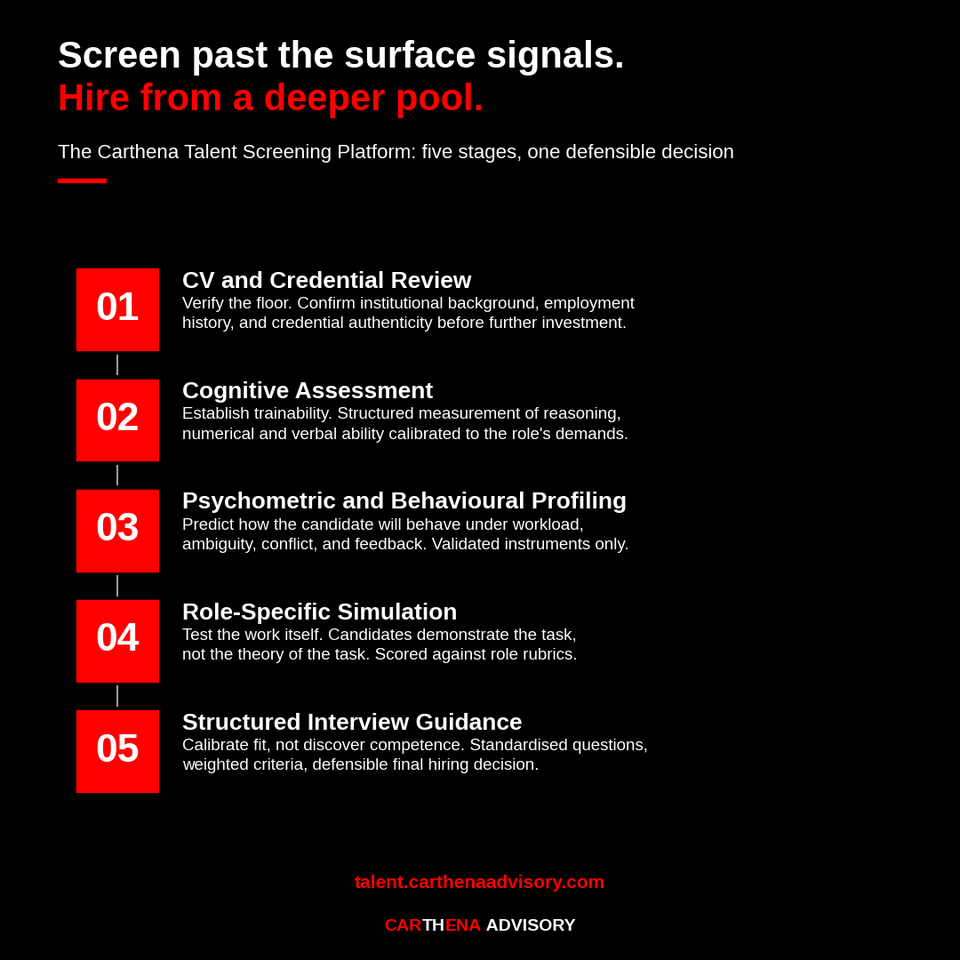
The way to fix this is not to hire more or hire less. It is to screen more intelligently. Run structured cognitive assessment alongside CV review to verify the floor. Run validated psychometric and behavioural screening to identify how a candidate will actually behave under workload, ambiguity, conflict, and feedback. Run role-specific simulation rather than unstructured interview to test the work itself. Reserve human conversation for the calibration of fit, not the discovery of competence.
This is what the Carthena Advisory Talent Screening Platform does. It runs a structured five-stage screening process - CV plus credential review, cognitive assessment, psychometric and behavioural profiling, role-specific simulation, and structured interview guidance - built for Nigerian recruiters who are seeing exactly the gap Eniolorunda described and who do not have the instrumentation to screen past surface signals. The platform produces a defensible hiring decision with explicit weighting between cognitive and behavioural factors, calibrated to the role rather than to the recruiter’s intuition.
The point of the platform is not to replace judgment. It is to give recruiters something better than CV plus credential plus instinct, in a market where all three of those have lost predictive power.
A final word
Eniolorunda’s statement was wrong in tone and incomplete in diagnosis, but it pointed at something real. Nigeria’s education system has weakened. The bridge from education to the workforce was poorly designed for the economy that actually exists. Both problems are decades in the making and neither will be solved by a hiring policy decision.
But the hire still has to be made. Five hundred roles do not stay open while the country fixes its schools.
The honest path is to hire for the cognitive floor that the role requires, screen properly for the behavioural and emotional traits that determine whether someone will do the job once trained, and accept that some development burden returns to the employer. Interswitch took on that burden with Eniolorunda. Moniepoint can take it on with the next generation. The companies that build that capability now will hire from a deeper pool than the ones still complaining the pool is shallow.
That is the something we should actually do.
Wole Ogundare is Founder and Managing Partner of Carthena Advisory, a financial and management advisory firm based in Lagos and London. The Carthena Talent Screening Platform is available at talent.carthenaadvisory.com.