
Ghana defaulted in 2022 with 54% inflation and 93% debt. By 2026 it had single-digit inflation, a completed IMF programme and returning capital. It is doing the work.
By Wole Ogundare, Founder and Managing Partner, Carthena Advisory
The word people reach for when they describe an African economy in trouble is precipice. It is a useful word, because it captures the moment before a fall. It is also the wrong word for Ghana in 2026, and the reason it is wrong is worth an entire issue, because the mistake it encodes is the same one this newsletter has been circling since Issue 1.
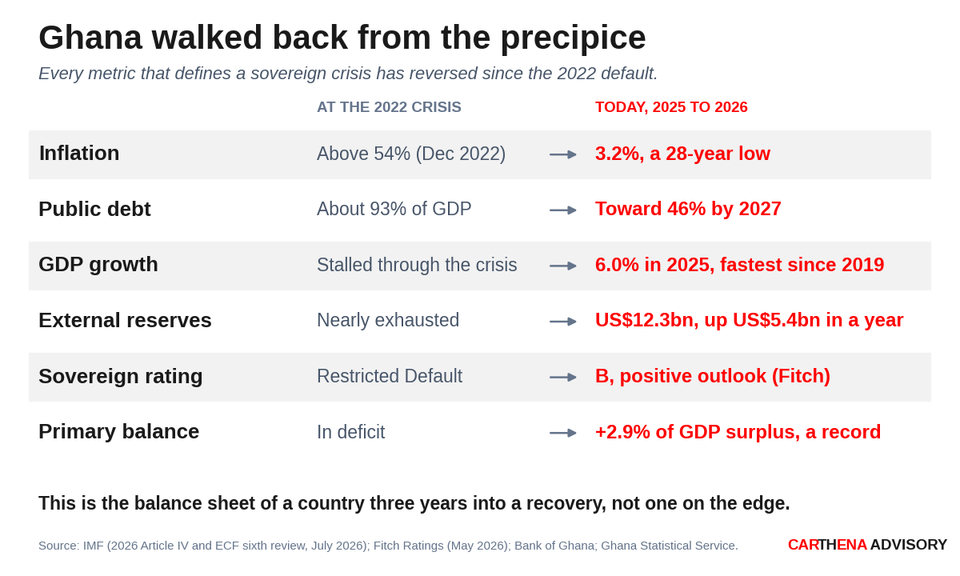
Ghana was genuinely on a precipice. In December 2022 it defaulted on most of its external debt. Inflation passed 54 per cent in the same month, public debt reached about 93 per cent of GDP, the currency was in freefall and the reserves were nearly gone. If the word ever applied to a West African economy in living memory, it applied to Ghana at the turn of 2023. What happened next is the part the precipice framing cannot accommodate, because Ghana did not fall. It turned around, and it did so by taking on the specific, unglamorous, politically expensive work that its larger neighbour keeps announcing and deferring.
The precipice was real, and Ghana walked back from it
By the middle of 2026 the numbers had inverted. Inflation, which peaked above 54 per cent, fell to 3.2 per cent in March 2026, the lowest reading in twenty-eight years, and has stayed in single digits through the year. Public debt, near 93 per cent at the crisis, is on a path to 46 per cent of GDP by 2027, having fallen twenty-one percentage points in 2025 alone. Growth reached 6.0 per cent in 2025, the fastest since 2019, and ran at 6.4 per cent in the first quarter of 2026, comfortably above the four per cent regional average. Reserves climbed to 12.3 billion dollars, up 5.4 billion in a single year, enough for close to six months of imports. The primary balance, in deficit at the crisis, closed 2025 in a surplus of 2.9 per cent of GDP, a record. In July 2026 the International Monetary Fund completed Ghana's programme in full and moved the country onto a non-financing instrument, which is the clearest signal a fund programme offers that a country no longer needs the money.
This is not the balance sheet of a country on the edge. It is the balance sheet of a country three years into a recovery from one.
The work was unglamorous, and it hurt
The recovery is worth studying precisely because it was not painless, and honesty about the cost is what separates analysis from cheerleading. Ghana's domestic debt exchange in 2023 fell on local bondholders, pension funds and ordinary savers, who took real losses so the sovereign could restore its solvency. The fiscal consolidation that followed meant austerity in a country where austerity carries an electoral price. None of it was the kind of work that produces a signing photograph or a summit headline. It was the slow, domestically unpopular business of fixing the fundamentals: bringing the primary balance back to surplus, rebuilding reserves, restoring a credible disinflation path, and re-establishing the rule that the central bank does not finance the deficit.
That is the point most commentary misses. The countries that attract durable capital are not the ones that convene the most investment summits. They are the ones that pay the price of stabilisation up front, in full, and in domestic political currency. Ghana paid it, and the reward arrived on schedule.
What the discipline bought
Independent institutions have now ratified the turnaround, which matters because their judgment is the one investors actually price. Fitch moved Ghana from Restricted Default to B with a positive outlook by May 2026, citing the fall in debt, the fiscal consolidation and the rebuilt reserves. S&P has it at B-. In April 2026 Ghana returned to its own domestic bond market with a seven-year issue, its first since the 2023 debt exchange, which is the market's way of saying the sovereign is investable again. The current account ran a surplus of 7.9 per cent of GDP in 2025. Lending rates have fallen from 27.4 per cent to 16.3 per cent in a year, and the ninety-one-day Treasury bill yields under five per cent. These are not the readings of an economy in distress. They are the readings of one that capital has decided to trust.
Ghana is not the cheaper place to produce, it is the safer place to invest
Here the analysis has to be careful, because there is a genuine counter-argument and it is worth stating at its strongest. On the narrow question of what it costs to produce a unit of output, Nigeria often beats Ghana. Nigeria's domestic market of 220 million dilutes fixed costs across a volume Ghana cannot match. Its abundant gas gives large manufacturers cheap captive power. Its devalued currency has made labour and local inputs cheap in dollar terms. A cement plant or a refinery in Nigeria can carry a lower factory-gate cost than the same plant in Ghana, and any honest comparison concedes it.
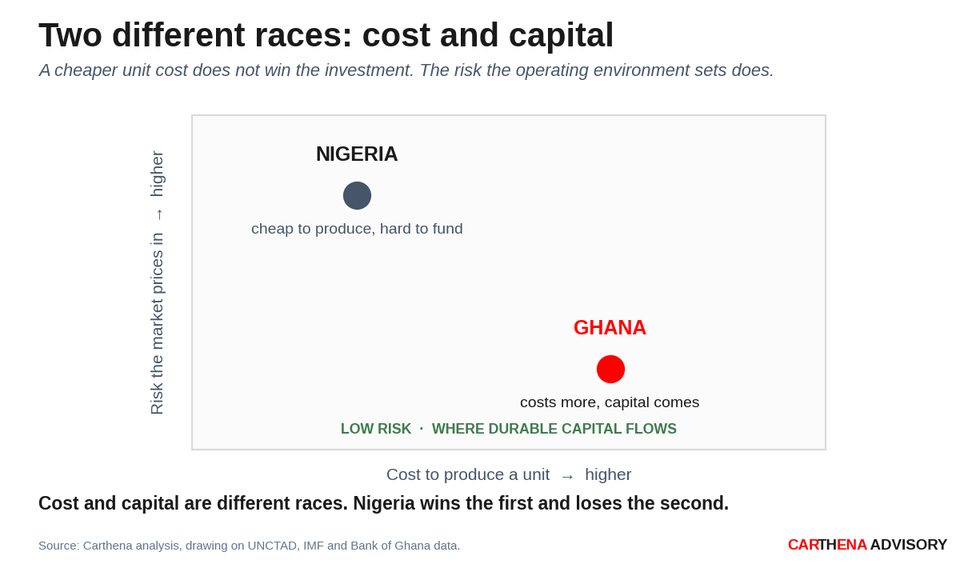
But cost competitiveness and capital competitiveness are different races, and the error is to assume the first wins the second. Foreign direct investment is a discounted cash flow decision, and in that decision the unit cost of production is only one input, discounted by everything the operating environment does to the risk of the cash flows. Can dividends declared in year three be repatriated in year four, and how long is the queue. What premium must be applied for a currency that can move thirty per cent in a year. What does it cost, in money and in weeks, to move a container off the dock and to the factory. On these questions Ghana now answers cleanly, and Nigeria does not. A lower cost of production sitting behind an unpredictable currency, a repatriation queue and a port that clears cargo in thirteen days rather than four is a cost advantage the investor never reaches.
The scale paradox: cheap to produce in, thin to operate in
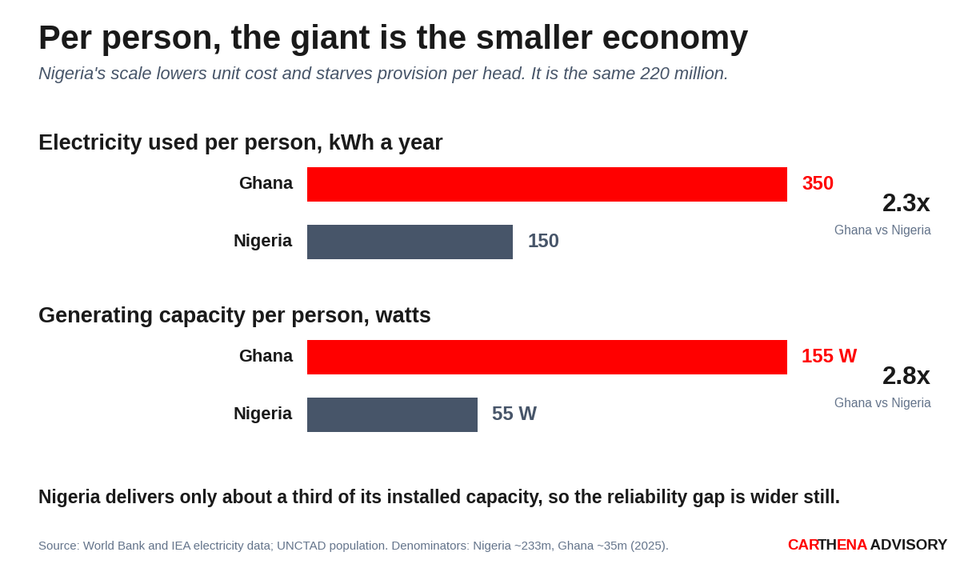
There is a version of the counter-argument that credits Nigeria's lower costs to superior infrastructure, and it gets the mechanism backwards. Where Nigeria is cheaper, the drivers are scale, gas and a weak currency, and none of the three is infrastructure. The deeper point is that scale plays on both sides of the ledger at once. The 220 million people who dilute fixed costs and lower the unit cost of production are the same 220 million who divide the country's power, ports and roads across nearly seven times more heads than Ghana. Scale lowers the cost of making a unit and starves the provision each person and each business actually receives.
The gap in provision per head is stark - a Nigerian consumes about 150 kilowatt hours of electricity a year; a Ghanaian consumes more than twice that. On installed generating capacity per person the gap is close to threefold, and because Nigeria delivers only about a third of what it has installed, the difference in reliable power reaching a factory is wider still.
The same logic runs through logistics. Moving a container from the port to a Lagos warehouse can cost several times the equivalent journey from Tema, Nigerian ports clear cargo in about thirteen days against a four-day global norm, and roughly sixty per cent of Nigeria's own imports are cleared through the ports of Ghana, Togo and Benin. A country whose infrastructure served its firms would not be exporting its own cargo clearance to the countries next door. This is what an investor actually consumes: not national output, but the power, the port and the road available per head, and on that measure the giant is the smaller economy.
The capital has already voted
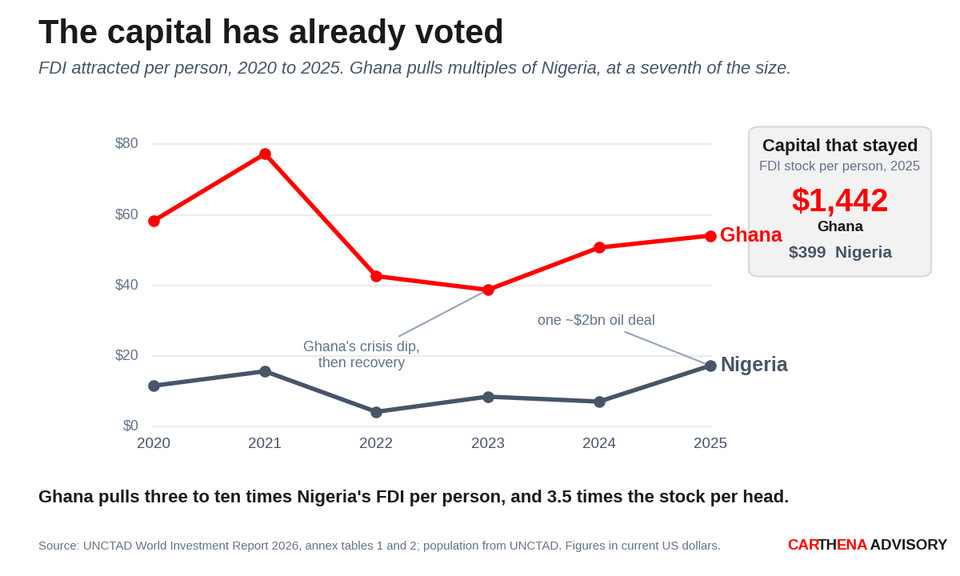
The argument does not rest on theory, because the capital has already chosen, and the per-capita record is emphatic. On UNCTAD's own numbers, Ghana attracted between three and ten times Nigeria's foreign direct investment per person in every year from 2020 to 2025, at a seventh of the population. In 2025 Ghana drew about 54 dollars a head against Nigeria's 17, and Nigeria's figure is flattered by a single two-billion-dollar oil financing; strip it out and Nigeria falls back to about nine dollars. The retention measure is starker still - cumulative foreign investment stock, (the capital that came and stayed), stands at roughly 1,440 dollars per person in Ghana against 400 in Nigeria.
The lesson for Nigeria is not to become Ghana. Nigeria's scale is a genuine and rare asset, and no serious strategy would trade it away. The lesson is about sequence. Ghana put the fundamentals first and let the capital follow, in the same order Vietnam and Egypt followed, as Issue 3 set out. Nigeria has the order reversed, running the summits and signing the memoranda while the currency, the repatriation queue and the ports stay unaddressed, then wondering why the announced billions do not arrive. The capital is not withheld out of ignorance of Nigeria's market, it is withheld because the fundamentals that price the risk, and sets the provision each investment receives, have not been fixed.
The test
The claim is testable, and the test is a fair one. Watch Ghana over the next two years for the two things that would falsify this reading: a stall in disinflation, or a reversal of the primary surplus. Neither is in the current data, and if neither appears, the capital will keep arriving, because the fundamentals that summon it are in place. Watch Nigeria for the opposite test. When the next set of memoranda is announced, ask what changed in the power supply, the fx repatriation queue and the port clearance time in the weeks before. If the answer is nothing, the capital will stay away, whatever the headline figure says, and the neighbour that did the quiet work will keep taking the investment that Nigeria's scale should ideally command.
Ghana is doing the work. That is the whole of the difference, and it is available to Nigeria the moment it decides the price of stabilisation is worth paying up front rather than deferring for another summit.
Sources
- Bank of Ghana, Summary of Economic and Financial Data, May 2026
- IMF, press release on the sixth and final review of Ghana's Extended Credit Facility and the 2026 Article IV consultation, 27 July 2026
- Fitch Ratings, Ghana upgraded to B with a positive outlook, 8 May 2026
- Ghana Statistical Service, first-quarter 2026 GDP
- World Bank, Global Economic Prospects, June 2026
- SBM Intelligence and PwC Nigeria on Apapa and Tema port costs, and the Nigerian Shippers' Council on cargo diversion
Carthena Advisory works with boards, chief executives and investors across Sub-Saharan Africa on strategy, transactions and the institutional capability to execute. To discuss what this analysis means for your business, write to info@carthenaadvisory.com.