
Nigeria's $2.3 trillion infrastructure gap is not the story - it is the starting point. The real question is whether the convergence of reform momentum, institutional capital, and private sector readiness will finally close the distance between plan and delivery.
01 | The Provocation
The Gap Is Not the Story
Every serious conversation about Nigeria's economic future eventually arrives at the same number. Two point three trillion dollars. The figure appears in policy documents, development bank reports, conference keynotes, and newspaper headlines with such regularity that it has become almost ceremonial — invoked to signal awareness of the problem rather than to advance any serious thinking about solving it.
That needs to stop.
Nigeria's infrastructure deficit is not the story. It is the starting point. And the persistent habit of treating the gap as the headline, rather than as the context for a far more important set of questions, is itself part of the problem. It keeps the national conversation anchored in the language of lack, when the more consequential questions are about structure, sequencing, and leadership.
"As a society, grossly underfunded infrastructure and poor governance has been and continues to be an albatross around our necks. These two issues should be the dominant conversations across Nigeria, but unfortunately isn't. The reason? Many can't see the whole elephant." — @woleogundare on X
The questions that actually matter in 2026 are these: Why, with a pension fund sector holding over N19 trillion in assets, does private capital still sit largely on the sideline of infrastructure financing? Why does Nigeria continue to produce infrastructure plans of genuine sophistication while struggling to close the distance between plan and project? Why does a nation with the largest economy on the continent, the most dynamic private sector in sub-Saharan Africa, and a diaspora remitting more than $20 billion annually still rank behind 23 other African nations on the African Development Bank's Infrastructure Development Index?
These are not questions about money. They are questions about architecture — the institutional, regulatory and advisory architecture that converts capital intent into bankable projects, and bankable projects into functioning assets.
"At some point, we'll all understand the infrastructure conversation and prioritize same across all geo zones. Lazy leaders will continue to avoid this like a plague, but we MUST continue to drive conversations in this direction, vs the diversionary monetary policy narrative." — @woleogundare on X
What I want to argue in this piece is that Nigeria is approaching a genuine inflection point. Not because the numbers have improved dramatically — they have not — but because the convergence of demographic pressure, geopolitical realignment of global capital, domestic reform momentum, and a maturing private sector creates a window that has not existed before in quite this form. The infrastructure moment is real. The question is whether Nigeria's institutions, its advisory community, and its private sector leadership are positioned to seize it — or whether we will spend another decade narrating the gap.
The difference between nations that build and nations that plan is not the quality of their documents. It is the quality of their deal-makers.
"Many Nigerians will be forced to understand the word infrastructure. All the cashless issues we're facing today is lack of the right infrastructure investments to cater to 200m people. Invest in targeted infrastructure and watch Nigeria grow!" — @woleogundare on X
02 | What the Numbers Actually Mean
$2.3 Trillion in Context
Let us sit with the number properly before moving past it.
Nigeria's reviewed National Integrated Infrastructure Master Plan, last updated in 2020, estimates that the country requires $2.3 trillion in infrastructure investment between now and 2043 — approximately $150 billion annually — to bring its infrastructure stock from its current level of 30% of GDP to the internationally benchmarked threshold of 70%. That is a 23-year commitment, roughly equivalent to five consecutive Nigerian governments, across seven distinct asset classes: transportation, energy, ICT, housing, agriculture and water, social infrastructure, and security.
To make the scale legible: $2.3 trillion is approximately five times Nigeria's current GDP. It exceeds the combined annual output of more than two dozen sub-Saharan African economies. And critically, even this figure is now considered conservative. Independent assessments published in 2025 suggest the true gap may be closer to $3 trillion, as the 2020 baseline failed to fully account for population growth, climate adaptation costs, and the accelerating pace of urban migration.
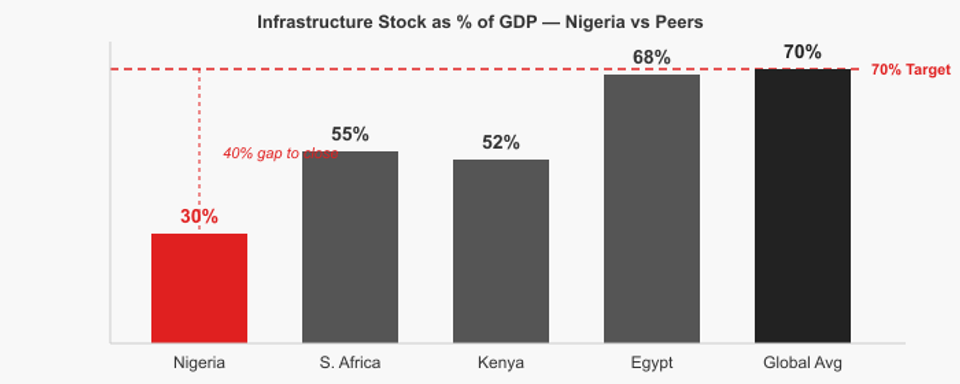
"Nigeria needs an average spend of $150bn per annum for the next 23 years — across all infrastructure stock (energy, transport, etc) to move our infra stock to about 80% of GDP where we need to be. Note that our oil/non-oil revenues is $16/17bn today. See the massive gap? How do we bridge this?" — @woleogundare on X
None of this is a reason for paralysis. It is a reason for precision. The single most important implication of these numbers is one that is rarely stated plainly: the Nigerian government cannot close this gap. Not through borrowing, not through oil revenues, not through budget allocations, and not through any combination of the three. The 2025 Federal Budget allocated N4.06 trillion — roughly $2.7 billion — to infrastructure. That represents 7.4% of total government spending, and it is a meaningful commitment in the context of Nigeria's fiscal constraints. Set against an annual requirement of $30 to $100 billion, it is structurally insufficient, and it was always going to be.
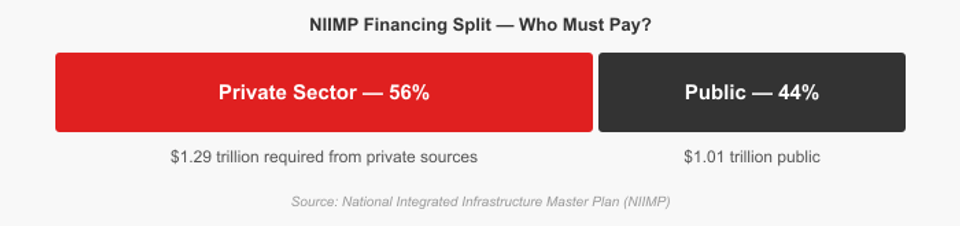
This is not a criticism of government. It is a statement of the fundamental economic reality that shapes every intelligent conversation about Nigerian infrastructure: the private sector is not a supplement to public infrastructure investment in this country. It is the primary vehicle. The NIIMP itself recognised this, assigning 56% of the total financing requirement to private sources.
"South Africa has an infrastructure investment gap of $293bn, targeting to close same by 2030. Nigeria has an infrastructure investment gap of $2.9trn, targeting to close same by 2043. Sort your infrastructure investment gap, and reap the bountiful rewards — therein lies the key." — @woleogundare on X
The Human Cost Behind the Macro Numbers
There is a human cost to the abstract figures that is worth naming once, clearly. Nigeria's businesses spend an estimated $29 billion every year on diesel generators and backup power systems — a private tax on commerce that falls hardest on small and medium enterprises.
"Remember we even named generators 'I better pass my neighbour'? The average Nigerian wants to be seen as better than the next. What better way to ensure some parity — when the state has completely abdicated its responsibilities on power." — @woleogundare on X
Every naira spent on generator fuel is a naira not invested in headcount, inventory, or expansion. Lagos, Nigeria's largest city contributing approximately 30% of national economic activity, remains the only megacity on earth without a proper functioning rail network. The infrastructure gap is not only a macroeconomic variable. It is a daily levy on Nigerian enterprise, and the cumulative drag it places on competitiveness is difficult to overstate.
What Is Already Available
Consider what is already in place. Nigeria's pension fund sector holds assets exceeding N19 trillion — long-duration pools of patient capital precisely matched to infrastructure's extended timelines. Pension funds invested N262.567 billion in infrastructure in the first ten months of 2025, a 48.1% year-on-year increase. That growth is encouraging. But as a proportion of total pension assets, it remains marginal, reflecting a structural shortage of bankable, de-risked projects rather than any absence of capital appetite.
The Nigeria Sovereign Investment Authority's Nigeria Infrastructure Fund holds over $2.6 billion available for co-investment. InfraCredit has demonstrated a proof of concept for credit-enhancing infrastructure bonds to pension-fund-eligible standards. Nigeria became the first African nation to issue a sovereign green bond. These are genuine achievements. They are also episodic rather than systemic.
What the data reveals is not a capital shortage. Nigeria has capital. What it has not yet built — consistently and at sufficient scale — is the institutional plumbing that connects available capital to investible opportunities: the project preparation facilities, the credit enhancement structures, the regulatory predictability, and the advisory capability that sophisticated investors require before committing long-term capital to hard assets in an emerging market context.
03 | The Seven Pillars
Infrastructure Is Not One Problem — It Is Seven
Nigeria's infrastructure challenge is frequently discussed as though it were a single problem requiring a single solution. It is not. The NIIMP identifies seven distinct asset classes, each with its own market structure, financing profile, regulatory environment, and implementation pathway. Treating them as interchangeable produces generic recommendations. Understanding their differences produces actionable strategy.
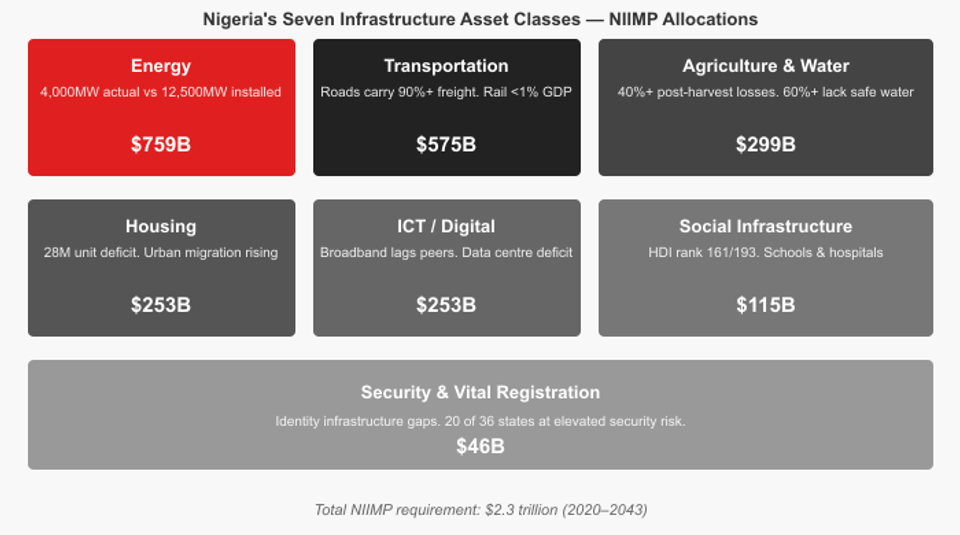
Energy — Nigeria generates approximately 4,000MW against an installed capacity of 12,500MW. Businesses spend $29 billion annually on diesel backup. The unlock: gas-to-power acceleration, mini-grid scale-up, and transmission investment. NIIMP allocation: $759 billion.
Transportation — Roads carry over 90% of freight. Rail contributes less than 1% of GDP. Chronic congestion costs the economy billions annually. The unlock: highway concessions, standard gauge rail completion, port efficiency reform. NIIMP allocation: $575 billion.
Housing — A 28-million unit deficit against accelerating urban migration. The unlock: affordable housing PPPs, MREIF instruments, mortgage market deepening. NIIMP allocation: $253 billion.
ICT / Digital — Broadband penetration lags regional peers. Data centre capacity is insufficient. Last-mile connectivity gaps persist. The unlock: subsea cable leverage, a digital infrastructure fund, data sovereignty frameworks. NIIMP allocation: $253 billion.
Agriculture & Water — Over 40% post-harvest losses. More than 60% of Nigerians lack access to safe water. The unlock: cold chain investment, rural road linkages, blended finance for water systems. NIIMP allocation: $299 billion.
Social Infrastructure — Schools and hospitals are structurally underfunded. Nigeria ranks 161 out of 193 on the Human Development Index. The unlock: impact bonds, diaspora capital, output-based aid structures. NIIMP allocation: $115 billion.
Security & Vital Registration — Identity infrastructure gaps. 20 of 36 states face elevated security risk. The unlock: digital ID systems, civil registration modernisation. NIIMP allocation: $46 billion.
"In the short term, transport (road, rail, aviation & waterways) and energy should be prioritised as asset classes with the largest immediate economic benefit. We must also track the outcome and output KPIs — accountability must be the watchword. There should always be an annual performance audit." — @woleogundare on X
The critical insight across all seven pillars is consistent: the bottleneck is rarely the absence of a policy framework. Nigeria has frameworks. The bottleneck is the capacity to originate, structure, and close transactions within those frameworks — and to do so with enough consistency to build the investor track record that unlocks the next tranche of capital.
"The fuel haulage should naturally be on rail lines, BUT we are where we are for a reason." — @woleogundare on X
That one observation — made in passing about a fuel haulage story — carries the weight of the entire transportation argument. The rail network that should exist does not. The road network that exists cannot bear the load it carries. And the decision-makers who could begin changing that calculus are, as has been the case for decades, otherwise occupied.
The Lagos Waterways Case Study
One story from my own experience illustrates the private sector problem with painful clarity. For four years, an investor was seriously interested in developing Lagos waterways — including the major six jetties — with an overall objective of reducing road congestion by up to 40%. They lobbied the right people. They met all the relevant criteria. The economic case was ironclad. The project never happened.
"Massive water transportation investment potential in LASWA jetties spread across town will reduce pressure on current road traffic gridlocks by 60% in less than 1 year! But NO! Na $5bn on the 4th MB and bloated blue/red rail lines wey chop chop dey una chook head." — @woleogundare on X
This is not a story about a bad investor or an unusual circumstance. It is a story about a system that cannot process genuine private sector initiative at the sectoral level — not because the intent is absent, but because the institutional capacity to receive, evaluate, and advance a well-structured proposal simply is not there consistently enough to be relied upon.
04 | The Financing Architecture
The Capital Is There. The Structures Are Not.
The answer requires honesty about a problem that rarely gets named directly in polite infrastructure discourse: Nigeria has a trust deficit, and it is the primary barrier to private capital mobilisation. This is not a vague cultural observation. It is a commercially precise diagnosis. Policy inconsistency makes it difficult for investors to model regulatory risk over the 20 to 30-year horizons that infrastructure projects require. Currency volatility undermines the economics of naira-denominated returns for dollar-denominated capital. Weak contract enforcement creates legal risk that sophisticated investors price into their hurdle rates — or use as justification for not engaging at all.
"A comprehensive NIIMP doc prepared in 2013 was shared with Prof Osinbajo's team in 2015 during the initial transition but ignored. We're right back to square one 8 years later. Hopefully Infracorp will use this document to jumpstart their mandate." — @woleogundare on X
Nigeria does not have a capital shortage. It has a deal-structuring shortage — and a trust deficit that every successfully completed transaction works to slowly repair.
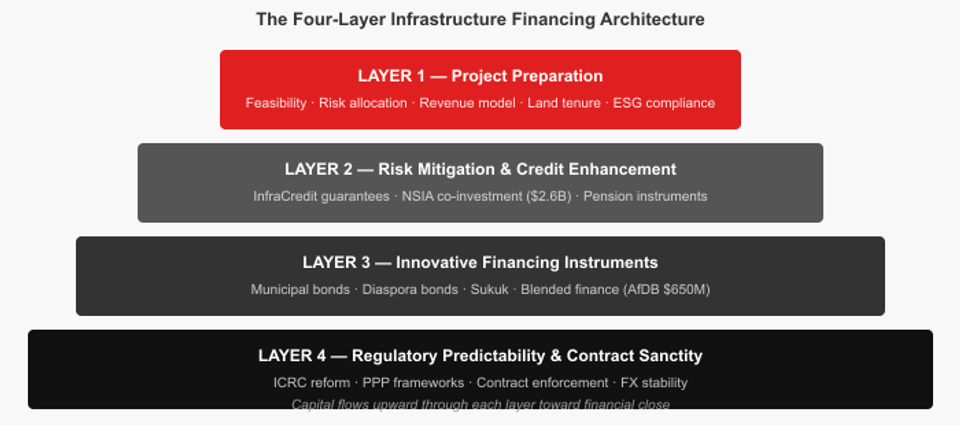
Layer One: Project Preparation
The first and most persistently underestimated bottleneck in Nigerian infrastructure financing is not at the capital-raising stage. It is at the project preparation stage. A bankable project is one with credible feasibility analysis, structured risk allocation, a defined revenue model, clear land tenure, environmental and social compliance documentation, and a procurement process that can withstand investor due diligence. Nigeria has a pipeline of planned infrastructure. It does not have a sufficient pipeline of prepared infrastructure.
"Before erecting any infrastructure, there are practical frameworks that should be used to prioritize the impact of each infrastructure project. The challenge with many States is their unwillingness to do the hard work required to put the Nation on the right path." — @woleogundare on X
Layer Two: Risk Mitigation and Credit Enhancement
Assuming a project is properly prepared, the next structural requirement is a mechanism to bring its risk profile within the tolerance of domestic institutional investors. InfraCredit's model is instructive: by providing credit guarantees for infrastructure bonds, it elevates the credit rating of instruments that pension funds would otherwise be unable to hold under their regulatory frameworks. The limitation is scale. Every dollar of guarantee capacity can unlock multiples in bond issuances.
Layer Three: Innovative Financing Instruments
Three instruments deserve particular emphasis. Municipal bonds — unlocked by the Investment and Securities Act 2025, which explicitly grants local governments authority to issue bonds and Sukuk — represent an underexploited frontier. Diaspora bonds, targeting Nigeria's $20 billion-plus annual remittance community, represent a second frontier: diaspora investors have emotional stakes that moderate volatility sensitivity, and structured bonds linked to specific visible projects create the accountability this investor class responds to. Blended finance, anchored by the AfDB's $650 million annual Nigeria commitment (2025–2030), provides the third pillar — but only if concessional terms genuinely crowd in commercial capital rather than substituting for it.
"In Nigeria today, remittances from citizens living abroad have become an important source of foreign exchange earnings, often exceeding FDI and ODA. These remittances have a crucial role to play in fixing our ailing infrastructure." — @woleogundare on X
Layer Four: Regulatory Predictability and Contract Sanctity
No financing architecture, however cleverly designed, will deliver sustained private capital mobilisation without a regulatory environment characterised by consistency, transparency, and genuine enforcement of contract rights. The recent empowerment of the ICRC to approve PPP projects below N20 billion without Federal Executive Council approval is a meaningful reduction in bureaucratic friction. But the deeper reform required is cultural as much as legal: a shared understanding that infrastructure concession agreements are commercial commitments whose sanctity is the foundation of Nigeria's credibility as an investment destination.
"For every corresponding debit entry — taxes — citizens have the full rights to ask for the corresponding credit entry: infrastructure. This is not complicated." — @woleogundare on X
The Advisory Imperative
There is one financing conversation that rarely appears in Nigerian infrastructure discourse with the seriousness it deserves: the role of the private advisory and transaction management community. Infrastructure projects fail at the financing stage not only because capital is scarce or structures are wrong, but because the human capital required to originate, structure, negotiate, and close complex transactions is itself in short supply. The advisory gap is at least as real as the engineering gap, and it receives far less attention.
05 | The Tinubu Reform Window
A Narrow but Real Opening
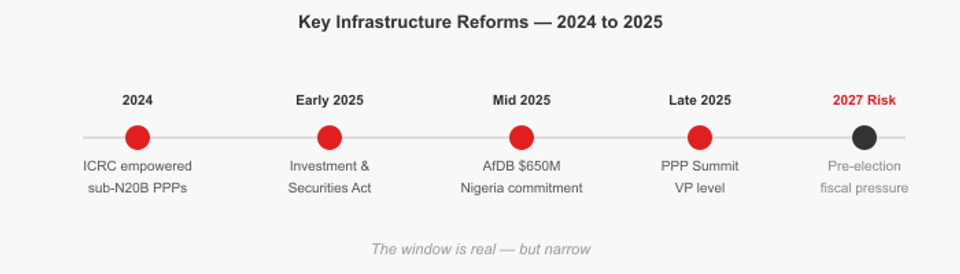
There is reform momentum in Nigeria's infrastructure landscape that is real and should be acknowledged without cheerleading it uncritically. The current administration has positioned infrastructure as a centrepiece of the Renewed Hope Agenda, and some of the institutional changes made in 2024–2025 are genuinely structural rather than cosmetic.
The new Investment and Securities Act 2025 grants local governments explicit authority to issue municipal bonds and Sukuk — a shift that, if properly implemented, could unlock subnational infrastructure finance at scale for the first time. The ICRC's empowerment to approve PPP projects below N20 billion without Federal Executive Council approval addresses a real bottleneck that has caused significant project delays. The Lagos-Calabar Coastal Highway and Sokoto-Badagry Superhighway represent the largest single infrastructure commitments the country has seen in a generation.
"Now we're starting to focus on the infrastructure conversation. If properly implemented, watch these states and their GDP growth per capita in the next 10 years. This is how to start creating a productive economy that can generate socioeconomic stability and development." — @woleogundare on X
But the reform window is narrow, and the risks to it are specific. The 2027 pre-election cycle will introduce fiscal pressures that historically inflate recurrent spending at the expense of capital expenditure. FX stability — which underpins the attractiveness of every naira-denominated infrastructure instrument — remains contingent on oil production and portfolio inflows that are beyond domestic policy control.
"I noticed that most of the street lights along Musa Yaradua (main road connecting Abuja Intl Airport to the city) are dead. How can we be struggling with basic ancillary infrastructure and a LOT of other essentials, but prioritize a coastal road? Na jazz? Infrastructure must be sequenced by impact, not by optics." — @woleogundare on X
That observation captures the tension precisely. The question for any infrastructure investment is not whether it is large, visible, or politically popular. The question is whether it meets a tested framework for impact — economic multiplier, connectivity benefit, population served, private sector leverage potential.
Every infrastructure project should be run through a framework. Impact. Population served. Economic multiplier. Private leverage potential. If it can't survive that test, it shouldn't survive the budget process.
06 | The Private Sector Mandate
Government Cannot Build This Alone — And Shouldn't
The most important structural insight of the entire NIIMP is also the one that is most consistently ignored in public conversation: 56% of Nigeria's infrastructure financing requirement is assigned to the private sector. Not to foreign aid. Not to multilateral loans. To the private sector.
The evidence on this is mixed at best. On the encouraging side: Nigerian institutional investors are allocating more to infrastructure — pension fund infrastructure investment grew 48.1% year-on-year in 2025. Local FMCG manufacturers are investing in supply chain infrastructure in ways that multinational parents would not have countenanced. Fintech companies are building payment and data infrastructure that governments have failed to provide. The private sector is not absent.
What it has not done, with sufficient consistency and scale, is step into the role of infrastructure project originator and sponsor. The gap between having capital and creating the bankable projects that deploy it remains the defining structural failure of Nigeria's private infrastructure ecosystem.
"It's simple. We're not creating wealth. One chap was telling me a few months ago that they will carry on business regardless of FG/States ineptitude at fixing things, primarily infrastructure, a major wealth anchor. Wish I could ask him now — how market?" — @woleogundare on X
Three Mandates the Private Sector Must Own
First: the deal-making gap is a private sector problem. Sophisticated advisory firms, legal practices specialising in project finance, and transaction management capabilities are the missing ingredient between capital availability and infrastructure delivery. Building this community domestically — rather than relying on international advisers whose tenure is project-specific — is the long-term investment that compounds. Every domestic transaction that reaches financial close with Nigerian advisers at the table builds the capability for the next one.
Second: institutional investors must move from passive to active. Nigerian pension funds holding N19 trillion in assets have a social mandate that is not being fulfilled by sitting in government securities while the infrastructure that would generate returns for their beneficiaries remains unbuilt. The regulatory environment has been progressively adjusted to enable infrastructure investment. The InfraCredit mechanism exists to de-risk it. The NSIA co-investment facility exists to anchor it.
Third: the diaspora capital question demands a serious answer. Nigeria's diaspora remits over $20 billion annually — patient capital with an emotional stake in Nigerian outcomes. Structured diaspora bonds linked to specific, visible, accountable infrastructure projects represent one of the most compelling untapped financing instruments available. Ethiopia, Kenya, and Rwanda have each demonstrated the concept. Nigeria has the diaspora base to dwarf any of those programmes.
"Infrastructure, infrastructure, infrastructure! Get on the rooftops and scream it at them. The fiscal side of things MUST tilt towards infrastructure spending. Support this with policies at the macro and micro levels." — @woleogundare on X
The private sector's accountability in this story is not only about investment. It is about voice. Nigeria's business community — its chambers of commerce, its industry associations, its individual business leaders — has not made infrastructure investment the consistent, non-negotiable condition of political engagement that it needs to become.
07 | The Carthena Advisory Perspective
What We Have Learned. What We Believe.
I have been making versions of this argument for most of my professional career — in client engagements, in media appearances, in boardrooms, and across years of public commentary that began as frustration and evolved into something closer to a consistent analytical position.
First: the infrastructure conversation in Nigeria is not lost on people. It is suppressed by proximity to immediate crises. People understand, at some level, that a 30% infrastructure stock-to-GDP ratio cannot sustain a productive economy. What they lack is the institutional framework to make that understanding actionable in their own roles.
"Our National infrastructure stock to GDP ratio is around 30%. No Nation on earth can see sustainable growth/development with this status. Productive Nations are around 65/70%." — @woleogundare on X
Second: the sequencing argument matters more than most acknowledge. Energy and transport have the largest immediate economic multipliers. Agriculture and water infrastructure have the deepest poverty reduction impact. Social infrastructure — schools, hospitals — has the longest compound return. Getting the sequence wrong is not a neutral error. It is a choice to defer the highest-impact investments in favour of the most politically visible ones.
"If the govt truly wants to attract foreign investors, top 3 priorities should be fiscal spending on the following, in accordance with the regional priorities as stated in the NIIMP: Energy. Transport. Agriculture. Match those with policy consistency and watch what happens." — @woleogundare on X
Third: the conversation about infrastructure and the conversation about governance are the same conversation. Underfunded infrastructure is not an engineering failure. It is a governance failure — the cumulative result of decades of choosing current expenditure over capital expenditure, choosing political loyalty over technical competence in project execution, and choosing the announcement of projects over the accountability for their completion.
"Tell any arm of the Nigerian govt to show you their quarterly performance audit report on projects... Crickets! This is the actual problem. Not the plans. The absence of accountability for the plans." — @woleogundare on X
What Carthena Advisory brings to this moment is not another framework for thinking about the infrastructure gap. Nigeria has frameworks. What we bring is the practitioner's discipline to work inside the gap between plan and execution — structuring engagements that move from diagnosis to implementation, building the commercial cases that attract capital, and providing the governance architecture that keeps projects accountable across political cycles.
The infrastructure gap is the defining advisory opportunity of this generation in West Africa. The organisations that build the capacity to operate inside it — structuring transactions, preparing projects, advising on financing architecture, and managing implementation accountability — will create more value in the next decade than those focused on any other single challenge in the Nigerian market.
Nigeria's infrastructure moment will not be seized by the loudest voices or the largest budgets. It will be built, project by project, by those who show up with structures that work, capital that commits, and the discipline to see it through.
"SMEs need enablers to create wealth. If you check indicators on the ease of doing business index, most are infrastructure-enabled. Address these simple factors and see how the SMEs start to thrive. No be rocket science — but na loyalty over competence is the issue." — @woleogundare on X