
UNCTAD's 2024 Africa FDI numbers show $97bn inflows. One Egyptian mega-deal accounts for nearly half. Nigeria has slipped to 18th. The Carthena analysis.
By Wole Ogundare, Founder and Managing Partner, Carthena Advisory
UNCTAD's World Investment Report 2025, published in June, recorded Africa's 2024 foreign direct investment inflows at $97.0 billion, a 75% increase on 2023. The headline ran across every wire service and was widely interpreted as evidence of an African investment revival. The underlying numbers tell a different story.
Egypt accounted for $46.6 billion of the continental total. Out of that, $35 billion was a single signed transaction: the Ras El-Hekma urban development agreement between Egypt's government and ADQ, the sovereign wealth fund of Abu Dhabi. Strip out that one deal and Africa's 2024 FDI growth disappears. The remainder of the continent attracted roughly $62 billion, broadly flat against 2023.
Three further features of the 2024 data warrant attention. Nigeria, often described as a regional investment magnet, ranked 18th at $1.08 billion. That is the second-lowest in a six-year sequence and a clear downward trajectory from $3.3 billion in 2021. Three countries (Angola, Eritrea, Lesotho) registered net divestment, meaning foreign investors withdrew more capital than they committed during the year. UNCTAD's H1 2025 update, also published this month, shows Africa-wide FDI fell 42% year-on-year in the first six months of 2025, confirming that the 2024 figure was an outlier driven by a single transaction.
This note unpacks the data, the structural drivers, and the implications for boards, investors and policymakers operating in or considering African markets.
1. The headline number, decomposed
UNCTAD's Annex Table 1 to the WIR 2025 records the following continental and country positions for 2024 (USD billions):
- Africa total: $97.0
- Egypt: $46.6 (48% of continental total)
- Ethiopia: $3.98
- Côte d'Ivoire: $3.80
- Mozambique: $3.55
- Uganda: $3.31
- DR Congo: $3.11
- South Africa: $2.47
- Namibia: $2.06
- Senegal: $2.02
- Tanzania: $1.72
- Ghana: $1.67
- Morocco: $1.64
- Mauritania: $1.53
- Kenya: $1.50
- Algeria: $1.44
- Zambia: $1.24
- Gabon: $1.15
- Nigeria: $1.08
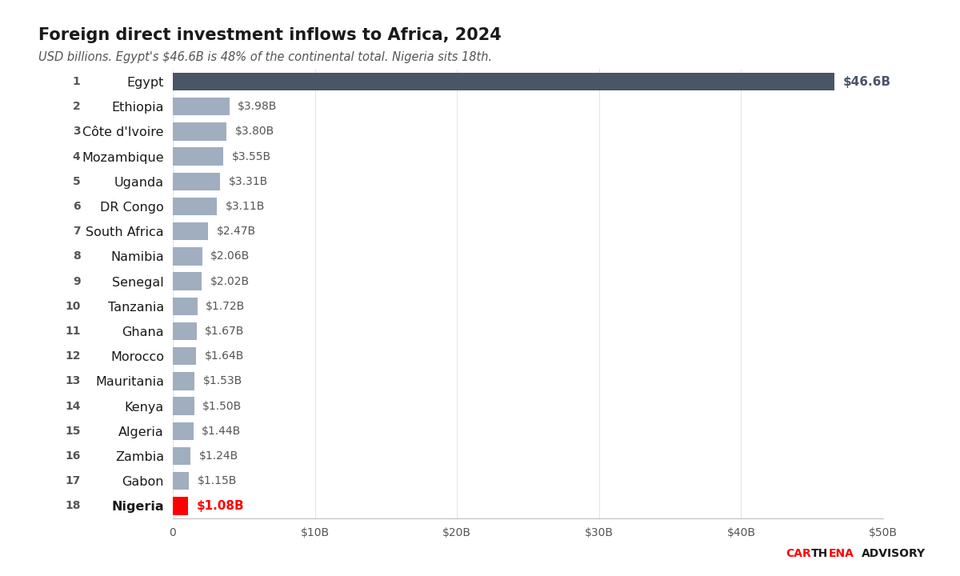
Egypt's $46.6B accounts for nearly half of all FDI into Africa in 2024. Nigeria ranks 18th. Source: UNCTAD World Investment Report 2025, Annex Table 1.
Nigeria sits 18th. Twenty-five African economies received less than $1 billion. Three (Angola, Eritrea, Lesotho) recorded negative inflows.
Two structural observations follow from the distribution.
First, FDI into Africa is heavily concentrated. The top five recipients accounted for $61.0 billion, 63% of the continental total. The bottom forty recipients combined attracted less than $20 billion. This is not a 2024 phenomenon, but the Egypt effect makes it sharper than usual.
Second, the country ranking has shifted materially against the 2018 to 2023 averages. Côte d'Ivoire, Mozambique and Senegal have all moved up the table on the strength of consistent multi-year capital commitment programmes. South Africa has fallen sharply, from over $40 billion in 2021 (also distorted by a single transaction, the Naspers/Prosus share exchange) to $2.47 billion in 2024. Nigeria's decline is the most pronounced in the top 20.
2. The Ras El-Hekma transaction
In February 2024, Egypt's Prime Minister Mostafa Madbouly announced a $35 billion development agreement between the Egyptian government and ADQ, the Abu Dhabi Developmental Holding Company. The deal granted ADQ development rights to Ras El-Hekma, a 170-square-kilometre stretch of Egypt's north Mediterranean coast, in exchange for $24 billion in fresh capital plus the conversion of $11 billion in pre-existing UAE deposits at the Central Bank of Egypt into Egyptian-denominated assets.
Three features of the transaction matter for understanding Egypt's headline FDI number.
The $24 billion in fresh capital qualifies clearly as foreign direct investment under UNCTAD's IMF BPM6 methodology. It represents a long-term equity-type commitment by a foreign investor in a host-country project. The capital was deposited in tranches throughout 2024, with the bulk hitting Egypt's external accounts in Q1 and Q2.
The $11 billion deposit conversion is more contestable, but UNCTAD's methodology accepts it as inward FDI on the grounds that the underlying claim shifted from a CBE liability to an ADQ equity position. Whether national statisticians outside Egypt would book it identically is an open question. For comparative purposes, treating it as FDI inflates Egypt's number relative to a stricter methodology that would exclude reclassifications.
Ras El-Hekma is a megaproject, not a representative transaction. It does not reflect a broad-based change in international investor sentiment toward Egypt or toward African real estate as an asset class. It reflects bilateral capital recycling between two Gulf-aligned states with overlapping geopolitical interests. Generalising from Ras El-Hekma to "African FDI is up" misreads the data.
Stripping Ras El-Hekma out of Egypt's number yields an underlying 2024 figure of approximately $11.6 billion. Still the largest in Africa, but in the same order of magnitude as Ethiopia and Côte d'Ivoire rather than dwarfing them.
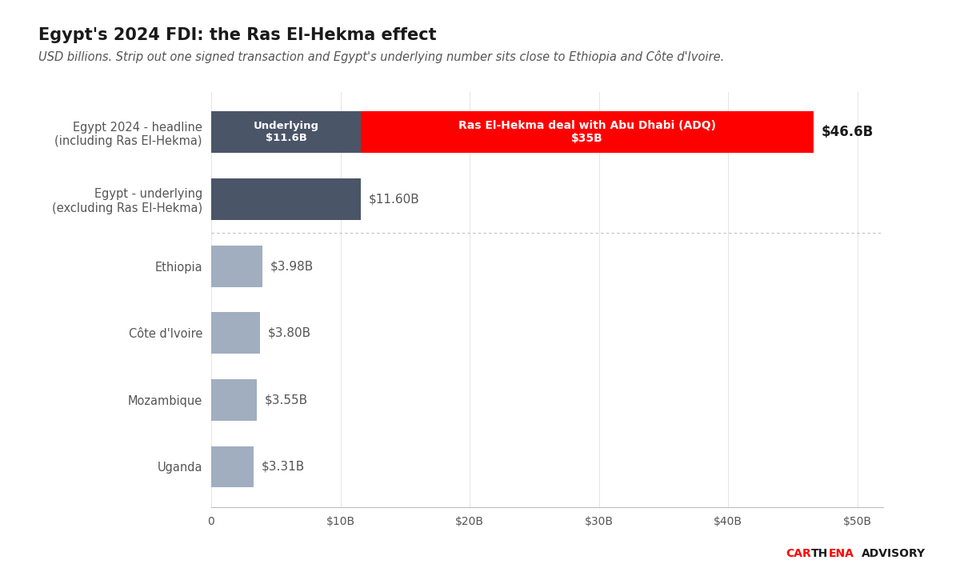
Strip the $35 billion Ras El-Hekma transaction out of Egypt's number and the underlying figure sits close to Ethiopia and Côte d'Ivoire. Source: UNCTAD WIR 2025; Egyptian Cabinet, February 2024 communique.
3. Nigeria's structural decline
Nigeria's $1.08 billion in 2024 is the second-lowest in the six-year UNCTAD sequence (2019 to 2024) and continues a clear downward trajectory. The path: $2.3 billion (2019), $2.4 billion (2020), $3.3 billion (2021), $0.9 billion (2022), $1.9 billion (2023), $1.08 billion (2024).
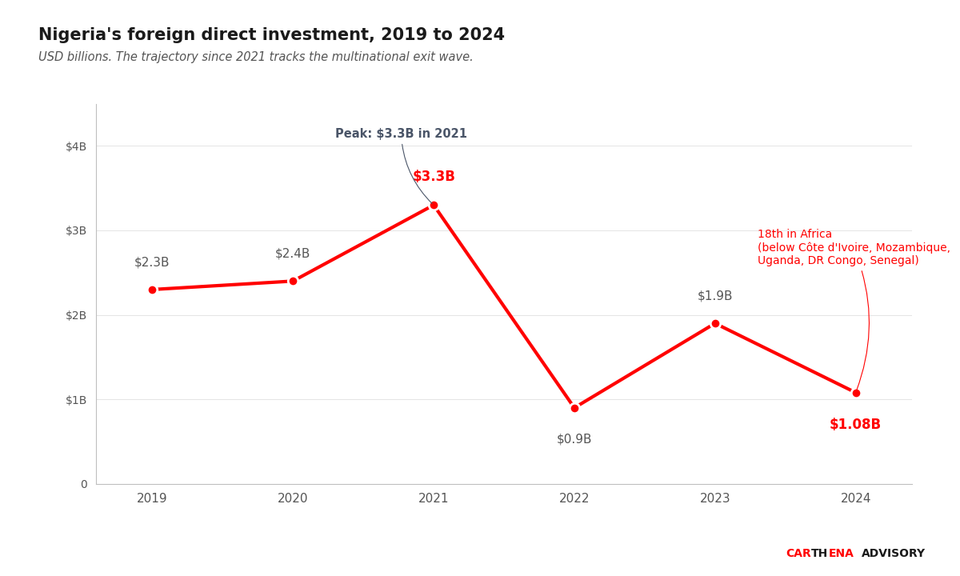
Nigeria's FDI has weakened across four consecutive years. The trajectory tracks the wave of multinational exits since 2022. Source: UNCTAD WIR 2025.
The drivers are well understood inside Nigerian boardrooms. Three are structural.
The multinational exit wave. Shell completed the sale of its Nigerian onshore upstream business to Renaissance Africa Energy in 2024 for $2.4 billion, a transaction recorded as FDI outflow under UNCTAD's accounting. GlaxoSmithKline exited Nigeria in 2023 after 51 years, ending direct manufacturing and distribution. Procter & Gamble closed its Agbara manufacturing facility in 2023. Unilever discontinued local manufacturing of detergents and beauty products in 2024. Sanofi withdrew its commercial operations in 2024.
These are not portfolio reallocations. They are operating businesses that concluded the in-country footprint could no longer be justified against the macroeconomic, FX, regulatory and security risk profile. Each exit reduces the FDI stock and weakens the country's ability to attract replacement capital.
The FX regime overhang. Despite the 2023 currency reforms and the 2024 CBN tightening cycle, foreign investors remain wary of FX repatriation risk. Backlogged FX liabilities to foreign airlines, dividend payments and supplier obligations were only partially cleared during 2024. A new investor commits capital today knowing that the queue for FX-out is longer than the queue for FX-in.
The capital importation confusion. Nigerian policymakers and commentators frequently quote NBS or CBN capital importation figures, which include foreign portfolio investment, foreign loans and other investment alongside FDI, as if they were FDI. Q1 2025 capital importation was $5.2 billion, of which approximately $4.2 billion was foreign portfolio investment (largely in OMO and Treasury bills) and only a small fraction was productive FDI. The viral "Nigeria attracted $5.6 billion in FDI in 2025" graphics circulating on LinkedIn this month appear to confuse these categories.
4. The three divestment countries
Angola's net outflow of $0.14 billion reflects the continued retreat of international oil majors from Angolan offshore blocks, combined with Sonangol's ongoing restructuring. Angola was, until the mid-2010s, one of the two largest FDI destinations in Africa alongside Egypt. The collapse of that position over a decade is one of the more under-reported continental investment stories.
Eritrea's net outflow of $28 million is small in absolute terms but consistent with the country's isolation from international capital markets.
Lesotho's net outflow of $42 million reflects the wind-down of textile manufacturing operations linked to the expiry of AGOA-related tariff preferences and the broader contraction of the southern African garment supply chain.
5. The H1 2025 reversal
UNCTAD's H1 2025 update, published earlier in June, makes the Egypt-effect interpretation unavoidable. Africa-wide FDI fell 42% year-on-year to $28 billion in the first six months of 2025. North African FDI fell to $11 billion, from $27 billion in H1 2024, a halving driven entirely by the absence of a Ras El-Hekma-equivalent transaction. Sub-Saharan Africa fell 23% to $17 billion.
If H2 2025 holds at H1 levels, Africa's full-year 2025 FDI will land at roughly $55 to $60 billion, broadly in line with the 2019 to 2023 average and roughly 40% below the 2024 outlier figure. The "African investment revival" narrative built on the 2024 data will likely not survive the publication of the WIR 2026 in June 2026.
6. Sector mix
UNCTAD's sector analysis adds further texture. Across the COMESA region (which captured two-thirds of Africa's 2024 greenfield value), construction investment rose nearly fivefold to $24 billion, driven entirely by Egypt and Ras El-Hekma. Energy and gas supply grew 22% and remained the largest greenfield sector, with concentration in Egypt, Tunisia, Rwanda and Malawi. Extractives continued to dominate sub-Saharan greenfield activity. The digital economy grew fastest by percentage but absolute volumes remain low: Sub-Saharan Africa attracted only $0.7 billion in digital greenfield projects in 2024.
The sector picture confirms the headline finding. Outside Egypt, FDI into Africa in 2024 was a continuation of existing patterns, energy and extractives-led with a small but growing digital tail. Not a structural shift toward higher-value, climate-aligned or technology-led capital.
7. Implications for boards, investors and policymakers
Five implications follow from this analysis.
For African investment promotion agencies, the competitive pool is smaller than the headline suggests. Outside Egypt's mega-deal, Africa attracted roughly $50 billion in 2024 from a global pool of approximately $1.5 trillion in cross-border FDI. The continent's share of global FDI remains around 3%, broadly unchanged for a decade. Improving that share requires sustained institutional and regulatory upgrade work, not headline transaction marketing.
For Nigerian policymakers, distinguishing FDI from capital importation is now urgent. The conflation in public commentary risks obscuring the structural decline in productive investment that the data clearly shows. Foreign portfolio investment chasing real yields in Treasury bills will leave the moment yields compress or FX risk re-escalates. Productive FDI builds factories.
For boards of multinationals with African exposure, the 2024 data confirms the trend many internal teams have been signalling. The continent is becoming more concentrated by destination, with Egypt absorbing a disproportionate share of new capital. Diversification within Africa increasingly means looking at the second-tier markets (Côte d'Ivoire, Senegal, Mozambique) where consistent multi-year inflows suggest a more stable investment thesis.
For investors evaluating African transactions, the H1 2025 data is more important than the 2024 headline. The reversal is real, broad-based, and likely to define the 2025 picture once full-year data is published.
For Carthena's own clients, the implication is twofold. First, the Nigerian discount on multinational entry has widened, not narrowed. Second, the climate finance, agricultural transformation and infrastructure-finance opportunities that Carthena works on require capital flows that the 2024 headline number does not capture. These are not picked up in inbound FDI statistics, and they will be the more meaningful investment story over the medium term.
Sources
- UNCTAD, World Investment Report 2025, Annex Table 1 (FDI inflows, by region and economy, 2019 to 2024), published June 2025.
- UNCTAD, mid-year Investment Trends Monitor, H1 2025 data, published June 2026.
- UNCTAD WIR 2025, Africa chapter, and the Africa Investment Monitor, for sector breakdown.
- Egyptian Cabinet, official communique on the Ras El-Hekma agreement, February 2024; subsequent ADQ disclosures on the $24bn fresh capital and $11bn deposit conversion structure.
- Shell plc, completion of the sale of the SPDC onshore upstream business to Renaissance Africa Energy, 2024.
- World Bank, capital importation methodology guidance; Nigerian Bureau of Statistics, Q1 2025 capital importation release.
- IMF, Balance of Payments Manual, 6th edition (BPM6), for FDI definitional standards.
If you would like to discuss what this analysis means for your portfolio, board or capital allocation strategy, please get in touch at info@carthenaadvisory.com.